Risks of Buying Property in Dubai: 2026 Buyer’s Audit

Quick answer: The main risks of buying property in Dubai include developer default on off-plan projects, hidden transaction costs, oversupply pressure on yields, title fraud and double selling, unregistered agents, buying outside a designated freehold zone, unclear inheritance rules without a will, and anti-money laundering (AML) compliance requirements. Every one of these risks is identifiable and manageable with the right verification steps before you sign.
Every property market carries risk. Dubai is no exception, and pretending otherwise does buyers no favors. What sets an informed buyer apart from an exposed one isn’t luck it’s verification. You deserve clarity before you commit capital, not a hard lesson after the transfer has already gone through.
According to Dubai Land Department (DLD) data, the emirate recorded well over 180,000 real estate transactions in 2024, with momentum carrying into 2025 as international demand continues to climb. That volume brings opportunity. It also brings a wider pool of buyers who never ask the right questions before they wire a deposit.
This guide is a structured audit of the risks of buying property in Dubai eleven specific exposures, from transaction-stage fraud to what legally happens to your property if you pass away without a will. Most guides stop at the purchase. This one covers both the transaction-stage risks that can cost you money before you own the property, and the post-purchase legal exposure that can cost your family far more after you do. Few resources cover both in one place.
If you need the step-by-step purchase process itself, that’s covered separately in How to Buy Property in Dubai. Here, the focus is exclusively on what can go wrong, and how to close each gap before it costs you.
Risk 1: Developer Default on Off-Plan Projects
Off-plan property remains one of Dubai’s most active segments, and one of its most misunderstood risk categories. Developers can stall, restructure, or in rare cases collapse before handover.
Dubai’s escrow law offers real protection here, but it has to be understood correctly. Every RERA-registered project holds buyer payments in a project-specific escrow account. Funds are released to the developer only against verified construction milestones, not on request. This is a meaningful safeguard but it is not a blanket guarantee of delivery timelines or final quality.
Before signing anything, verify the project’s RERA registration and OQOOD (interim registration) status directly through DLD’s official channels. A project without both is a project you should not be paying into.
What First Call Real Estate checks on your behalf: RERA registration status, escrow account validity for the specific project (not just the developer’s name), and the developer’s track record on prior handovers.
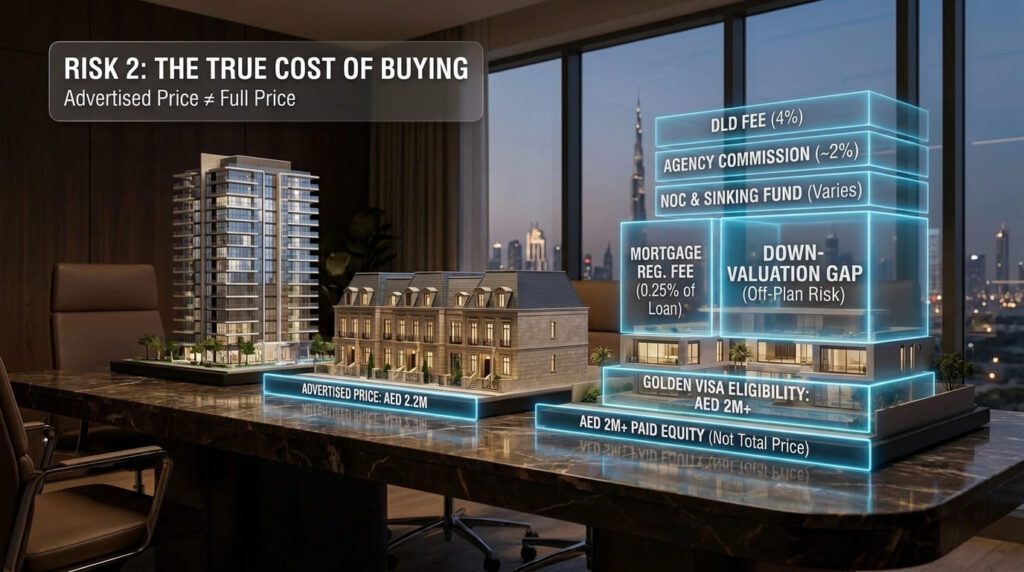
Risk 2: The True Cost of Buying
The advertised price is never the full price. Buyers who budget only for the purchase price routinely find themselves short at the finish line.
| Cost Item | Typical Rate |
| DLD Transfer Fee | 4% of purchase price |
| Agency Commission | ~2% of purchase price |
| NOC Fee (developer) | Varies by developer |
| Mortgage Registration Fee | 0.25% of loan amount |
| Sinking Fund Contribution | Set annually per building |
There’s a second cost trap specific to off-plan buyers chasing the Golden Visa: banks conduct their own valuation before releasing mortgage funds, and a down-valuation can leave you covering the gap in cash. This matters because Golden Visa eligibility is based on equity actually paid into the property typically AED 2 million paid in not simply the total purchase price on paper.
For the complete fee breakdown by transaction type, see Master the Exact Buying Property in Dubai Process.
Risk 3 & 4: Oversupply and Service Charge Erosion
Two market-level risks work against each other in the same portfolio.
Localized oversupply, particularly in fast-growing off-plan corridors, puts downward pressure on both rental yields and resale values. A community that looked scarce at launch can look saturated three years later once neighboring towers complete.
Service charges compound the problem quietly. A unit with an attractive headline yield can see that return eroded year over year by rising service charge rates, especially in buildings with extensive shared amenities. Net yield, not gross yield, is the number that matters.
What First Call Real Estate checks on your behalf: Community-level supply pipelines, historical service charge trends for the specific building, and net yield projections rather than headline gross figures.
Risk 5: Real Estate Fraud Dubai: Forgery and Double Selling
Real estate fraud in Dubai typically follows one of three mechanisms: forged ownership signatures, agent or seller impersonation, or “double selling” the same unit sold to more than one buyer before DLD registration is finalized.
These are not theoretical risks. Gulf News reported a case in which nine individuals were implicated in forging ownership signatures to fraudulently sell two Palm Jumeirah plots valued at AED 27 million. The scheme relied on buyers who trusted paperwork without independently confirming it against DLD’s own records.
Two free tools close most of this gap. The DLD Title Deed Verification service confirms genuine ownership records directly with the regulator. The Madmoun QR code, now standard on legitimate listings, links back to a verified, government-sourced property record.
The single biggest red flag in any Dubai transaction: being asked to pay a deposit into a personal bank account instead of a RERA-registered escrow account. No legitimate transaction requires this. If it’s requested, walk away.
Ask First Call Real Estate to independently verify the title deed and agent credentials before you send any deposit. Contact us before you transfer a single dirham.
Risk 6: Unregistered Agents and Scam Red Flags
Fraud and unlicensed representation tend to travel together. Fake listings, high-pressure “reserve now before it’s gone” tactics, and bait-and-switch showings where the unit advertised differs from the unit shown are the most common patterns reported to Dubai authorities.
The Trakheesi ad-permit system is the buyer’s verification layer here. Every legitimate property advertisement in Dubai carries a Trakheesi permit number, and that number can be checked against DLD records to confirm the listing and the agent are properly licensed. No permit number, no verification, no deposit.
The same rule from Risk 5 applies without exception: never pay into a personal account.
What First Call Real Estate checks on your behalf: Trakheesi permit validity, agent licensing status with RERA, and cross-referencing of listing details against the actual unit.
Risk 7: Off-Plan Marketing vs. Reality
Marketing renders are aspirational by design. The finished unit, the delivered amenities, and the actual handover date can diverge from what was pitched at launch.
Once you sign the Sales and Purchase Agreement (SPA), your ability to reverse course narrows considerably. Off-plan SPAs typically carry limited or no cooling-off period, and cancellation clauses often favor the developer, with penalty structures that scale against the payment plan already made. Read the cancellation terms before you sign, not after you want out.
What First Call Real Estate checks on your behalf: SPA cancellation and penalty clauses, delivery specification against marketing materials, and realistic handover timelines based on the developer’s history.
Risk 8: Resale Liquidity
Not every property sells quickly, even in an active market. Niche unit types, unusual layouts, and buildings with limited comparable transactions can sit on the market considerably longer than mainstream stock, particularly if you’re trying to exit during a market-wide slowdown.
Liquidity risk is best managed at the point of purchase, not at the point of sale by favoring configurations and communities with deep, active resale demand. When you’re ready to list, How to Sell Property in Dubai covers the process in full.
Risk 9: Currency and Interest Rate Exposure
The UAE dirham is pegged to the US dollar, which removes currency risk for USD-earning buyers but creates direct exposure for anyone earning in GBP, EUR, or other currencies whose value fluctuates against the dollar over the holding period.
Mortgage holders carry a second exposure: variable-rate financing in the UAE is typically tied to EIBOR (the Emirates Interbank Offered Rate), meaning monthly payments move with regional interest rate cycles. Buyers financing a purchase should model both a rate-rise and a currency-shift scenario before committing to a payment plan.
Risk 10: Buying Outside a Designated Freehold Zone
Foreign buyer property laws in Dubai are specific and non-negotiable. Under Law No. 7 of 2006, non-UAE and non-GCC nationals can only hold full freehold title within designated zones — areas such as Dubai Marina, Downtown Dubai, Palm Jumeirah, and Business Bay, among others named in the law.
Buy outside a designated freehold zone as a foreign national, and the purchase itself sits on shaky legal ground potentially unenforceable, and difficult to unwind cleanly once money has changed hands. Confirming zone eligibility takes minutes. Skipping that check can take years to fix.
For the complete zone list, see Freehold Property in Dubai: The 2026 Ownership Guide. For eligibility rules by nationality and residency status, see Can Expats Buy Property in Dubai.
Risk 11: Inheritance and Succession Exposure
This is the risk most guides get wrong, and getting it wrong has real consequences for your family.
Since Federal Decree-Law No. 41 of 2022 took effect in February 2023, Sharia inheritance rules no longer apply automatically to non-Muslims who die without a will in the UAE. Several competing articles still repeat the outdated position that it no longer reflects current law.
Here’s the part that still matters, though: dying without a will doesn’t hand your estate directly to your intended heirs either. Bank accounts and the property title can still freeze during probate, and without a registered will directing the court, distribution may not match what you actually wanted.
DIFC Wills have become the standard mitigation for foreign property owners. Registration can be completed remotely, and while exact fees should be confirmed against the current DIFC fee schedule at the time of registration, the value shows up most clearly in timeline: probate with a registered will typically moves in a matter of weeks, while probate without one has been reported to take many months longer, according to legal practitioners handling UAE estates. Sources vary on exact figures, but the direction is consistent and will accelerate resolution significantly.
Two details buyers consistently miss:
- Joint ownership is not automatic survivorship. If you co-own a Dubai property and one owner dies without a will, the surviving co-owner does not automatically inherit the other’s share it enters probate like any other asset.
- Mortgaged property doesn’t pass freely either. If the property carries a mortgage, the lending bank can demand full repayment before any transfer takes place on death. Life insurance covering the outstanding loan balance is a common way owners protect their heirs from this exposure.
First Call Real Estate is not a source of legal advice, but as a due-diligence partner, referral to a qualified legal partner for DIFC will registration is part of getting this right.
Speak to a First Call Real Estate advisor about how your Dubai property is held and whether a will is in place we can refer you to a qualified legal partner for DIFC will registration. Contact us to start that conversation.
Risk 12: AML, KYC, and Source of Funds Compliance
Dubai has tightened anti-money laundering (AML) enforcement across real estate significantly in recent years, and international buyers are frequently caught off guard by it.
Cash transactions of AED 55,000 or more trigger mandatory reporting requirements under UAE AML regulation. Beyond the cash threshold, buyers should expect to provide rigorous Source of Funds documentation bank statements, income verification, and in some cases, an explanation of the fund trail across borders. Buyers who cannot produce this documentation cleanly risk delayed transfers, frozen funds pending review, or in serious cases, blocked transactions altogether.
The fix is straightforward: prepare Source of Funds documentation before you make an offer, not after a compliance officer asks for it.
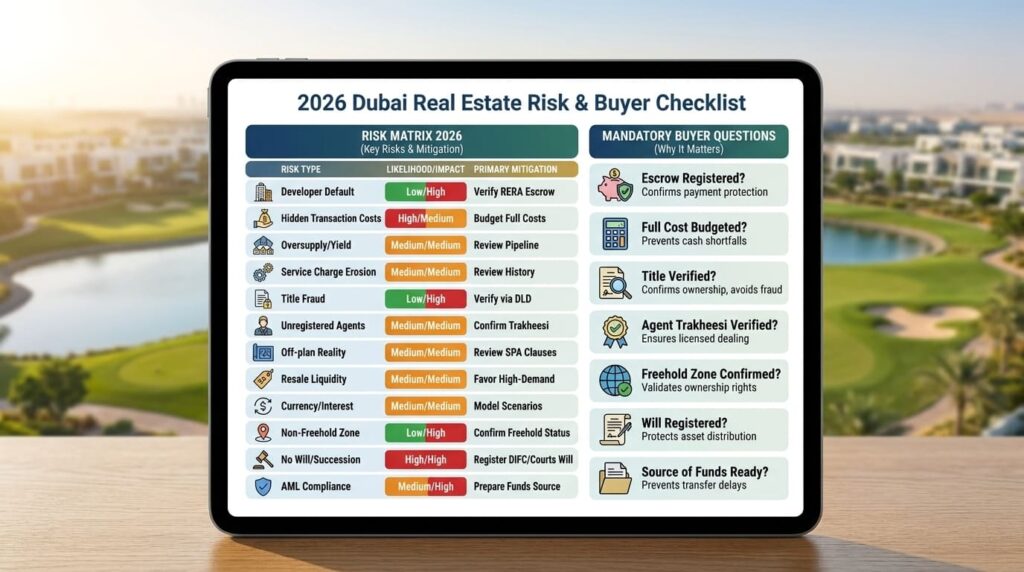
2026 Updated Risk Matrix and Buyer Questions
Table 1: Risk Matrix 2026
| Risk Type | Likelihood | Impact | Primary Mitigation |
| Developer default (off-plan) | Low | High | Verify RERA/OQOOD registration and project-specific escrow |
| Hidden transaction costs | High | Medium | Budget full cost stack, confirm bank valuation early |
| Oversupply / yield pressure | Medium | Medium | Review community-level supply pipeline |
| Service charge erosion | Medium | Medium | Review historical service charge trend |
| Title fraud / double selling | Low | High | Verify title deed via DLD before any payment; never pay to a personal account |
| Unregistered agents / scams | Medium | Medium | Confirm Trakheesi permit and agent license |
| Off-plan marketing vs. reality | Medium | Medium | Review SPA cancellation and penalty clauses |
| Resale liquidity | Medium | Medium | Favor high-demand configurations and communities |
| Currency / interest rate exposure | Medium | Medium | Model currency and EIBOR rate scenarios |
| Buying outside a freehold zone | Low | High | Confirm the zone is a designated freehold area before signing |
| No registered will / succession risk | High | High | Register a DIFC or Dubai Courts will; clarify joint-ownership status |
| AML / Source of Funds compliance | Medium | High | Prepare Source of Funds documentation in advance |
Table 2: Mandatory Buyer Questions
| Question | Why It Matters |
| Is the developer’s escrow account registered for this specific project? | Confirms your payments are protected under escrow law |
| Have I budgeted for the full transaction cost stack, not just the purchase price? | Prevents cash shortfalls at transfer |
| Is the property’s title deed verified and free of forgery flags? | Confirms legal ownership and rules out double-selling |
| Is the agent and listing verified through Trakheesi? | Confirms you’re dealing with a licensed party |
| Is this zone a designated freehold area for my nationality? | Confirms your ownership will be legally valid |
| Do I have a registered will covering my Dubai property? | Protects your family from asset freezes and unintended distribution |
| Do I have my Source of Funds documentation ready? | Prevents delayed or blocked transfers under AML rules |
How First Call Real Estate Reduces Your Risk
Every risk in this guide has a verification step attached to it. That’s the audit mindset, and it’s the standard First Call Real Estate applies to every transaction it supports.
That means independent title deed verification before any deposit changes hands. It means checking agent and listing licensing through Trakheesi rather than taking a listing at face value. It means confirming escrow validity at the project level, not the developer level. And where legal structuring is needed a DIFC will, a joint-ownership review, an inheritance question it means a direct referral to a qualified legal partner, because that advice deserves a specialist, not a generalist.
This is a due-diligence partnership. Not a transaction processor.
Buy with Confidence, Not Assumptions
Every risk covered in this audit is identifiable. Every one of them is manageable, provided you verify before you commit rather than after.
Two dimensions run through this entire guide: transaction-stage risk fraud, cost, market pressure and post-purchase legal exposure inheritance, succession, compliance. Treat them as separate problems and you leave half the picture unaddressed. Treat them together, and you buy with your eyes fully open.
If you’re weighing a purchase in Dubai, start with the process itself: How to Buy Property in Dubai. And before you commit capital, speak with a First Call Real Estate advisor explore available properties or get in touch directly. Clarity before capital. That’s the standard worth holding your next purchase to.
Frequently Asked Questions
How do I check if a Dubai title deed is genuine?
Use DLD’s official Title Deed Verification service to confirm the deed against government records, and check the property’s Madmoun QR code where available. Never rely on a document provided directly by the seller or agent without independent verification.
What happens to my Dubai property if I die without a will?
Your bank accounts and property title can freeze during probate, and the court will determine distribution without a document reflecting your specific wishes. This can take significantly longer, and produce a different outcome, than dying with a registered will in place.
Does Sharia law automatically apply to non-Muslim property owners in Dubai?
No. Since Federal Decree-Law No. 41 of 2022, effective February 2023, Sharia inheritance rules no longer apply automatically to non-Muslims who die without a will. Many older articles still state otherwise that position is outdated.
Can I buy property anywhere in Dubai as a foreigner, or only in certain areas?
Foreign nationals can hold full freehold title only within designated freehold zones under Law No. 7 of 2006, such as Dubai Marina, Downtown Dubai, and Palm Jumeirah. Buying outside these zones as a non-UAE/GCC national risks an invalid or unenforceable purchase.
What is a DIFC Will and do I need one?
A DIFC Will is a legal document registered with the Dubai International Financial Centre courts, designed specifically to give non-Muslim property owners control over how their UAE assets are distributed. If you own property in Dubai and want your estate distributed according to your own wishes rather than default court proceedings, it’s worth registering one.