
Can Expats Buy Property in Dubai? Full Legal Guide 2026
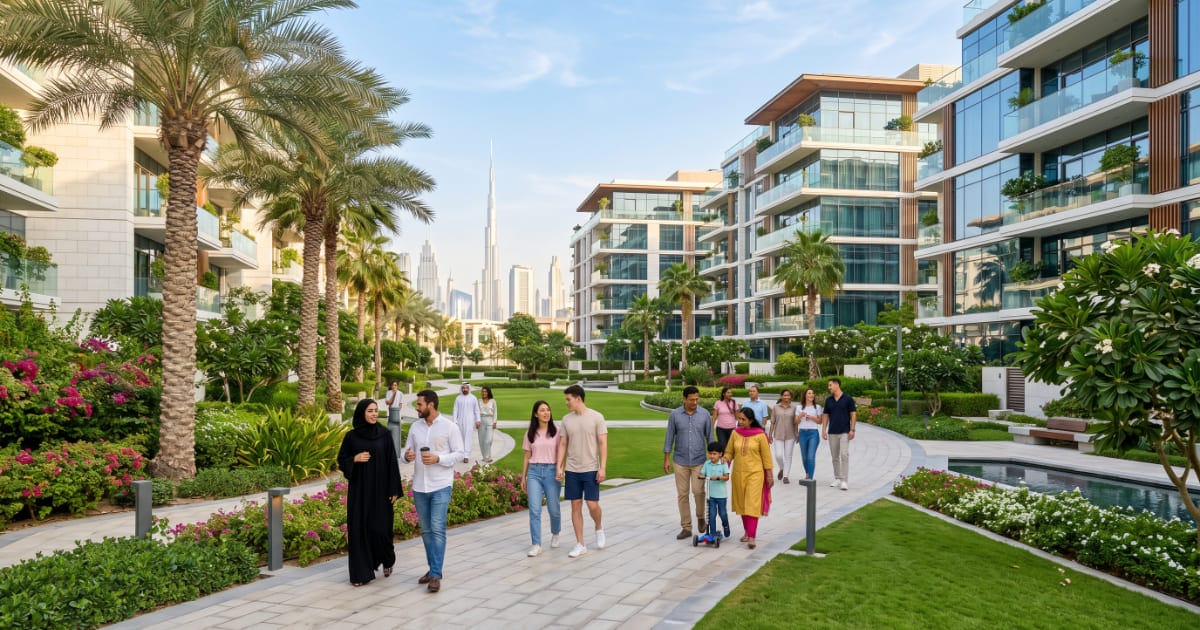
Quick answer: Yes. Expats and foreign nationals can legally buy property in Dubai. Under Dubai Property Law No. 7 of 2006, non-UAE citizens hold full freehold ownership rights in designated zones no residency visa required, no foreign exchange restrictions, and no cap on the number of properties owned.
So, can expats buy property in Dubai? The answer is a definitive yes. Foreign nationals have held the legal right to own freehold property in Dubai since the enactment of Dubai Property Law No. 7 of 2006 (the foundational state decree that dismantled historical ownership limits, allowing non-GCC citizens to register absolute land ownership in designated zones).
This guide is built for three groups: overseas investors evaluating Dubai for the first time, resident expats ready to convert rent payments into equity, and international non-residents assessing the legal safety of deploying capital abroad. Every claim here is anchored in current statutory law and the 2026 regulatory environment.
What follows is a complete operational map, the legal framework, freehold zones, nationality rules, Golden Visa eligibility, mortgage access, required documents, and a streamlined step-by-step process tailored specifically for expat buyers. For broader market context, start with our complete guide on How to Buy Property in Dubai.
The Legal Framework: What Dubai Law Says About Expat Property Rights
Before 2006, foreign nationals had no legal right to own property in Dubai. Ownership was restricted to UAE and GCC citizens. Dubai Property Law No. 7 of 2006 rewrote that reality granting non-citizens the right to register absolute freehold title in government-designated zones.
The Freehold Permanence Rule: Under Dubai Property Law No. 7 of 2006, foreign nationals hold absolute freehold ownership rights in designated zones. This guarantees unrestricted legal control over both the physical building structure and the underlying plot footprint in perpetuity completely decoupled from local employment or long-term residency mandates.
The 2006 decree established five core legal parameters that still govern expat ownership in 2026:
- 100% freehold ownership is available to foreign buyers in designated zones, covering both the building and the land beneath it.
- No residency requirement — buyers do not need a UAE visa to purchase, register, or hold property.
- No cap on portfolio size — a foreign national can acquire an unlimited number of properties.
- Remote ownership and management — property can be bought, owned, and managed without a single in-person visit.
- No foreign exchange restrictions — capital can be transferred into the UAE freely from any country.
These parameters make Dubai the most transparent ecosystem for international wealth deployment in 2026. The legal framework protects every buyer equally local, resident, or overseas under a single registered title system administered by the Dubai Land Department (DLD).
Can Expats Buy Property in Dubai? Freehold vs. Leasehold Zones
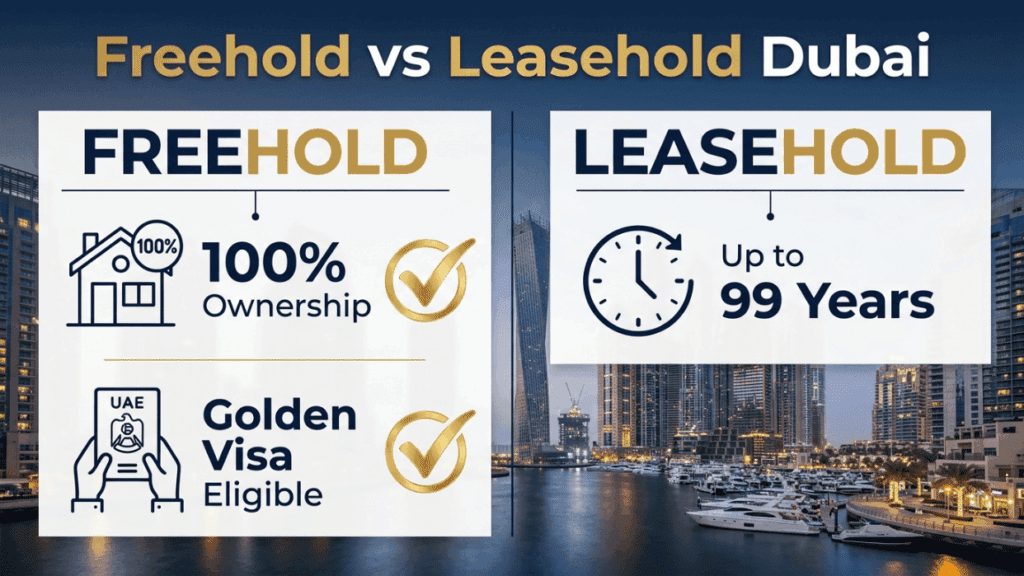
Yes, but where you buy determines what you own. Dubai operates two ownership structures, and understanding the distinction protects your capital.
Freehold (unrestricted property ownership in perpetuity, granting the title holder absolute rights to sell, lease, or pass down the asset via inheritance) gives you 100% ownership of both the property and the land, indefinitely, with full resale rights at any time.
Leasehold grants property use rights for a capped term of up to 99 years, with no ownership of the underlying land and limited mortgage and resale options.
All major communities are freehold and fully open to foreign buyers Downtown Dubai, Dubai Marina, Palm Jumeirah, Jumeirah Village Circle (JVC), Business Bay, and Dubai Hills Estate. Some older districts, including parts of Deira and Bur Dubai, remain leasehold-only for non-GCC foreigners. Over 60% of Dubai’s designated freehold zones are open to all nationalities.
| Factor | Freehold | Leasehold |
| Ownership Type | 100% land and property | Property use only no land |
| Duration | Indefinite | Up to 99 years |
| Resale Rights | Full any time | Subject to lease terms |
| Mortgage Eligibility | Full mortgage access | Limited mortgage options |
| Golden Visa | Yes AED 2M+ | Not typically eligible |
| Best For | Long-term investment | Short-term use |
| Areas Available | Major communities | Some older areas |
Contact First Call Real Estate to explore freehold property options for expat buyers in Dubai. For a zone-by-zone breakdown, see our deep dive on Freehold Property Dubai.
Who Can Buy Property in Dubai? Nationality Rules Explained
There is no blanket passport-based restriction on buying property in Dubai’s designated freehold zones. All nationalities can purchase. What varies is the area of access and the mortgage terms each buyer type receives.
- GCC Nationals hold full buying rights across all areas, including non-freehold zones, with the highest loan-to-value (LTV) ceiling at 80%.
- Non-GCC Foreign Nationals hold full buying rights within designated freehold zones, with LTV up to 75%.
- Overseas Non-Residents can buy entirely remotely without visiting Dubai. Income proof is required for any mortgage application.
- Corporate Buyers can purchase in designated zones, with mortgage eligibility assessed case by case. The Golden Visa does not apply to corporate ownership.
Freehold zone designation is what matters; not every district is open to foreign ownership, so confirm the zone status before committing capital.
| Buyer Type | Freehold Rights | Leasehold Rights | Mortgage Eligibility | Golden Visa |
| GCC Nationals | Full all areas | Yes | Yes 80% LTV | Yes AED 2M+ |
| Non-GCC Foreigners | Designated freehold zones | Yes | Yes 75% LTV | Yes AED 2M+ |
| Overseas Non-Residents | Designated freehold zones | Yes | Yes with income proof | Yes AED 2M+ |
| Corporate Buyers | Designated zones | Yes | Case by case | Not applicable |
For broader eligibility context, review our core guide on How to Buy Property in Dubai.
The Golden Visa Advantage: How Property Investment Unlocks UAE Residency
For expat buyers in 2026, the UAE Golden Visa is the single most powerful incentive attached to property ownership. An investment of AED 2 million or more in Dubai real estate qualifies the buyer for a 10-year renewable Golden Visa.
The 2026 criteria are more accessible than ever. The historical requirement to pay a minimum AED 1 million equity share upfront on mortgaged properties has been fully removed. Eligibility now depends strictly on the gross title deed or off-plan contract value crossing the hard AED 2,000,000 threshold irrespective of whether the property is mortgaged, off-plan, or fully paid.
Key Golden Visa facts for 2026:
- AED 2 million minimum in property value qualifies for the 10-year visa.
- Off-plan properties count — provided the contract value reaches AED 2M.
- Joint ownership qualifies — combined investment value must reach AED 2M, and spouses or first-degree relatives can consolidate ownership to the main applicant.
- Full residency rights — the visa enables UAE bank account access and family sponsorship.
- Renewable every 10 years, linked to continued property ownership.
This positions a single AED 2M asset as both a wealth-preservation anchor and a residency mechanism for the entire family. Golden Visa thresholds and qualifying criteria remain subject to government review buyers who act under current terms lock them in. Luxury villas remain a primary category of Golden Visa-qualifying inventory; explore our Luxury Villas portfolio for qualifying examples.
Can Expats Get a Mortgage in Dubai? Financing Rules for Foreign Buyers
Yes. Expats qualify for UAE bank mortgages on terms comparable to UAE nationals, with slightly adjusted LTV ratios. The 2026 Central Bank framework sets clear, predictable limits.
Core mortgage parameters for 2026:
- Maximum LTV of 75% for ready (completed) properties.
- Maximum LTV of 50% for off-plan properties.
- Minimum down payment of 25% for ready property purchases, paid in liquid cash.
- Mortgage tenure up to 25 years for expat buyers.
- Minimum monthly salary of AED 15,000 required by most UAE lenders.
Off-plan buyers have an alternative to bank financing: developer payment plans. These structure capital across construction milestones, lowering the upfront commitment and easing entry. And because the UAE imposes no foreign exchange restrictions, mortgage and purchase funds transfer freely from any country.
For a full breakdown of milestone-based financing, see our guide on Buy Property on Installments.
Documents Required for Expat Property Buyers
The documentation pipeline is short and predictable. Most overseas buyers complete it without a single in-person visit.
- ✅ Valid passport — mandatory for all buyers
- ✅ Emirates ID — if the buyer is a UAE resident
- ✅ Proof of income — salary certificate, or business financials for self-employed buyers
- ✅ Bank statements — last 3 to 6 months
- ✅ No Objection Letter (NOL) from employer if applicable
- ✅ Credit report — from the home country for overseas non-resident buyers
Requirements vary slightly by lender and by whether the purchase is cash or mortgage-financed. First Call Real Estate acts as your transactional concierge, managing this pipeline end to end from first inquiry to Title Deed receipt.
⚠️ OFF-PLAN CONTRACT VALIDITY & ESCROW TRACKING: While overseas buyers can fully execute real estate transactions remotely without visiting the UAE, all off-plan installment capital must be strictly routed into verified, project-specific RERA Escrow Accounts. Confirm that your purchase agreement generates an official DLD Oqood pre-registration title certificate before finalizing foreign currency wire transfers.
Step-by-Step Guide: How Expats Buy Property in Dubai
The process below is built specifically for expat and overseas workflows, with emphasis on remote execution and the digital DLD pipeline now standard in 2026.
- Confirm eligibility — All nationalities can buy in designated freehold zones. No residency visa required.
- Choose your freehold zone — Downtown Dubai, Dubai Marina, Palm Jumeirah, JVC, and Business Bay are all open to foreign buyers.
- Arrange financing — Apply for a UAE bank mortgage or confirm developer payment plan terms. Know your LTV before you search.
- Engage First Call Real Estate — View properties remotely via video tour or in person with a dedicated expat buyer specialist.
- Make an offer and sign Form F (MOU) or SPA — The Memorandum of Understanding locks in terms. Off-plan purchases use a Sales and Purchase Agreement.
- Transfer funds — The UAE imposes no foreign exchange restrictions. Funds transfer freely from any country.
- Complete DLD registration — Dubai Land Department registration is fully digital in 2026. No physical attendance required.
- Receive your Title Deed — Issued by the DLD and deliverable digitally to overseas buyers.
- Apply for the Golden Visa — If investment value exceeds AED 2M, initiate your Golden Visa application immediately after registration.
For the complete transaction walkthrough, see our [Buying Property Process] guide, and for off-plan specifics, review our Investment cluster.
Conclusion: Secure Your Expat Property Rights in Dubai
The question is settled: yes, expats can buy property in Dubai, and the 2026 legal framework protects those rights without ambiguity. Dubai Property Law No. 7 of 2006 grants freehold ownership to all nationalities, major communities are fully open to foreign buyers, and the path from inquiry to registered Title Deed runs almost entirely digital.
The key takeaways for 2026:
- Dubai Property Law No. 7 of 2006 grants freehold ownership rights to all nationalities.
- Major communities Dubai Marina, Downtown, Palm Jumeirah are fully open to foreign buyers.
- Expats qualify for UAE bank mortgages at up to 75% LTV on ready property.
- AED 2M+ in property unlocks a 10-year UAE Golden Visa, with the upfront equity requirement now removed.
- No residency visa required, no foreign exchange restrictions, and Title Deeds available digitally.
Premier freehold inventory that qualifies for the Golden Visa is absorbing rapidly under sustained global migration pressure, and qualifying criteria remain subject to government review. Acting under current terms secures them. Apartment investors should review our [Buy Apartment] portfolio for entry-level qualifying options.
Contact First Call Real Estate today. Our expat buyer specialists are ready to guide you from eligibility check to Title Deed.
🔗 Browse Expat-Ready Properties — Property Listings Page
🔗 Book a Free Consultation — First Call Real Estate Consultation Page
Frequently Asked Questions
Can expats buy property in Dubai?
Yes. Dubai Property Law No. 7 of 2006 allows expatriates to own freehold property in designated zones without a residency visa.
Which areas can expats buy property in Dubai?
Downtown Dubai, Dubai Marina, Palm Jumeirah, JVC, Business Bay, and Dubai Hills Estate are all open to foreign buyers, alongside over 60% of all designated freehold zones.
Can expats get a mortgage in Dubai?
Yes. UAE banks offer mortgages to expats at up to 75% LTV for ready properties and 50% for off-plan, with a typical minimum monthly income of AED 15,000.
What is the minimum investment for a Golden Visa in Dubai?
AED 2 million in property value qualifies for a 10-year UAE Golden Visa. As of 2026, Dubai has removed the AED 1 million upfront equity requirement for mortgaged properties.
Can all nationalities buy property in Dubai?
Yes. There are no nationality-based restrictions in designated freehold zones. Access and mortgage LTV terms vary by buyer type, but the right to purchase applies to all passports.
For a balanced view on due diligence, read our guide on the Risks of Buying.