Dubai Rental Market Guide 2026: Prices, RERA & Ejari
The Dubai rental market recorded 214,445 contracts in the first seven months of 2026 alone, putting it on track to exceed its previous annual record. Rental yields range from 4% to 11% depending on area and strategy. This guide covers rental prices by area, Ejari registration, RERA rent increase rules, the post-dated cheque system, STR vs LTR comparison, and the H2 2026 forecast.
Dubai’s rental market is operating at record volume. The 214,445 rental contracts logged between January and July 2026 signal one of the strongest rental demand periods the emirate has recorded and the year is not over. At the current pace, total annual contracts are expected to surpass the previous record of approximately 300,000. For a broader view of the investment landscape that drives this demand, see Dubai Property Investment.
Three distinct groups need to understand what is happening: landlords trying to maximize net yield, tenants navigating the rental process for the first time, and investors assessing whether to buy before prices move further. This guide serves all three. The fundamentals supporting that demand are structural. Dubai’s population has passed 3.5 million and is growing at 4% annually. That growth rate means new residents enter the rental market every month across every price bracket.
What follows covers current rental prices by area and property type, the RERA rental increase calculator, how Ejari registration works, the post-dated cheque system, a direct comparison of short-term versus long-term rental strategies, and a data-grounded H2 2026 forecast.
Dubai Rental Market 2026: What Does the Data Actually Show?
The headline figure 214,445 contracts in seven months breaks into two meaningful categories. New tenancy agreements accounted for 58.71% of that total. That figure confirms strong inbound demand: new residents signing leases for the first time. Renewal contracts made up the remaining 41.29%, indicating that tenant retention in established communities remains solid. Year-on-year contract growth sits at 13.59%, confirming this is not a one-quarter spike but consistent market expansion.
The market divides clearly into two segments. Premium areas Downtown Dubai, Dubai Marina, and Palm Jumeirah are holding rents firm. Supply in these locations remains constrained, and occupier demand has not weakened. Affordable areas including Jumeirah Village Circle (JVC), Dubai South, and International City are experiencing slight rent easing as new supply enters the market. For full 2026 sales transaction data, see Dubai Property Market 2026.
Dubai Rental Price Guide 2026: Every Area, Every Property Type
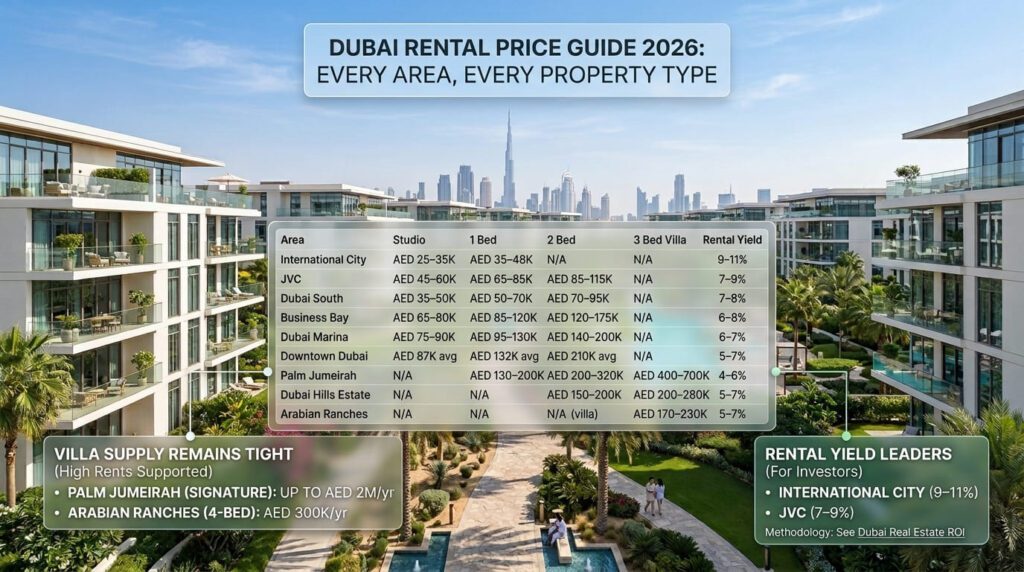
The table below gives you current rental price ranges and gross yield benchmarks for every major area. These figures reflect 2026 market conditions.
| Area | Studio | 1 Bed | 2 Bed | 3 Bed Villa | Rental Yield |
| International City | AED 25–35K | AED 35–48K | N/A | N/A | 9–11% |
| JVC | AED 45–60K | AED 65–85K | AED 85–115K | N/A | 7–9% |
| Dubai South | AED 35–50K | AED 50–70K | AED 70–95K | N/A | 7–8% |
| Business Bay | AED 65–80K | AED 85–120K | AED 120–175K | N/A | 6–8% |
| Dubai Marina | AED 75–90K | AED 95–130K | AED 140–200K | N/A | 6–7% |
| Downtown Dubai | AED 87K avg | AED 132K avg | AED 210K avg | N/A | 5–7% |
| Palm Jumeirah | N/A | AED 130–200K | AED 200–320K | AED 400–700K | 4–6% |
| Dubai Hills Estate | N/A | N/A | AED 150–200K (villa) | AED 200–280K | 5–7% |
| Arabian Ranches | N/A | N/A | N/A | AED 170–230K | 5–7% |
Villa supply remains tight across the market. Arabian Ranches 4-bedroom villas reach AED 300K annually. Palm Jumeirah signature villas go up to AED 2,000,000 per year. Those rents are well supported precisely because new villa supply is not arriving at scale.
The yield leaders are International City at 9–11% and JVC at 7–9%. These are the areas investors targeting rental income should prioritize. For the complete yield formula methodology, see Dubai Real Estate ROI.
Tenant Guide: How to Rent Property in Dubai Step by Step
Where to search: Use Property Finder, Bayut, and Dubizzle as your primary portals. Only engage RERA-licensed agents verify the license number at dubailand.gov.ae before you proceed. Always inspect the property in person. Request the Ejari certificate from the previous tenancy to confirm the property’s rental history.
Documents you need: Passport copy, UAE visa copy, Emirates ID, and an employment letter or business registration document as proof of income.
Before you sign: Check the asking rent against the RERA rental index at dubailand.gov.ae to confirm it is fair. The security deposit is capped at 5% of annual rent for unfurnished units and 10% for furnished. Structural maintenance is the landlord’s legal responsibility. Minor maintenance typically falls to the tenant read the contract carefully before signing.
The post-dated cheque system: Dubai rent is paid almost universally by post-dated cheques. One cheque means the full year upfront. Four cheques (quarterly) is the most common arrangement. Six cheques (bimonthly) is the most tenant-friendly option, though some landlords charge a premium for this. A bounced cheque is a criminal offense under UAE law. Never issue a cheque you cannot fund on the collection date. Bank transfer is increasingly accepted as an alternative in newer agreements.
Ejari Registration: What It Is and Why It Is Mandatory
Ejari is the official tenancy registration system administered by the Dubai Land Department (DLD). Every Dubai rental contract must be registered through Ejari without exception.
⚠️ THE EJARI & COMPLIANCE DISCLOSURE:
Tenants and landlords must never treat Ejari registration as an optional administrative step. Ejari is the official Dubai Land Department (DLD) tenancy registration system. Without a valid Ejari certificate, a tenant cannot legally connect DEWA utilities (water and electricity) or sponsor and renew UAE residency visas for their dependents. Furthermore, an unregistered contract drastically weakens both the landlord’s and the tenant’s legal standing should a dispute proceed to the RERA Rental Dispute Center.
How to register through Ejari:
- Gather the required documents: signed tenancy contract, tenant’s Emirates ID, tenant’s passport copy, and the landlord’s title deed.
- Access the Dubai REST app or the DLD portal at dubailand.gov.ae.
- Submit the documents and pay the fee AED 220 for apartments and villas, plus small administrative charges.
- Registration is typically completed within 24–48 hours.
- Download and save the Ejari certificate. You will need it for DEWA connection and visa renewals.
Registration must be completed within 30 days of the tenancy start date. In most cases, the landlord or their agent handles registration on behalf of the tenant.
RERA Rental Increase Rules: What Landlords Can and Cannot Do
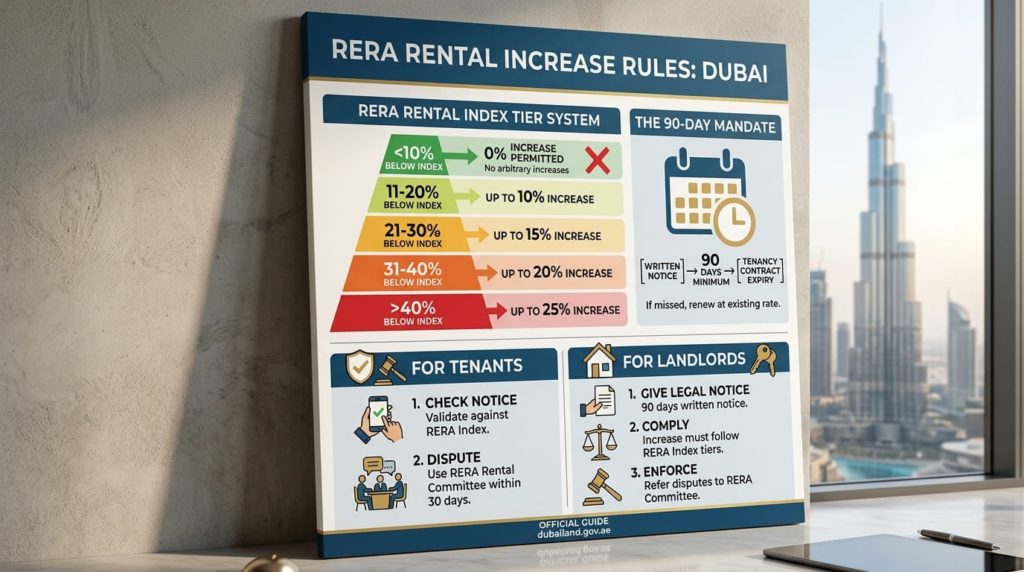
Dubai regulates all rent increases through the RERA Rental Index. A landlord cannot increase rent beyond what RERA permits, regardless of market conditions. You can check the current benchmark at dubailand.gov.ae.
The RERA 90-Day Mandate: In the Dubai rental market, a landlord cannot unilaterally or arbitrarily increase rent at renewal. All rental increases are strictly governed by the RERA Rental Index calculator. Furthermore, for any legally permitted increase to be enforced, the landlord must notify the tenant in writing at least 90 days prior to the expiration of the current tenancy contract. If this notice period is missed, the tenant is legally entitled to renew at the existing rate.
The RERA rental increase calculator works on a tiered system based on how far your current rent sits below the RERA index:
- Within 10% of the index: No increase permitted
- 11–20% below the index: Landlord can increase up to 10%
- 21–30% below the index: Landlord can increase up to 15%
- 31–40% below the index: Landlord can increase up to 20%
- More than 40% below the index: Landlord can increase up to 25%
If you receive an increase notice as a tenant: Check it against the RERA index immediately. Dispute any non-compliant increase through the RERA Rental Committee within 30 days of receiving the notice.
If you are a landlord with a legitimate increase: Tenants who dispute a compliant increase can be referred to the RERA Rental Committee for enforcement.
Landlord Guide: How to Maximize Rental Income in 2026
STR vs LTR — the core decision
Short-term rental (STR) generates gross yields of 10–14% in top areas but requires a DTCM permit, carries higher management burden, and produces seasonal income variation. Long-term rental (LTR) delivers gross yields of 5–9% with stable annual income, lower vacancy risk, and simpler management. Choose STR if active income maximization and the flexibility of personal use matter more than predictability. Choose LTR if passive, consistent income is the priority.
Furnished vs unfurnished
A furnished rental commands a 15–30% premium over an unfurnished equivalent. A furnished studio earns AED 10,000–15,000 more per year. A furnished 1-bedroom earns AED 15,000–25,000 more. The tradeoff is higher tenant turnover and more frequent unit refresh costs. The furnished STR strategy works best in Downtown Dubai, Dubai Marina, and JBR.
Property management options
- Full-service LTR management (tenant sourcing, rent collection, maintenance, reporting): 5–8% of annual rent
- STR management (daily operations, platform listing, guest management): 15–25% of rental revenue
- Maintenance-only: Some landlords self-manage tenants but outsource maintenance coordination
When selecting a management company, confirm it holds a valid RERA license, has a structured tenant-vetting process, and offers responsive maintenance coordination.
First Call Real Estate’s property management division operates with licensed RERA agents. Contact us to find qualified tenants and maximize your Dubai rental income. For service charge impact on net yield calculations, see Best Areas to Invest in Dubai and Dubai Real Estate ROI.
Short-Term Rental in Dubai: How to Get Your DTCM Permit
Short-term rental in Dubai requires a valid permit from the Department of Tourism and Commerce Marketing (DTCM). Operating without one is a regulatory violation, and platforms including Airbnb and Booking.com require the permit number before listing your property.
STR yield data: Downtown Dubai STR rates range from AED 400 to AED 2,000 per night at 80–90% peak occupancy. Dubai Marina ranges from AED 350 to AED 1,500 per night at 75–85% occupancy. Net yield after management costs typically runs 7–10%.
| Factor | Short-Term Rental | Long-Term Rental |
| Gross Yield | 10–14% best areas | 5–9% |
| Net Yield | 7–10% after management | 4–7% after costs |
| Management Burden | High daily operations | Low annual contract |
| DTCM Permit | Required | Not required |
| Income Stability | Variable seasonal | Stable annual contract |
| Vacancy Risk | Higher off-peak | Lower annual contract |
| Personal Use | Flexible block dates | Not available during tenancy |
| Best Areas | Downtown, Marina, JBR, Palm | JVC, Dubai South, Business Bay |
| Best For | Active income maximizers | Passive income investors |
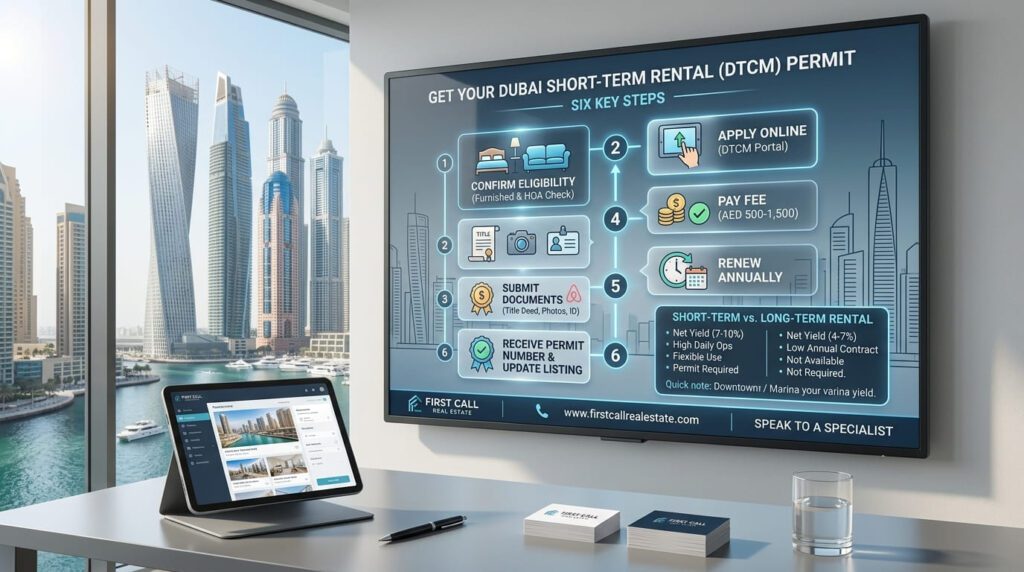
How to get your DTCM permit:
- Confirm eligibility furnished apartments qualify; villas require HOA approval.
- Apply online through the DTCM portal.
- Submit required documents: title deed, property photos, and valid ID.
- Pay the permit fee: AED 500–1,500 depending on property type.
- Receive your DTCM permit number and add it to your Airbnb or Booking.com listing.
- Renew the permit annually.
First Call Real Estate assists investor clients with DTCM permit applications. Speak to a specialist about your short-term rental strategy.
Rental Dispute Resolution: Your Rights and the RERA Process
When a landlord-tenant dispute cannot be resolved directly, the RERA Rental Committee is the official resolution body. Cases are filed through the Dubai Courts rental dispute center online filing is available. The filing fee is AED 3,500 per dispute, and resolution typically takes 3–6 weeks.
Common disputes handled by the Rental Committee:
- Rent increases above RERA-permitted limits
- Eviction without legal basis
- Security deposit disputes
- Landlord failure to carry out structural maintenance
Tenant protections: Protection against illegal eviction, above-RERA rent increases, and landlord neglect of structural maintenance obligations.
Landlord protections: Legal recourse for non-payment, property damage, and unauthorized subletting.
Prevention is more effective than dispute resolution. Register every tenancy through Ejari. Document the property condition at handover with a signed inventory. Send all notices in writing with verifiable delivery. Keep copies of all cheques and payment records.
Dubai Rental Market H2 2026 Forecast: What to Expect
The overall Dubai rental market is moderating after a period of strong growth. This is a healthy correction, not a downturn.
Premium areas (Downtown Dubai, Dubai Marina, Palm Jumeirah): Rents are holding firm. Strong occupier demand and limited new supply keep current price levels well supported. No material easing is expected through the end of 2026.
Affordable areas (JVC, Arjan, Silicon Oasis): Approximately 32,000 new units are entering the market across these communities, softening rents by an estimated 3–7%. Tenants in these areas have more negotiating power in 2026 than in previous years. Landlords should factor this into asking rents and renewal terms.
Villa rental market: Supply remains tight across Dubai Hills Estate and Arabian Ranches. Rents are well supported and are not expected to ease materially regardless of the broader supply pipeline.
STR outlook: Peak season runs October to April. Downtown Dubai and Dubai Marina are expected to sustain high occupancy rates through Q4 2026. Winter tourism demand remains a reliable driver for short-term landlords in prime locations.
The long-term demand floor: Dubai’s population growing at 4% annually means new renters enter the market continuously. Short-term supply additions in affordable areas do not change the structural demand trajectory. For the full 2026 sales market context, see Dubai Property Market 2026 and Is Dubai Good Investment.
Take Your Next Step with First Call Real Estate
The Dubai rental market in 2026 is one of the most active on record, with yields of 4–11% across areas and a clear regulatory framework protecting both landlords and tenants through RERA. The data points in one direction: demand is structural, not cyclical, and it is underpinned by a population growing at 4% per year.
Here is what each audience should take away. Landlords: the three levers that determine net yield are the furnished premium (15–30%), the STR versus LTR decision, and the quality of your property management. Tenants: check the RERA rental index before you sign, register through Ejari immediately after signing, and understand your rights under the rent increase calculator. Investors: International City, JVC, and Dubai South offer the strongest yields; Downtown Dubai and Palm Jumeirah offer prestige income at lower percentage returns but stronger capital growth potential.
The Dubai rental market 2026 data confirms this is a market that rewards those who act with information. First Call Real Estate provides the data, the licensed professionals, and the management infrastructure to help you act with confidence.
Landlords: Contact First Call Real Estate to list your property and find qualified tenants
Tenants: Search available properties with First Call Real Estate
For overseas buyers planning to become landlords, see Dubai Property Investment for Foreigners. For buyers converting to landlords after purchase, explore Apartments for Sale Dubai and Villas for Sale Dubai.
Frequently Asked Questions: Dubai Rental Market 2026
Is Dubai a good rental market in 2026?
Yes. With 214,445 contracts recorded in the first seven months alone, demand is at record levels. Gross yields range from 4–11% depending on area and rental strategy, making Dubai one of the stronger yield markets globally for residential property.
What is the average rent in Dubai in 2026?
Rent varies significantly by area and unit type. A studio in JVC averages AED 45,000–60,000 per year. A 1-bedroom in Downtown Dubai averages AED 132,000 per year. A 3-bedroom villa on Palm Jumeirah starts at AED 400,000 annually.
Will Dubai rents decrease in 2026?
Affordable areas are seeing modest softening of 3–7% due to new supply entering communities like JVC, Arjan, and Silicon Oasis. Premium areas and the villa segment are holding firm, with no material decrease expected through the end of the year.
Which area in Dubai has the highest rental yield?
International City leads at 9–11% gross yield, followed by JVC at 7–9% and Dubai South at 7–8%. These are the areas that deliver the strongest returns for yield-focused investors.
How does renting work in Dubai cheques and Ejari?
Rent in Dubai is paid by post-dated cheques, typically issued in 1, 4, or 6 installments per year. All rental contracts must be registered through Ejari within 30 days of the tenancy start date. Without Ejari, tenants cannot connect DEWA utilities or renew residency visas.
Can a landlord increase rent in Dubai?
Yes, but only within the limits set by the RERA Rental Index calculator. The permitted increase ranges from 0% to 25% based on how far the current rent sits below the RERA benchmark. A 90-day written notice is mandatory for any increase to be legally enforceable.
How do I get a DTCM permit for short-term rental in Dubai?
Apply online through the DTCM portal, submit your title deed, property photos, and valid ID, then pay the permit fee of AED 500–1,500. The permit must be renewed annually and is required before any short-term rental platform will list your property.
What is Ejari and is it mandatory in Dubai?
Ejari is the Dubai Land Department’s official tenancy registration system. It is mandatory for all rental contracts in Dubai. Without a valid Ejari certificate, tenants cannot connect DEWA utilities or renew UAE residency visas for themselves or dependents.