Dubai Real Estate ROI: The Complete Numbers Guide

Dubai real estate ROI delivers net rental yields of 5–9% and zero capital gains tax a combination no major global market matches in 2026. This guide covers the four core ROI metrics, exact AED formulas, real property examples, and a direct comparison against London, New York, Singapore, Sydney, and Paris.
Dubai real estate ROI is not a marketing headline. It is a measurable, calculable figure and when you run the numbers accurately, Dubai consistently outperforms every comparable global market on an after-tax basis.
This guide is not a broad investment case for Dubai, nor a community-by-community area comparison. Those articles exist and serve a different purpose. This guide focuses exclusively on the numbers: the exact formulas, the real AED costs that compress your returns, and the calculations that separate a profitable investment from a disappointing one.
If you are comparing Dubai against your home market, evaluating your first purchase, or benchmarking an existing portfolio, these figures give you a precise starting point. For broader context on why Dubai is attracting global capital, read our Dubai Property Investment guide first.
Four ROI metrics matter here: gross yield, net yield, total ROI, and cash-on-cash return. Each one tells you something different. Confusing them is the most common and most costly mistake overseas investors make.
What Does Dubai Real Estate ROI Actually Measure?
Before running any numbers, define your terms. The four metrics below are frequently conflated by agents and listing platforms. Each measures something distinct.
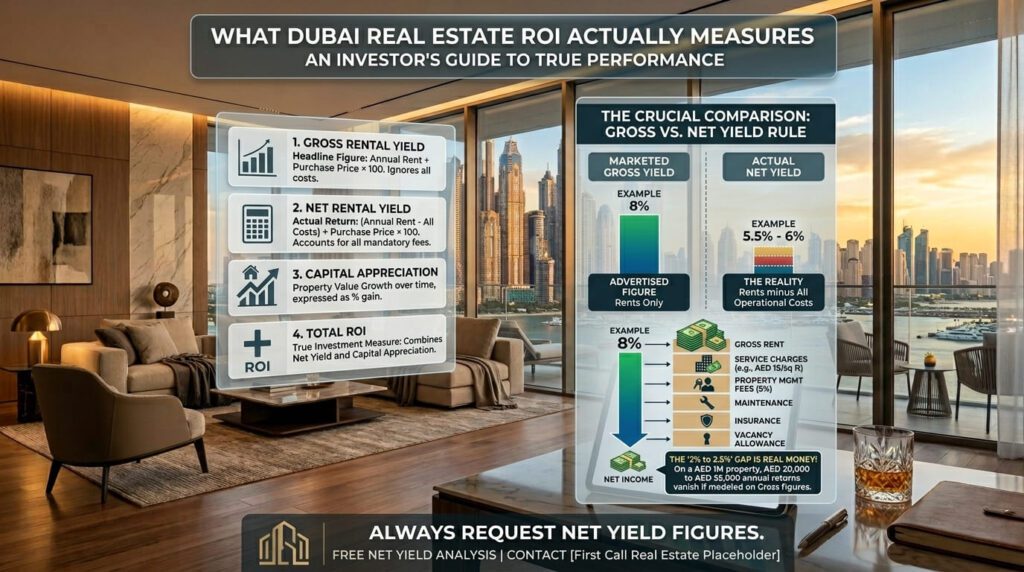
Gross Rental Yield is annual rent divided by purchase price, multiplied by 100. This is the headline figure most agents advertise. It ignores all costs.
Net Rental Yield is annual rent minus all annual costs, divided by purchase price, multiplied by 100. This is the return you actually receive after service charges, management fees, maintenance, insurance, and vacancy allowance.
Capital Appreciation is the increase in property value over time, expressed as a percentage gain. In Dubai’s current cycle, appreciation is a significant component of total returns.
Total ROI combines net rental yield and capital appreciation. This is the true measure of investment performance and the figure that makes Dubai’s case most clearly.
Cash-on-Cash Return divides net income by actual cash invested. For leveraged purchases, this figure can substantially exceed the unlevered net yield, depending on financing costs.
The Gross vs. Net Yield Rule: In the Dubai real estate market, investors must rigorously separate marketed gross yields from actual net cash flow. An advertised 8% gross yield on an AED 1M property (AED 80,000 annual rent) typically compresses to a 5.5% to 6% net yield once mandatory service charges (AED 15 per sq ft) and professional property management fees (5%) are deducted. Failing to underwrite these operational costs before purchase is the single most common error made by overseas investors.
The 2% to 2.5% gap between gross and net yield is not a rounding error. On a AED 1M property, it represents AED 20,000 to AED 25,000 in annual returns that disappear if you model on gross figures. Always request net yield figures. Contact First Call Real Estate for a free net yield analysis on any Dubai property.
How to Calculate Dubai Rental Yield: The Exact Formulas
Three formulas drive every ROI calculation in this guide. Apply them in order.
Gross Yield Formula
Gross Yield = (Annual Rental Income ÷ Property Purchase Price) × 100
Real example: An AED 1M property renting at AED 80,000 per year produces a gross yield of (80,000 ÷ 1,000,000) × 100 = 8%.
Net Yield Formula
Net Yield = ((Annual Rental Income − Annual Costs) ÷ Purchase Price) × 100
Real example: AED 80,000 rent minus AED 20,000 in annual costs equals AED 60,000 net income. Net yield = (60,000 ÷ 1,000,000) × 100 = 6%.
Total ROI Formula
Total ROI = Net Yield + Annual Capital Appreciation %
Real example: 6% net yield plus 20% capital appreciation equals 26% total ROI in Year 1.
The net yield calculation is where most investor models break down. Gross yield is easy to find on any listing portal. Net yield requires you to know your actual cost stack which the next section covers precisely.
All Costs That Reduce Your Dubai Property ROI
Two categories of costs reduce your returns: one-time acquisition costs and ongoing annual costs. Model both before you commit to any purchase.
One-Time Purchase Costs (approximately 6% to 7% of purchase price)
- Dubai Land Department (DLD) transfer fee: 4% of purchase price → AED 40,000 on a AED 1M property
- Agent commission: 2% → AED 20,000 on a AED 1M property
- Registration Trustee fee: AED 4,200 for properties above AED 500K
- Title Deed fee: AED 580
For a complete breakdown of purchase costs, see our full cost breakdown for first-time buyers.
⚠️ THE ACQUISITION FRICTION & SERVICE CHARGE DISCLOSURE:
Overseas investors modeling Dubai property returns must account for upfront transactional friction and ongoing operational costs. A headline purchase requires a mandatory 4% Dubai Land Department (DLD) transfer fee alongside standard 2% agency commissions, representing a ~6.5% total upfront closing cost. Furthermore, investors must verify a building’s specific service charge history before executing a Memorandum of Understanding (MOU), as excessive community fees can severely erode net yields.
Annual Ongoing Costs
- Service charges: AED 10 to AED 60 per sq ft depending on community verify this figure before you sign; it varies significantly between buildings and has a direct impact on net yield
- Property management fee: 5% to 10% of annual rent
- Maintenance and repairs: 1% to 2% of property value annually
- Building insurance: AED 2,000 to AED 5,000 annually
- DEWA deposits and connections: one-time cost per new tenant
Vacancy Allowance
Average vacancy runs 4% to 8% per year depending on location. High-demand areas including JVC, Downtown Dubai, and Dubai Marina typically sit below 4%. Less popular communities can reach 10%. Use a 5% vacancy factor as your conservative baseline in all net yield calculations. For a deeper look at demand patterns, see our guide on vacancy rates by community.
Dubai Net ROI Calculator: 5 Real Property Examples
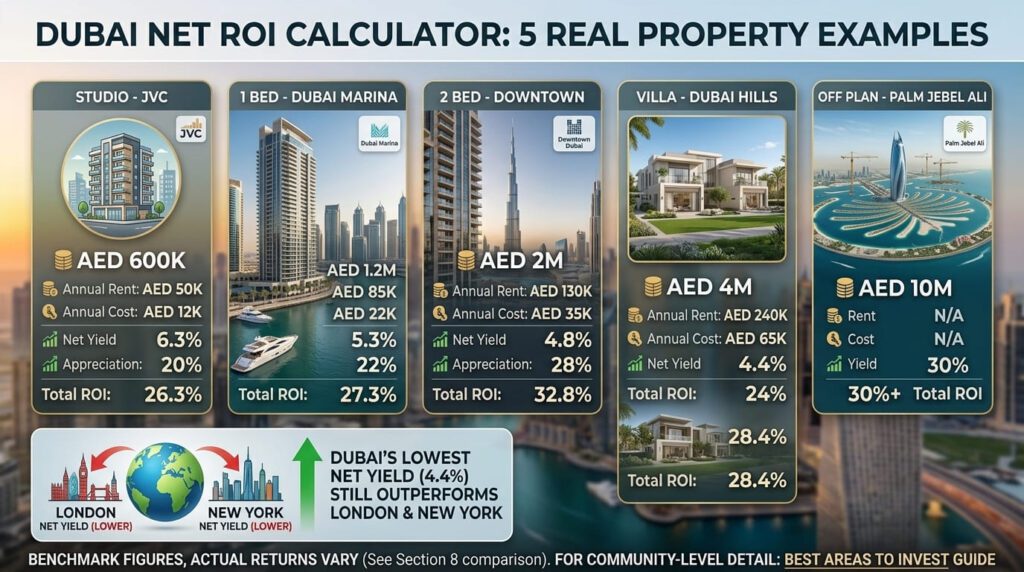
The table below applies the net yield formula to five real property types across Dubai’s core investment communities. Use these figures as benchmarks, not guarantees your actual returns will vary based on building-level service charges, tenant quality, and management fees.
| Property | Area | Purchase Price | Annual Rent | Annual Costs | Net Yield | Appreciation | Total ROI |
| Studio | JVC | AED 600K | AED 50K | AED 12K | 6.3% | 20% | 26.3% |
| 1 Bed | Dubai Marina | AED 1.2M | AED 85K | AED 22K | 5.3% | 22% | 27.3% |
| 2 Bed | Downtown | AED 2M | AED 130K | AED 35K | 4.8% | 28% | 32.8% |
| Villa | Dubai Hills | AED 4M | AED 240K | AED 65K | 4.4% | 24% | 28.4% |
| Off Plan | Palm Jebel Ali | AED 10M | N/A | N/A | N/A | 30% | 30%+ |
The lowest net yield in this table 4.4% on the Dubai Hills villa still outperforms net yields in London and New York. The full comparison appears in Section 8. For community-level detail on which areas offer the strongest long-term returns, see our Best Areas to Invest guide.
Long-Term vs. Short-Term Rental ROI: Which Performs Better?
The answer depends on your appetite for active management. Both models generate strong returns the trade-off is yield level versus operational complexity.
Long-Term Rental ROI (2026 Data)
- Studio, JVC: gross yield 8% net yield 6% to 6.5%
- 1-bed, Dubai Marina: gross yield 7% net yield 5.5% to 6%
- 2-bed, Downtown: gross yield 6% net yield 4.5% to 5%
- Villa, Dubai Hills / Arabian Ranches: gross yield 6% net yield 4.5% to 5%
Short-Term Rental (STR) ROI (2026 Data)
STR Gross Yield = (Total Annual STR Revenue ÷ Purchase Price) × 100
- Studio, Downtown Dubai: gross STR yield 12% net STR yield 8% to 9%
- 1-bed, Dubai Marina: gross STR yield 11% net STR yield 7% to 8%
- 2-bed, Palm Jumeirah: gross STR yield 10% net STR yield 6% to 7%
STR Costs Are Higher: Account for Them
The net STR yield figures above already reflect higher cost structures:
- Management fee: 15% to 25% of revenue (versus 5% to 10% for long-term rental)
- Cleaning and consumables: substantially higher than long-term rental equivalents
- DTCM permit: AED 500 to AED 1,500 annually straightforward to obtain, but a required cost
STR is not a passive income strategy. It requires active management or a specialist operator. Investors who underestimate STR operational complexity typically see yields compress toward long-term rental equivalents.
The Decision Framework
STR delivers 1% to 3% higher net yield but requires ongoing operational involvement. Long-term rental provides stable, predictable cash flow with lower management burden. A hybrid approach STR during peak tourist season, long-term rental in off-peak months can optimize annual revenue without full STR complexity. For pure yield, studios and 1-bed units in tourist-heavy locations produce the best STR results: lower running costs, higher occupancy rates.
Off-Plan ROI: How Capital Appreciation Changes the Calculation
Off-plan ROI works differently. There is no rental income during construction, so capital appreciation drives the entire return until handover.
The calculation is straightforward: buy at AED 1M off-plan, receive the property at handover valued at AED 1.3M, and the capital gain equals AED 300,000 a 30% return on purchase price. Spread across a two-year construction period, that equates to an effective annual return of 15% before a single tenant moves in.
From handover onwards, add 6% to 8% annual net yield to the calculation. Combined ROI across the first three years post-purchase frequently exceeds 40%.
Early Palm Jebel Ali buyers provide the most recent reference point: investors who entered early achieved 35% appreciation in two years, without any rental income factoring into that return.
Payment plan mechanics amplify cash-on-cash returns further. Off-plan buyers commonly pay 20% to 40% during construction. That means your effective cash deployed during the appreciation period is a fraction of the total purchase price and cash-on-cash returns are significantly higher than the headline appreciation figure suggests. For more detail, see our Off Plan Investment Guide and our explanation of payment plan ROI.
Historical Dubai ROI Data: What the Numbers Show Over 5 and 10 Years
The five-year period from 2020 to 2025 produced total returns across Dubai communities that no comparable global market matched.
Five-Year Average Total Returns (2020–2025)
- Palm Jumeirah: 120% average total return
- Downtown Dubai: 100% average total return
- Dubai Hills Estate: 90% average total return
- JVC: 70% to 80% average total return
These figures include both rental yield and capital appreciation. No equivalent after-tax return exists across the same period in London, New York, Singapore, Sydney, or Paris.
The standout single investment of the period: early Palm Jebel Ali buyers, who achieved 35% appreciation in two years.
Current price levels still represent a meaningful entry point. However, as the market matures, the window at these valuations is narrowing. Investors who entered in 2021 and 2022 captured the steepest part of the appreciation curve. The market today rewards selectivity and community-level research rather than broad market exposure. For forward-looking projections, see our Dubai Property Market outlook for 2026 to 2027 and our analysis of the long-term case for Dubai real estate.
Dubai Real Estate ROI vs. Global Markets
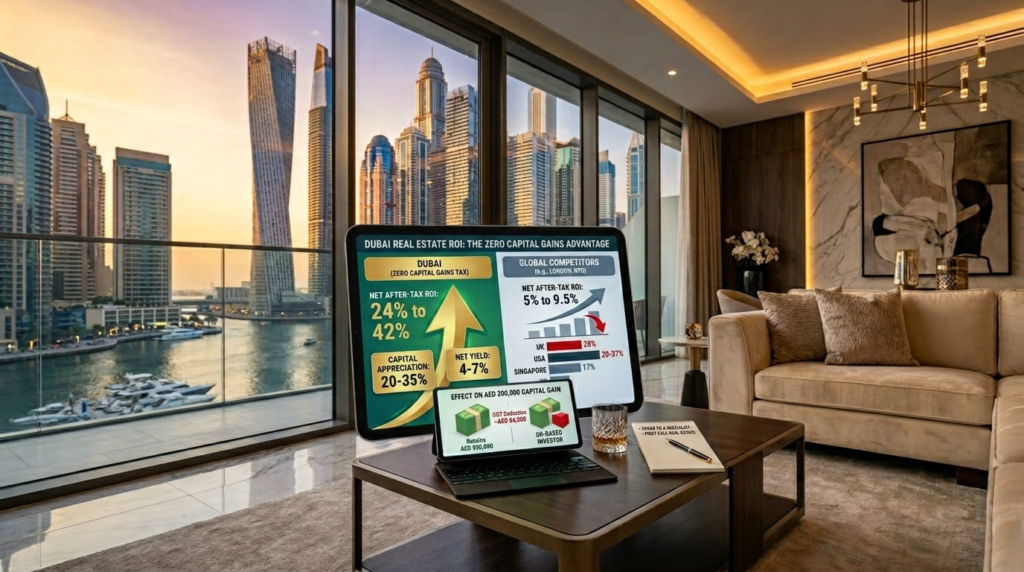
Property investment returns in Dubai outperform every market in the table below not because gross yields are the highest, but because zero capital gains tax eliminates the single largest deduction applied to returns in every competing market.
| Market | Gross Yield | Net Yield | Appreciation | CGT | Net After-Tax ROI |
| Dubai | 5–9% | 4–7% | 20–35% | Zero | 24–42% |
| London | 3–5% | 2–3.5% | 5–8% | 28% | 9–8.5% |
| New York | 3–5% | 2–3% | 4–7% | 20–37% | 7–7% |
| Singapore | 3–4% | 2–3% | 5–8% | 17% | 7.5–9% |
| Sydney | 3–4% | 2–3% | 5–10% | 25% | 7–9.5% |
| Paris | 3–5% | 2–3% | 3–6% | 19–34% | 5–6% |
The zero-tax advantage is not a footnote. It is the structural difference that makes Dubai’s ROI case decisive.
UK investors pay 28% of capital gains in CGT. US investors pay 20% to 37% at the federal level, plus state tax. On a AED 300,000 capital gain, a UK-based investor pays approximately AED 84,000 in CGT. A Dubai investor retains the full AED 300,000.
Even at equivalent gross yields which Dubai already exceeds Dubai’s net after-tax ROI outperforms every market in this table. At current Dubai yield levels, the gap is not close.
Speak to a First Call Real Estate investment specialist to maximize your Dubai property ROI.
How to Maximize Your Dubai Property ROI
Eight strategies consistently separate high-performing Dubai investments from average ones. Each addresses a specific lever in the net yield or total ROI calculation.
- Choose short-term rental in tourist areas. STR in locations like Downtown Dubai and Dubai Marina boosts yield by 1% to 3% above long-term equivalents. Requires a specialist operator or active self-management.
- Buy furnished. Furnished units command a 15% to 25% rental premium over unfurnished equivalents. The upfront furnishing cost typically recovers within 12 to 18 months.
- Buy near the Metro. Metro-adjacent properties consistently show sub-4% vacancy. Higher occupancy and stronger rental rates directly improve net yield.
- Enter off-plan early. Launch pricing captures maximum capital appreciation before the market re-prices at handover. Early entry is where the strongest total ROI is generated.
- Use professional property management. Professional managers reduce vacancy below 3% and protect long-term asset condition. The 5% to 10% fee cost is typically offset by lower vacancy and fewer maintenance surprises.
- Choose high-demand buildings over ultra-luxury. Service charges in standard high-demand buildings run AED 10 to AED 20 per sq ft. Ultra-luxury buildings can reach AED 40 to AED 60 per sq ft. That AED 20 to AED 40 per sq ft difference compounds meaningfully across a full year.
- Consider a hybrid STR strategy. STR in peak tourist months, long-term rental in off-peak periods. This approach optimizes annual revenue without committing to full STR operational complexity year-round.
- Factor financing carefully. On a leveraged purchase with manageable financing costs, cash-on-cash return can significantly exceed the unlevered net yield. Model your financing costs explicitly do not assume leverage automatically improves returns.
Conclusion: Your ROI Target by Investor Profile
Dubai real estate ROI delivers the highest total net returns of any major global market in 2026. Zero capital gains tax is the single structural variable no other market replicates and it is what converts competitive gross yields into decisive net after-tax outperformance.
Match your target ROI to your investor profile:
- Conservative investor (long-term rental, ready property): target 4.5% to 6% net yield plus 15% to 20% appreciation equals 19.5% to 26% total ROI
- Growth investor (off-plan, early entry): target 25% to 35% capital gain over two to three years, then add post-handover yield
- Active investor (STR, furnished, prime location): target 7% to 9% net STR yield plus capital appreciation
Current entry prices offer a strong window before further appreciation compresses yields. The investors achieving 25%+ total ROI today entered before the next re-pricing cycle. That window does not stay open indefinitely.
Contact First Call Real Estate today to receive a personalized Dubai real estate ROI analysis for your investor profile.
View investment listings | Book an ROI consultation
For forward-looking price projections, see our Dubai Property Market guide.
Frequently Asked Questions
What is the average ROI for Dubai real estate in 2026?
Total ROI combining net yield and capital appreciation ranges from 24% to 42% depending on property type, location, and rental strategy. On a net after-tax basis, no major global market produces comparable returns. Investors in high-demand communities with STR strategies and early off-plan entry consistently reach the top of this range.
What is the difference between gross yield and net yield in Dubai?
Gross yield is annual rent divided by purchase price. Net yield subtracts all annual costs service charges, management fees, maintenance, insurance, and a vacancy allowance before dividing by purchase price. The gap is typically 1.5% to 3%, which equals AED 15,000 to AED 30,000 annually on a AED 1M property. Always model on net yield.
How do I calculate rental yield on a Dubai property?
Use this formula: Net Yield = ((Annual Rent − Annual Costs) ÷ Purchase Price) × 100. For a AED 1M property generating AED 80,000 in annual rent with AED 20,000 in costs, net yield equals 6%. The full worked example with AED cost breakdowns appears in Section 2.
What costs reduce my Dubai property ROI?
The primary cost items are: DLD transfer fee (4%), agent commission (2%), Registration Trustee fee (AED 4,200 for properties above AED 500K), service charges (AED 10 to AED 60 per sq ft annually), property management fees (5% to 10% of annual rent), maintenance (1% to 2% of property value annually), building insurance (AED 2,000 to AED 5,000), and a vacancy allowance use 5% as a conservative baseline.
Is short-term rental more profitable than long-term rental in Dubai?
STR delivers 1% to 3% higher net yield than long-term rental in comparable locations. The trade-off is operational: STR management fees run 15% to 25% of revenue versus 5% to 10% for long-term, and the model requires active oversight or a specialist operator. Long-term rental provides stable, predictable cash flow. A hybrid strategy can capture the advantages of both.
What is the total ROI on a Dubai property including capital appreciation?
Total ROI adds net yield to annual capital appreciation. A JVC studio producing a 6.3% net yield with 20% capital appreciation delivers 26.3% total ROI in a single year. Off-plan purchases in the right communities frequently exceed 30% total ROI across a two-to-three-year investment horizon.
How does Dubai real estate ROI compare to London?
Dubai’s net after-tax ROI ranges from 24% to 42%. London delivers approximately 9% to 8.5% after capital gains tax at 28%. On a AED 300,000 capital gain, a London-based investor loses approximately AED 84,000 to CGT. A Dubai investor retains the full amount. When stamp duty and higher service charges are added to the London calculation, the gap widens further.
What is the best property type for maximum ROI in Dubai?
For pure net yield: studios in JVC or Downtown Dubai operated as STR. For maximum total ROI including capital appreciation: early-entry off-plan in emerging communities or established luxury areas where supply constraints support strong appreciation trajectories. For stable passive income: long-term rental in high-demand one-bed or two-bed units with low service charge buildings.