Dubai Property Investment 2026: Returns, Areas & Rules
Dubai property investment delivers rental yields of 5% to 9%, capital appreciation of 15% to 30%, and zero property, capital gains, or inheritance tax making it the highest net-return real estate market among major global cities in 2026. Foreign nationals can own 100% freehold property in 60-plus designated zones, with Golden Visa eligibility from AED 2 million.
Dubai is the only major global city where investors pay zero property tax, zero capital gains tax, and zero inheritance tax and still achieve rental yields of 5% to 9%. That combination does not exist in London, New York, Singapore, or Sydney. It exists here, and it is measurable.
The context matters. Dubai’s population has surpassed 3.5 million and is growing at 4% annually. Tourism reached 17 million-plus visitors in 2025, sustaining rental demand across both long-term and short-term markets. Supply is increasing, but so is the population absorbing it.
This guide is written for four distinct investor profiles: yield seekers targeting maximum rental income, capital growth investors positioning for appreciation, Golden Visa applicants using property to secure residency, and passive income investors building a portfolio managed remotely. Each section addresses your specific angle directly.
What follows covers the full investment case tax advantages, verified return data by property type, legal protections, top investment zones, financing routes, short-term rental strategy, Golden Visa eligibility, and the most common mistakes overseas investors make. This is Article 1 of the First Call Real Estate Dubai Property Investment Guide series, with each section linking forward to dedicated deep-dive articles.
Why Invest in Dubai Property? The Core Advantages
The Global Net Yield Arbitrage: In 2026, Dubai represents a structural anomaly in global real estate. While tier-one cities like London and New York heavily tax capital gains (20% to 28%) and suppress net rental yields to 3% or 4%, Dubai offers an established, USD-pegged market delivering 5% to 9% gross yields with absolutely zero property, capital gains, or inheritance taxes. For the international investor, this tax efficiency compounds the total net return, mathematically outperforming traditional Western safe-haven assets.
The zero-tax structure is the single most powerful differentiator Dubai holds over every competing global market. Here is what that means in practice:
- Zero property tax annually every dirham of net rental income stays in your account
- Zero capital gains tax 100% of the profit on sale belongs to you
- Zero inheritance tax property passes to heirs without deduction
- Freehold ownership 60-plus designated zones where foreign nationals hold full title deed rights
- UAE Dirham pegged to the US Dollar no currency risk for USD-denominated investors; reduced exposure for most international buyers
- Political stability Dubai consistently ranks among the world’s safest cities, underpinning long-term investor confidence
- World-class infrastructure direct access to international education, healthcare, and transport links that sustain rental demand
No other major global city combines all of these factors simultaneously. That is the investment thesis.
← Previous: Can Expats Buy Property in Dubai
Dubai Property Investment Returns in 2026: What Are the Numbers?
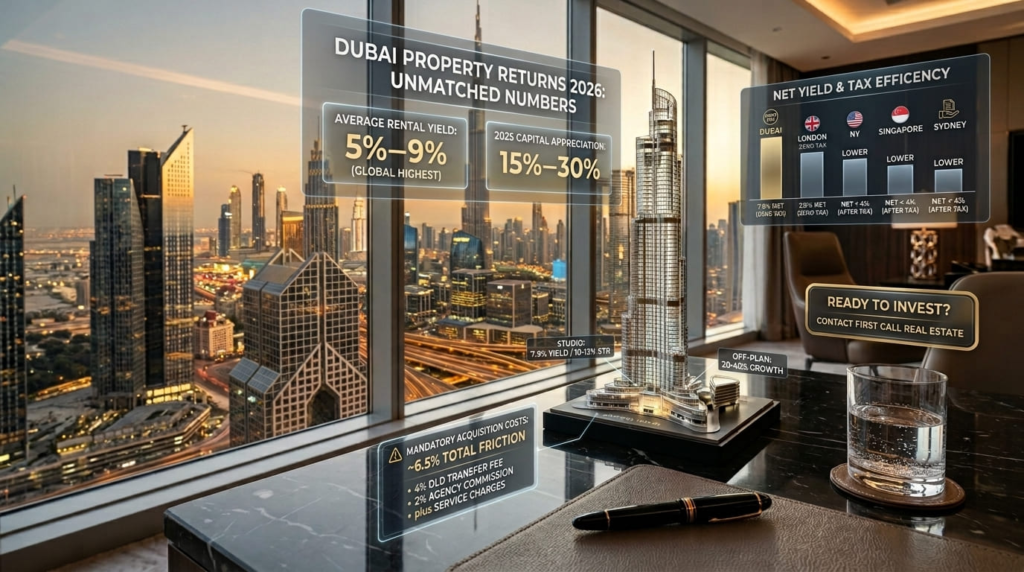
Dubai delivers average rental yields of 5% to 9% among the highest of any major global city. That headline number requires three separate components to evaluate properly.
Rental yield measures gross income as a percentage of purchase price. Capital appreciation measures the increase in the property’s market value. Total return combines both. In 2025, most Dubai communities delivered capital appreciation of 15% to 30%, pushing total returns to between 20% and 40% when combined with rental income.
Compare that to the alternatives:
- London: 3% to 4% rental yield, 28% capital gains tax on sale
- New York: 3% to 5% rental yield, 20% capital gains tax on sale
- Singapore: 3% to 4% rental yield, 17% corporate tax on gains
- Hong Kong: 2% to 3% rental yield
When tax efficiency is factored into net return calculations, Dubai outperforms all of these markets. A London investor yielding 3.5% and paying 28% capital gains tax nets considerably less than a Dubai investor yielding 7% with zero tax on the same capital gain.
One cost you must model accurately: the Dubai Land Department (DLD) transfer fee of 4% is a significant entry cost. Include it in your total return calculation from day one, not as an afterthought.
⚠️ THE ACQUISITION & FRICTION COST MANDATE:
Overseas investors modeling Dubai property returns must strictly account for upfront transactional friction and ongoing operational costs. A headline purchase requires a mandatory 4% Dubai Land Department (DLD) transfer fee alongside standard 2% agency commissions, representing approximately 6.5% total upfront closing cost. Furthermore, investors must calculate net yield not gross yield by thoroughly verifying a building’s annual service charges, which can erode gross rental income by 1% to 2% annually if poorly managed.
Table 1: Dubai Property Investment Returns by Property Type 2026
| Property Type | Entry Price | Rental Yield | STR Yield | Appreciation | Best For |
| Studio Apartment | AED 400K–900K | 7–9% | 10–13% | 15–25% | Maximum yield |
| 1 Bedroom Apartment | AED 700K–2M | 6–8% | 9–12% | 15–25% | Yield and stability |
| 2 Bedroom Apartment | AED 1M–3.5M | 5–7% | 8–11% | 15–25% | Stable income |
| Villa | AED 2M–10M | 5–7% | 7–10% | 20–30% | Long-term capital |
| Off-Plan Property | AED 500K–40M | N/A pre-handover | N/A | 20–40% | Capital growth |
| Commercial Office | AED 750K–10M | 7–10% | N/A | 10–20% | Stable income |
Table 2: Dubai vs Global Property Investment Comparison
| Factor | Dubai | London | New York | Singapore | Sydney |
| Rental Yield | 5–9% | 3–4% | 3–5% | 3–4% | 3–4% |
| Capital Gains Tax | Zero | 28% | 20% | 17% | 25% |
| Property Tax | Zero | Council tax | Property tax | Property tax | Council rates |
| Foreign Ownership | Full freehold | Full | Full | Restricted | Restricted |
| Currency Stability | USD peg | Volatile | USD | SGD stable | AUD volatile |
| Residency Benefit | Golden Visa | No | No | No | No |
| Total Net Return | Highest | Lower | Lower | Lower | Lower |
Contact First Call Real Estate to identify the best Dubai property investment for your goals.
Best Property Types for Dubai Investment: Matching Asset to Objective
Property type selection should follow your primary investment objective. Here is how to align the two.
Studio apartments (AED 400K–900K) deliver the highest percentage yield at 7% to 9%. They are the strongest entry point for first-time overseas investors and generate short-term rental yields of 10% to 13% in high-demand communities. Lower capital outlay, higher yield percentage.
1-bedroom apartments (AED 700K–2M) balance yield and demand depth. Rental demand from professionals remains consistent across Dubai’s established communities. Gross yield sits at 6% to 8%, with STR potential of 9% to 12% in well-located buildings.
2-bedroom apartments (AED 1M–3.5M) attract families and long-term tenants. Vacancy rates are lower, and tenant stability reduces management burden. Yield of 5% to 7% reflects the premium for predictability.
Villas (AED 2M–10M) offer a different trade-off. The yield percentage is lower at 5% to 7%, but capital appreciation of 20% to 30% is stronger. Long-term tenants reduce turnover, and villa communities in Dubai have seen sustained demand from families relocating for education and lifestyle.
Off-plan properties (AED 500K–40M) produce no rental income before handover, but capital appreciation of 20% to 40% is achievable before a unit is completed. Developer payment plans often structured as 60/40 or 1% monthly reduce the upfront capital requirement significantly.
Commercial offices (AED 750K–10M) generate yields of 7% to 10% with longer lease terms. Income stability is the primary advantage.
One caveat applies across all property types: service charges vary significantly by building and community. Always calculate net yield after service charges. A headline gross yield of 8% in a high-service-charge building can net below 6%.
← Previous: Apartments for Sale in Dubai | Villas for Sale in Dubai | Off-Plan Property Investment
Best Areas for Dubai Property Investment: An Overview
Location selection should be driven by rental demand data and yield history not by how a brochure looks or how close a building sits to a landmark. Here is where the numbers lead in 2026.
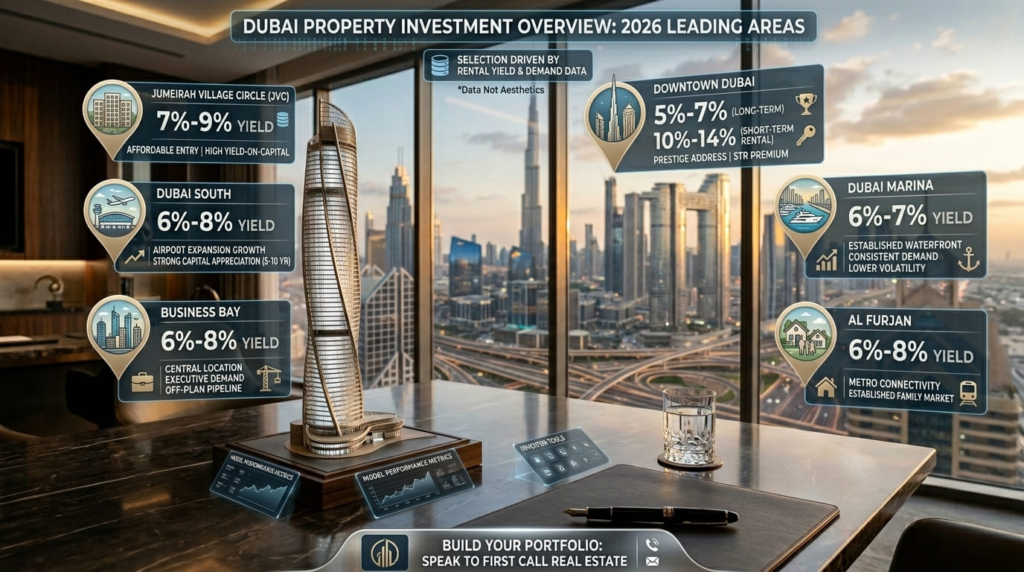
JVC (Jumeirah Village Circle): 7% to 9% yield. The most affordable entry point in a centrally located community. First-time overseas investors consistently achieve the highest yield-on-capital ratios here.
Dubai South: 6% to 8% yield. The long-term growth driver is the Al Maktoum International Airport expansion. Capital appreciation runway is among the strongest in the city for investors with a five-to-ten-year horizon.
Downtown Dubai: 5% to 7% long-term yield; 10% to 14% STR yield. A prestige address with premium short-term rental demand from business travelers and tourists. Entry prices are higher, but STR performance justifies the premium in the right buildings.
Dubai Marina: 6% to 7% yield. An established waterfront community with consistent demand from professionals and international tenants. Lower volatility than newer communities.
Business Bay: 6% to 8% yield. The central location drives executive rental demand. A strong off-plan pipeline continues to attract institutional developers.
Al Furjan: 6% to 8% yield. Metro connectivity and an established Nakheel community support a growing family rental market. Infrastructure is in place rather than promised.
Speak to a First Call Real Estate investment specialist to build your Dubai property portfolio.
The Legal Framework Protecting Your Dubai Investment
Dubai’s legal framework for property investment is among the most transparent and investor-protective in the region. Four institutions form the core of that protection.
Dubai Land Department (DLD): Every property transaction in Dubai is registered with the DLD. The title deed issued by the DLD is the definitive legal proof of ownership. No transaction exists outside this registry.
RERA (Real Estate Regulatory Agency): All developers and registered agents operate under RERA oversight. Before signing any agreement, verify the developer’s and agent’s RERA registration numbers. Unregistered parties carry legal risk that registered ones do not.
Freehold zones: Foreign nationals can own 100% of a property in 60-plus designated freehold areas across Dubai. Confirm your target property falls within a freehold zone before proceeding not all areas qualify.
Escrow accounts: All off-plan payments are held in DLD-regulated escrow accounts. Developers cannot access these funds freely they are released only against verified construction milestones. This mechanism directly protects buyers from developer cash flow mismanagement.
Oqood registration: Off-plan ownership is legally recorded from the point of contract via the Oqood system. You hold a registered ownership interest from signing day, not from handover.
Title Deed: Issued by the DLD on completion of a ready property purchase. This document is your legal proof of ownership and the instrument required for any subsequent sale, mortgage, or inheritance transfer.
← Previous: Freehold Property in Dubai
Financing Your Dubai Property Investment: Three Routes to Entry
Three primary financing routes are available to overseas investors in 2026. Each suits a different capital position and strategy.
Cash purchase delivers maximum negotiating leverage and eliminates mortgage approval timelines. For investors seeking the fastest transaction completion or the strongest position in a competitive off-plan launch, cash is the most flexible entry.
Mortgage financing gives expatriate buyers access to up to 75% loan-to-value (LTV) on ready properties. Off-plan properties are capped at 50% LTV. Both UAE-based banks and international lenders operate in the Dubai market. Mortgage approval timelines vary, so begin this process before identifying a specific property.
Developer payment plans are the most accessible entry point for first-time investors. Most off-plan launches require 5% to 10% on booking. Structured plans of 60/40 60% during construction, 40% on handover or 1% monthly payment arrangements are widely available. Capital appreciation accrues from the booking date, not from handover.
Rolling equity strategy: Experienced investors already in the market use capital gains from Phase 1 off-plan investments to fund deposits on subsequent units. This approach compounds returns without requiring additional external capital at each stage.
⚠️ THE ACQUISITION & FRICTION COST MANDATE:
Factor the 4% DLD transfer fee and 2% agency fee into your total acquisition budget from the outset. These costs are non-negotiable and non-refundable. Investors who exclude them from initial return modeling consistently underestimate the capital required to enter the market and overestimate early-stage yields.
Let First Call Real Estate guide you through every step of your Dubai property investment.
Short-Term Rental Investment in Dubai: What the STR Market Delivers
Dubai’s 17 million-plus annual tourists create sustained short-term rental demand that outperforms long-term yields in key locations. The STR market is not a niche it is a primary investment strategy for the right property types and areas.
DTCM permit: Every short-term rental operation in Dubai requires a permit from the Department of Tourism and Commerce Marketing (DTCM). The permit process is straightforward. First Call Real Estate guides investors through the application as part of the purchase process.
STR yields by area (2026 estimates):
- Downtown Dubai: 10% to 14%
- Dubai Marina: 9% to 11%
- Jumeirah Beach Residence (JBR): 10% to 12%
- Palm Jumeirah: 9% to 12%
Peak occupancy windows: New Year’s Eve, Dubai Shopping Festival, and the October-to-April tourist season consistently deliver 80% to 90% occupancy rates in well-managed units. Annual average occupancy varies by building and management quality.
STR vs. long-term rental: STR delivers higher gross yield but requires active management, higher tenant turnover, and stronger furnishing standards. The gross yield differential over long-term rental is typically 2% to 5% per annum, depending on location and management quality.
Investors do not need to self-manage. Licensed STR management companies operate across Dubai, and First Call Real Estate connects buyers with vetted management partners from day one of purchase.
Dubai Golden Visa: Invest in Property and Secure Residency
The Golden Visa is a benefit unavailable to property investors in London, New York, or Singapore. It converts a real estate purchase into a long-term residency anchor for you and your family.
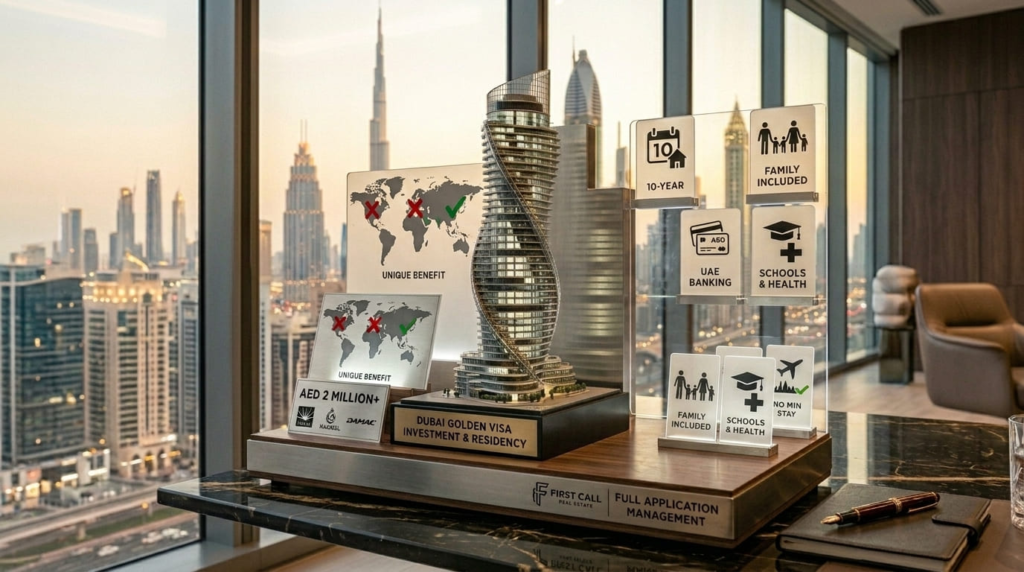
Eligibility threshold: A property investment of AED 2 million or above qualifies for the 10-year renewable UAE Golden Visa. Most Emaar, Nakheel, and DAMAC properties priced from AED 2 million qualify automatically.
Key Golden Visa benefits:
- 10-year renewable residency not tied to employment or a sponsoring employer
- Sponsor spouse and children family residency is included under one investment
- UAE bank account access full access to the UAE financial system for business and personal investment
- World-class education and healthcare access to Dubai’s international schools and private medical infrastructure
- No minimum stay requirement you do not need to live in Dubai to maintain your residency status
First Call Real Estate manages the complete Golden Visa application process alongside the property purchase. You do not need to navigate the application independently.
Common Dubai Property Investment Mistakes to Avoid
These are the errors that erode returns for overseas investors who skip due diligence. Each one is avoidable.
Focusing only on purchase price. The headline purchase price is not your total cost. DLD transfer fee (4%), agency fee (2%), conveyancing, and furnishing collectively add approximately 6.5% or more to your entry cost. Investors who ignore this consistently miscalculate their true ROI.
Choosing based on aesthetics, not data. Select property based on rental demand data, occupancy rates, and yield history. A building with a stunning lobby in a low-demand community will underperform a modest building in a high-demand one.
Ignoring service charges. High service charge buildings can reduce net yield by 1% to 2% annually. Always request the annual service charge figure and calculate net yield not gross yield before committing.
Not verifying developer RERA registration. For off-plan purchases, confirm the developer holds a valid RERA registration before signing anything. Non-registered developers carry legal risk that registered ones do not.
Buying in oversupplied buildings. Check vacancy rates in the specific building not just the community. High vacancy in a single building signals weak rental demand regardless of how the surrounding area performs.
No property management plan before handover. Arrange a licensed property management company before the handover date, not after you are trying to fill a vacant unit. A gap between handover and tenant occupancy costs yield.
Ignoring STR potential. In tourist-heavy areas, defaulting to long-term rental may leave 3% to 5% of potential annual yield unrealized. Run the STR comparison before choosing a rental strategy.
Concentrating in one community. Diversifying across two or more communities reduces exposure to localized supply increases or infrastructure delays that can suppress yields in a single area.
Dubai Property Investment Offers the Best Global Risk-Adjusted Returns in 2026
Three conclusions define the investment case in 2026.
First, Dubai property investment delivers the highest combination of rental yield, capital appreciation, and tax efficiency of any major global investment market. The data in this guide is not promotional it reflects what investors are actually earning, net of costs.
Second, the legal framework works. DLD registration, RERA regulation, escrow protection, and freehold title collectively provide foreign investors with enforceable rights and genuine asset security. These are not marketing promises; they are statutory mechanisms.
Third, the window for best returns is narrowing. Population growth at 4% annually, sustained tourism above 17 million visitors, and accelerating global investor demand are pushing prices upward. The yield compression that followed investor inflows in other global cities follows the same pattern here it is a question of timing, not likelihood.
Whether your primary goal is passive rental income, capital appreciation, Golden Visa residency, or all three, the Dubai market has a defined strategy that fits your profile. The next step is selecting the right asset, in the right community, with the right structure around it.
Contact First Call Real Estate today to discuss your Dubai property investment goals with a specialist who knows this market.
Explore Dubai investment properties →
Book a private investment consultation →
Frequently Asked Questions: Dubai Property Investment
Is Dubai property a good investment in 2026?
Yes. Rental yields of 5% to 9%, capital appreciation of 15% to 30%, zero property tax, and zero capital gains tax combine to make Dubai one of the strongest-performing investment markets globally. No comparable major city offers the same combination of yield, tax efficiency, and legal security.
What is the average rental yield for property in Dubai in 2026?
Average gross yield ranges from 5% to 9% depending on property type and location. Studio apartments in JVC and Dubai South consistently deliver the highest yields, reaching 7% to 9% gross. Always calculate net yield after service charges.
Can foreigners invest in Dubai property?
Yes. Foreign nationals can own 100% freehold property in 60-plus designated zones across Dubai, with full title deed rights registered through the Dubai Land Department. There are no restrictions on repatriating rental income or sales proceeds.
What is the minimum investment for Dubai property in 2026?
Entry-level studio apartments start from approximately AED 400,000. For UAE Golden Visa eligibility, the minimum qualifying investment is AED 2 million.
Which area is best for property investment in Dubai?
The best area depends on your investment objective. JVC delivers the highest rental yield for capital-limited investors. Downtown Dubai and Palm Jumeirah maximize short-term rental returns. Dubai South offers the strongest long-term capital appreciation runway linked to airport expansion.
Is Dubai property investment legally safe for overseas investors?
The DLD registers all transactions and issues title deeds. RERA regulates all developers and agents. DLD-controlled escrow accounts protect off-plan payments. Dubai’s statutory framework provides genuine, enforceable legal protection for foreign capital.
What taxes do I pay on Dubai property investment?
Zero property tax annually. Zero capital gains tax on sale. Zero inheritance tax. The only significant government fee is the 4% DLD transfer fee paid at the point of purchase. This must be factored into your total acquisition cost.
How does Dubai property investment compare to London?
Dubai yields 5% to 9% versus London’s 3% to 4%. Dubai charges zero tax on gains; London charges 28% capital gains tax. On total net return combining yield, appreciation, and tax efficiency Dubai outperforms London across every major metric tracked in 2025 and 2026.