Is Dubai Real Estate a Good Investment in 2026?
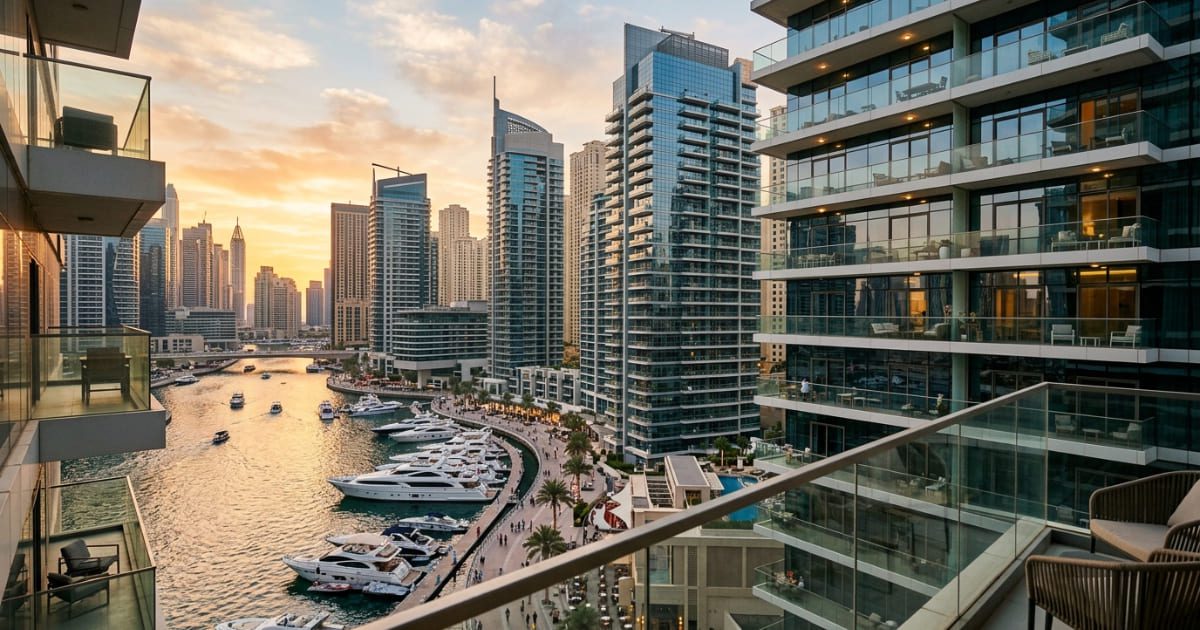
Dubai real estate is a good investment for the right investor with the right strategy in 2026 but not for everyone. Zero taxes, 5% to 9% rental yields, and 80% to 150% capital growth from 2020 to 2025 make the fundamentals compelling. High entry costs, supply concentration in affordable apartments, and liquidity risk make the wrong approach costly.
Most articles about Dubai property are written by people trying to sell you something. This one is not. First Call Real Estate works with buyers every day and part of that work involves telling people when Dubai real estate is not right for them.
So here is the honest position: Dubai property investment in 2026 is a strong “yes” for investors with the right profile, strategy, and time horizon. It is a clear “no” for others. Understanding the difference is what this guide is built to deliver.
Online forums and Reddit threads show real skepticism about Dubai property investors who bought the wrong building, held for too short a period, or trusted the wrong developer. That skepticism is not wrong. It reflects what happens when strategy is missing. The goal here is to give you the framework to make a genuinely informed decision.
The Investment Case For Dubai
The Zero Tax Advantage
Dubai’s tax structure is one of the most investor-friendly environments of any major global city. The numbers are straightforward:
- Zero property tax saves you 1% to 3% of your property’s value every year compared to holding in the UK, USA, or Australia
- Zero capital gains tax you retain 100% of your profit on sale (the UK charges 28%; the USA charges up to 20%)
- Zero inheritance tax your full estate transfers to heirs without deduction
These are not marginal advantages. Over a 10-year hold, the annual property tax saving alone can exceed the cost of acquisition.
Return Data
The Dubai real estate ROI data for the five years from 2020 to 2025 is difficult to argue with:
- Rental yields: 5% to 9% gross among the highest of any major global city
- Capital appreciation: 80% to 150% total return across communities during this period
- Q1 2026 transaction volume: AED 252 billion a 31% year-on-year surge, signaling sustained market confidence
- Foreign investment in Q1 2026: AED 148 billion institutional buyers from global markets, not just retail speculation
Structural Advantages
The Dubai property market 2026 is supported by structural drivers that go beyond short-term momentum:
- Population: 3.5 million residents growing at 4% annually consistent underlying housing demand
- Tourism: 17 million-plus visitors in 2025 direct driver of short-term rental demand
- USD peg: No currency risk for dollar-based investors since 1997
- Golden Visa: 10-year renewable residency for property investment of AED 2 million or more
- Diverse economy: Tourism, technology, finance, and logistics not oil-dependent
The Real Risks Agents Don’t Tell You
This section is where honest advisory separates itself from promotional content. These risks are real considerations for anyone buying property in Dubai and ignoring them is how investors lose money.
Supply Risk: The Biggest Current Risk in 2026
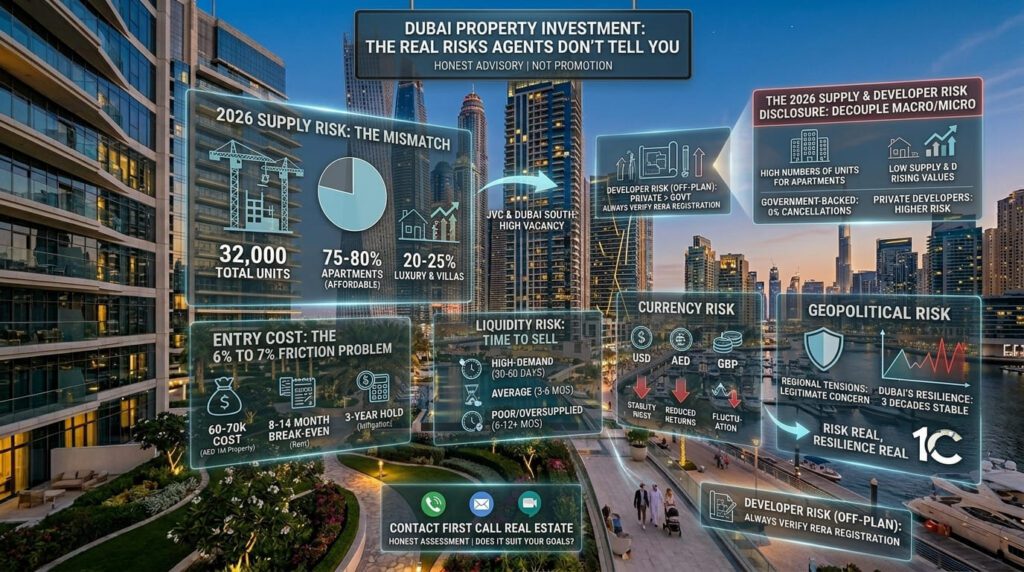
32,000 new residential units are expected for delivery in 2026. The critical detail: 75% to 80% of those units are apartments, concentrated in the affordable segment.
Jumeirah Village Circle (JVC) and Dubai South are showing increased vacancy in some buildings. The luxury and villa segment faces a very different supply picture constrained inventory and rising prices.
Mitigation: Buy in established buildings with verified low vacancy rates. Do not apply macro Dubai data to micro-market decisions.
⚠️ THE 2026 SUPPLY AND DEVELOPER RISK DISCLOSURE
Overseas investors must decouple macro Dubai data from micro-market realities. While the luxury and villa segments face severe supply constraints and rising values, the affordable apartment segment is absorbing the majority of the 32,000 new units scheduled for delivery in 2026. Investors allocating capital into off-plan projects must filter developers carefully. Government-backed entities like Emaar and Nakheel have zero historical cancellations. Private developers carry inherently higher execution and timeline risk.
Entry Cost: The 6% to 7% Friction Problem
Entry into Dubai real estate is not cheap:
- DLD transfer fee: exactly 4% non-negotiable
- Agent commission: 2% standard
- Registration and title deed fees: additional costs on top
On an AED 1 million property, your entry cost is AED 60,000 to AED 70,000 before you earn a single dirham. Break-even from rental income alone takes 8 to 14 months.
Mitigation: Plan a minimum three-year hold. Entry costs are not a problem they are a timing problem.
Liquidity Risk
Dubai is not as liquid as London or New York. Realistic timelines:
- Quality properties in high-demand areas: 30 to 60 days to sell
- Average or below-average properties: 3 to 6 months
- Oversupplied or poor-quality buildings: 6 to 12 months or longer
Mitigation: Buy quality in high-demand areas. Prioritize resale demand from day one, not just rental yield.
Currency Risk
The AED has been pegged to the USD since 1997 giving dollar-based investors full currency stability. British investors face a different calculation: GBP weakness reduces AED returns in sterling terms. European investors face EUR fluctuation risk on conversion.
Mitigation: Factor your home currency trajectory into your investment planning before committing.
Geopolitical Risk
Regional Middle East tensions periodically affect buyer sentiment and this is a legitimate concern, not something to dismiss. Dubai itself has remained peaceful and stable through every regional conflict since 1990. The Dubai property market continued growing during Gulf tensions in 2019 to 2020. Historical data shows recovery from every geopolitical concern.
First Call Real Estate’s assessment: regional risk is real. Dubai’s resilience over three decades is equally real.
Developer Risk for Off-Plan
Private developers carry more risk than government-backed developers. Emaar and Nakheel have zero historical project cancellations. Always verify RERA registration before any payment on off-plan property investment in Dubai.
Historical Perspective: Dubai’s 2008 and 2014 Crashes
Honest investors study crashes. Promotional content skips this section. Here is what actually happened.
The 2008 Dubai Crash
The 2008 crash combined the global financial crisis with Dubai World’s sovereign debt default. Prices dropped 50% to 60% from peak to trough. The investors hit hardest were speculative off-plan buyers and those carrying maximum leverage.
Recovery took approximately five to six years. Investors who bought on fundamentals between 2004 and 2006 recovered strongly over the long term. The lesson: over-leveraged speculative buying caused losses. Fundamental buyers recovered.
The 2014 to 2016 Correction
The 2014 correction was triggered by the collapse in oil prices, which reduced GCC wealth and regional buying power. Prices dropped 15% to 25% depending on segment. New all-time highs arrived between 2021 and 2023 within five to seven years of the trough. Long-term holders recovered. Short-term buyers suffered.
Why 2026 Is Different from 2007
The fundamentals that caused the 2008 crash are not present today:
- Regulatory framework: RERA, DLD, and escrow protection now provide meaningful buyer safeguards
- Economic base: Dubai is not oil-dependent tourism, tech, finance, and logistics drive growth
- Buyer profile: More institutional buyers, less speculative retail flipping
- Government planning: Dubai 2040 provides long-term structural demand visibility
- Population growth: Real housing demand from residents, not just speculation
Is Dubai Real Estate a Good Investment for You?
The answer depends on your profile, strategy, and time horizon. Here is the honest breakdown.
When Dubai Real Estate IS a Good Investment
- You plan to hold a minimum of three years entry costs recover and appreciation builds
- You are investing in the luxury or villa segment supply-constrained and most price-stable
- You are buying off-plan with a government-backed developer (Emaar or Nakheel only)
- You are investing in established high-demand areas: Downtown Dubai, Dubai Marina, Dubai Hills Estate
- You have liquid capital you are not at maximum leverage
- You plan short-term rental in a high-tourism area: Downtown, JBR, Marina, Palm Jumeirah
- You are a USD-based investor zero currency conversion risk
- You want a Golden Visa an AED 2 million-plus investment delivers 10-year residency
When Dubai Real Estate is NOT a Good Investment
- You need to exit within two years entry costs will likely eliminate your profit
- You are buying on FOMO without researching specific buildings and vacancy rates
- You are buying cheap apartments in oversupplied buildings
- You are using a private developer for off-plan without a verified delivery history
- You expect guaranteed returns no investment anywhere delivers that
- You cannot afford the total entry cost including all DLD and registration fees
- You are speculating with borrowed money in a moderating market
- You have no property management plan in place
The Verdict by Investor Profile
No competitor breaks this down at the building and profile level. This is the honest verdict.
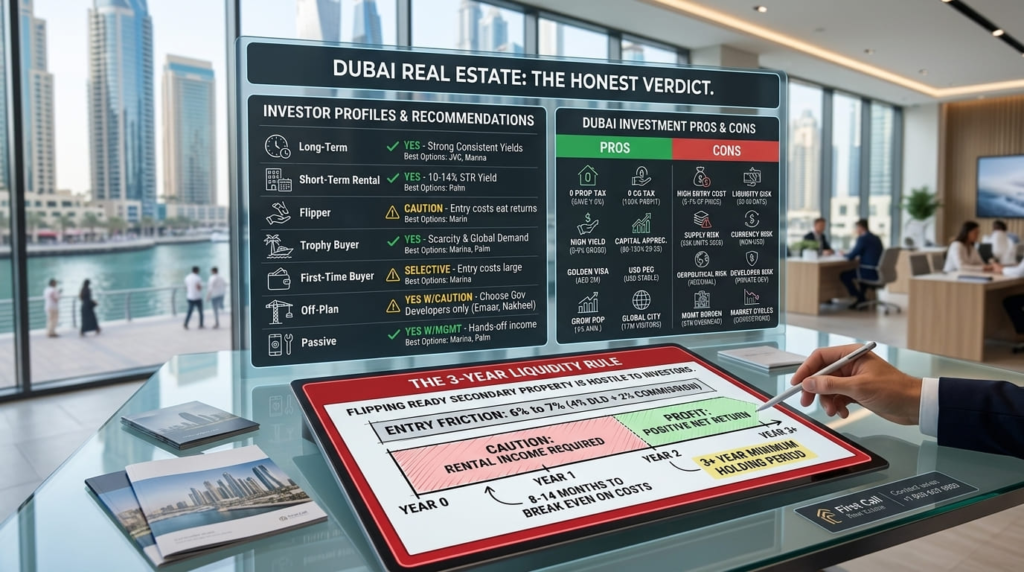
Table 1: Is Dubai Investment Right for You?
| Investor Profile | Answer | Reason | Best Option |
| Long-term yield (3+ years) | Yes | Strong consistent yields | JVC, Dubai South apartments |
| Capital growth (long-term) | Yes | Proven 80–150% five-year return | Dubai Hills, Palm Jumeirah |
| Short-term flipper (under 2 years) | Caution | Entry costs eat returns | Not recommended broadly |
| STR holiday let investor | Yes | 10–14% STR yield achievable | Downtown, Marina, JBR |
| UHNW trophy asset buyer | Yes | Scarcity and global demand | Palm Jumeirah, Emirates Hills |
| First-time buyer under AED 500K | Selective | Entry costs proportionally large | JVC established buildings only |
| Off-plan early stage investor | Yes with caution | Choose government developers only | Emaar, Nakheel only |
| Passive overseas investor | Yes with management | Hands-off income possible | Established managed buildings |
Table 2: Dubai Real Estate Investment: Pros and Cons
| Pro | Data | Con | Data |
| Zero property tax | Saves 1–3% annually | High entry costs | 6–7% of purchase price |
| Zero capital gains tax | 100% profit retained | Liquidity risk | 30–60 days best case |
| High rental yield | 5–9% gross | Supply risk (specific segments) | 32,000 new units in 2026 |
| Capital appreciation | 80–150% from 2020–2025 | Currency risk | Non-USD investors |
| Golden Visa eligibility | AED 2M qualifies | Geopolitical risk | Regional uncertainty |
| USD peg stability | No currency risk for USD investors | Developer risk | Private developers |
| Growing population | 4% annually | Management burden | STR requires active oversight |
| Global city and tourism | 17M visitors in 2025 | Market cycles | Corrections do happen |
The 3-Year Liquidity Rule
Short-term flipping on ready secondary properties in the Dubai real estate market is mathematically hostile to the investor. Buyers face an immediate 6% to 7% entry friction comprising the mandatory 4% DLD transfer fee and standard 2% agency commission. A property must generate 8 to 14 months of pure rental income just to break even on acquisition costs. A minimum holding period of three years is required to allow capital appreciation and rental yield to generate a positive net return.
For Dubai property investment for foreigners and an assessment of current Dubai rental market conditions by area, speak to a First Call Real Estate specialist who will tell you honestly whether Dubai investment is right for you.
Exit Strategy: How to Get Your Money Out
Most agent-led content never covers this. Here is exactly how a Dubai property sale works.
The Secondary Market Process: Step by Step
- List through a RERA-registered agent this is a legal requirement, not a preference
- Receive offers negotiate and agree on a price
- Sign Form F (MOU) with the buyer the buyer secures a 10% deposit at this stage
- Obtain NOC from your developer typically 5 to 15 business days
- Complete the DLD transfer receive your sale proceeds
Total timeline for a quality property in a high-demand area: 30 to 60 days.
Liquidity Factors That Affect Sale Speed
- Location: Downtown Dubai and Dubai Marina sell fastest 30-day average
- Quality: Premium buildings with strong management sell faster
- Pricing: Realistic pricing based on current market, not 2025 peak expectations
- Developer brand: Emaar properties command a buyer premium and sell fastest
Off-Plan Resale Before Handover
Some off-plan contracts allow resale before handover check your Sale and Purchase Agreement (SPA) carefully. A pre-handover sale allows you to sell appreciated value before receiving keys. The Oqood transfer process applies here this differs from a Title Deed transfer and requires specific documentation.
The Tax Advantage on Exit
- Zero capital gains tax you keep 100% of your profit
- Zero withholding tax immediate access to sale proceeds
- No repatriation restrictions transfer proceeds to any country freely
Is Dubai Real Estate a Good Investment in 2026? The Verdict.
Dubai real estate is a good investment in 2026 for investors who approach it with the right strategy, the right time horizon, and the right building selection. The luxury and villa segments represent a strong yes. Established yield-focused communities like JVC and Dubai South represent a selective yes for the right buyer. Affordable apartments in oversupplied buildings without verified occupancy data represent a clear no.
The risks covered in this guide entry costs, liquidity, supply concentration, and developer selection are not footnotes. They are the variables that determine whether you make money or lose it. The Reddit skeptics who report bad experiences are not wrong about Dubai. They are right about what happens when strategy is absent.
First Call Real Estate’s position is simple: we tell you when not to buy. That is what makes our yes mean something.
Book an honest, personalized investment assessment with First Call Real Estate. | Browse current property listings
Frequently Asked Questions
Is Dubai real estate a good investment in 2026?
Yes for the right investor with the right strategy. Strong fundamentals, zero taxes, and 5% to 9% rental yields make Dubai compelling for long-term holders. The answer is no for short-term flippers, over-leveraged buyers, and investors choosing oversupplied apartment segments without building-level research.
What are the disadvantages of buying property in Dubai?
Entry costs of 6% to 7% of purchase price are the first hurdle. Beyond that, liquidity is limited compared to London or New York, supply risk is concentrated in the affordable apartment segment, and private developer off-plan carries execution risk. Currency risk is real for British and European investors.
Is it safe to invest in Dubai real estate?
The regulatory framework is strong. RERA oversight, DLD registration requirements, and mandatory escrow accounts for off-plan payments provide meaningful buyer protection. Emaar and Nakheel, both government-backed developers, have zero historical project cancellations. Choosing the right developer and the right building removes most of the execution risk.
Is Dubai property overhyped?
Some hype exists particularly around off-plan launches marketed with inflated yield projections. The fundamentals, however, are verifiable: population growing at 4% annually, 17 million tourists in 2025, zero capital gains tax, and Q1 2026 transactions of AED 252 billion. Market moderation in 2026 is healthy, not a signal of collapse.
Will Dubai property prices crash in 2026?
A crash is not supported by the current data. Moderation slower price growth in specific segments is already visible and expected. The 2026 market has structural differences from 2007: stronger regulation through RERA and escrow, a diverse non-oil economy, and institutional rather than purely retail capital driving transactions.
Is it worth investing in Dubai real estate now?
For luxury properties and villas: yes. Supply is constrained in these segments and values are stable. For affordable apartments: selective. Entry at current moderation levels may outperform 2025 peak-price entry, but building selection matters more than ever. Work with an agent who will show you vacancy rate data, not just advertised yields.
What are the risks of investing in Dubai property?
The six primary risks are: supply concentration in the affordable apartment segment, high entry costs at 6% to 7% of purchase price, limited liquidity compared to global gateway cities, currency conversion risk for non-USD investors, developer execution risk for private off-plan projects, and normal market cycle risk. All are manageable with the right strategy.
When is Dubai real estate NOT a good investment?
Dubai real estate is not a good investment if you need to exit within two years, are buying in an oversupplied building without checking vacancy rates, are using a private developer for off-plan without a verified delivery track record, or are entering with maximum leverage. Entry costs alone ensure that short-hold strategies will struggle to generate positive returns.