Dubai Property Market 2026: Data, Trends & What to Do Now

The Dubai property market 2026 opened with AED 252 billion in Q1 transactions, a 31% year-on-year surge and the strongest Q1 on record. April then recorded a 1.76% month-on-month price decline, the first cooling signal of the year. This article breaks down what both data points mean for buyers, owners, and investors, segment by segment.
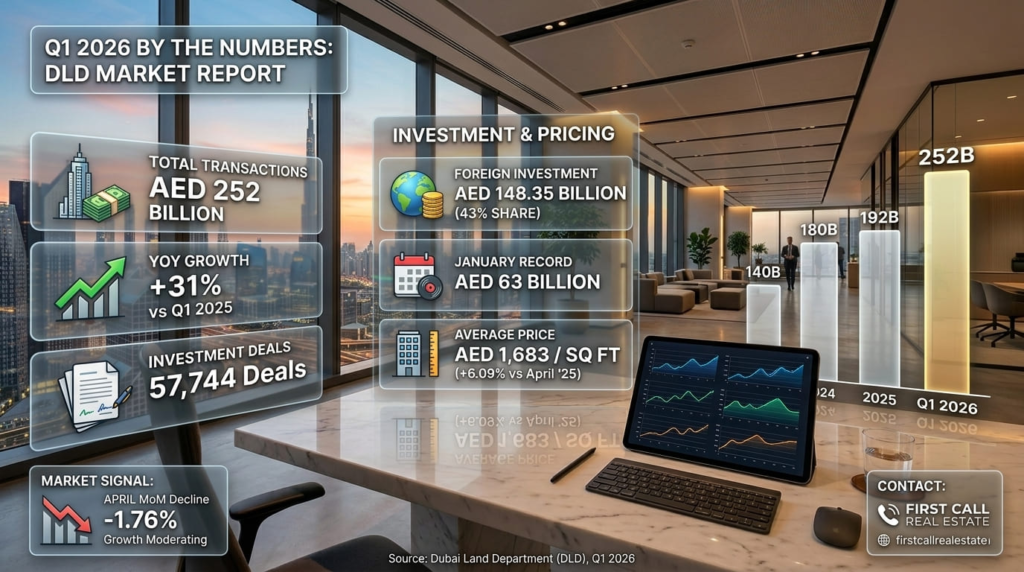
The numbers from Q1 2026 are hard to ignore. The Dubai property market 2026 generated AED 252 billion in total transactions, the strongest Q1 in Dubai’s recorded history, representing a 31% year-on-year increase over Q1 2025. Foreign investment reached AED 148.35 billion, January alone cleared AED 63 billion, the highest single month ever recorded by the Dubai Land Department (DLD).
Then April arrived. Prices dipped 1.76% month-on-month the first cooling signal of the year.
That is the paradox this article addresses directly. Record-breaking headline data sits alongside the first signs of moderation. Most market commentary picks one side of that story. This article does not. What follows is a data-led breakdown for buyers evaluating entry timing, existing owners assessing their position, and investors who have been waiting on the sidelines for clarity.
For context on the broader investment case, see our guide to Dubai property investment.
Q1 2026 by the Numbers: What the DLD Data Actually Shows
The DLD figures for Q1 2026 are unambiguous. AED 252 billion in total transactions. A 31% year-on-year increase against Q1 2025. 57,744 individual investment deals completed. Foreign investment reached AED 148.35 billion up 29% year-on-year representing 43% of total market activity. January 2026 alone posted AED 63 billion, a single-month record that no prior year has matched.
The average price per square foot at the end of Q1 stood at AED 1,683 still 6.09% above April 2025 levels.
Here is the key update. March and April showed softer activity. April recorded a 1.76% month-on-month price decline the first of 2026. That figure does not erase the Q1 record, but it signals that the base effect from 2025’s own record performance is beginning to compress year-on-year growth rates.
Table 2 — Dubai Property Market: Historical Comparison
| Metric | 2023 | 2024 | 2025 | 2026 Q1 |
| Total Transactions Value | AED 140B | AED 180B | AED 192B | AED 252B (Q1) |
| YoY Growth | 28% | 22% | 15% | 31% Q1 |
| Average Price per sq ft | AED 1,250 | AED 1,400 | AED 1,580 | AED 1,683 |
| Foreign Investment Share | 35% | 38% | 40% | 43% |
| Off-Plan Share | 50% | 55% | 58% | 62% |
| Villa Price Growth | 25% | 20% | 22% | 18% Q1 |
| Apartment Price Growth | 18% | 15% | 12% | 6% Q1 |
Source: Dubai Land Department, Q1 2026
The trajectory is clear: growth rates are moderating from a high base. That is a structural correction in pace, not a reversal of direction.
Contact First Call Real Estate for a current market assessment on your preferred Dubai property.
Dubai Property Market 2026: Segment by Segment
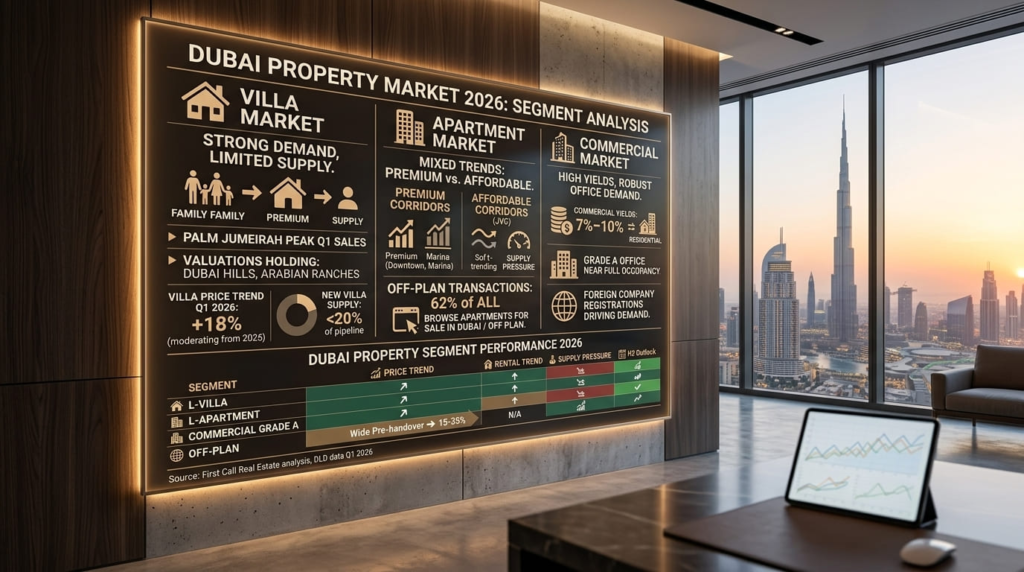
Dubai is not one market. It is several, each behaving differently in 2026. Treating the AED 252 billion headline as a single trend line will produce the wrong investment thesis.
Villa segment. Demand still outpaces supply. Palm Jumeirah recorded peak Q1 2026 sales. Dubai Hills and Arabian Ranches are holding value. Dubai villa prices are up 18% in Q1 moderating from the 22% pace recorded in 2025 but firmly positive. New villa supply represents under 20% of the total 2026 pipeline. That structural imbalance keeps values supported. See current villa for sale in Dubai listings.
Apartment segment. The picture is more mixed. Downtown Dubai and Dubai Marina are holding value under strong rental and purchase demand. JVC and more affordable corridors face pressure from new supply concentration. Off-plan apartments now represent 62% of all 2026 Dubai transactions a record share. Browse apartments for sale in Dubai and off plan property Dubai for current availability.
Commercial segment. Grade A office space in Business Bay and DIFC is approaching full occupancy. Commercial yields of 7%–10% are outperforming residential yields across most sub-markets. Foreign company registrations are driving consistent office demand, and that trend shows no signs of slowing.
Table 1 — Dubai Property Market Performance by Segment 2026
| Segment | Price Trend | Rental Trend | Supply Pressure | H2 2026 Outlook |
| Luxury villas AED 10M+ | Strong 20–30% | Rising 8–12% | Very low | Continued growth |
| Mid villas AED 3M–10M | Moderate 15–20% | Stable 5–8% | Low | Stable to positive |
| Affordable villas AED 2M–4M | Stable 10–15% | Stable 4–6% | Limited | Stable |
| Luxury apartments AED 3M+ | Strong 20–28% | Rising 8–12% | Low | Positive |
| Mid apartments AED 1M–3M | Moderate 10–18% | Stable 4–6% | Moderate | Cautious positive |
| Affordable apartments AED 500K–1M | Slowing 5–10% | Soft 2–4% | High | Mixed |
| Off-plan (all types) | 15–35% pre-handover | N/A | Growing | Positive demand |
| Commercial Grade A | Strong 10–15% | Rising 8–12% | Limited | Very positive |
Source: First Call Real Estate analysis, DLD data Q1 2026
The Supply Pipeline: 32,000 New Units and What That Means
The 2026 Supply Imbalance Rule: While top-line data shows a record-breaking AED 252 billion Q1, astute investors must segment the market by supply to understand future pricing. With 32,000 new units scheduled for delivery in 2026, 75%–80% of this pipeline consists of apartments. Consequently, the villa segment representing under 20% of new supply continues to experience strong upward price pressure, whereas select affordable apartment corridors face localized vacancy risks and softening yields.
32,000 new residential units are scheduled for delivery in 2026 the largest annual supply pipeline in recent memory. The composition matters more than the headline number.
Key delivery areas include JVC, Dubai South, and Business Bay all apartment-heavy. Over 200 active projects are currently registered with RERA in 2026. Emaar, Nakheel, and Damac are all running active launch programs; over 100 new off-plan projects launched in H1 2026 alone, signalling high developer confidence.
Not all new supply absorbs at the same pace. Quality-build projects in prime locations clear faster than affordable stock in oversupplied corridors. Building-level vacancy data not suburb-level summaries is the metric that matters when evaluating an affordable apartment purchase in 2026.
For location-specific guidance, see our analysis of the best areas to invest in Dubai.
Dubai Rental Market 2026: Moderating, Not Falling
The rental market is stabilising. That is not the same as declining.
Overall rental growth is tracking at 5%–8% year-on-year a meaningful step down from the 15%–20% pace recorded in 2024, but still firmly positive. The direction has not changed; the speed has.
Villa rentals remain strong. Limited supply keeps upward pressure on rents across Palm Jumeirah, Dubai Hills, and Arabian Ranches. Luxury rentals above AED 200,000 per year are still growing at 8%–12%.
Affordable apartment rents in the AED 40,000–80,000 range are showing softness in buildings with high vacancy, particularly in JVC and Dubai South where new supply is concentrated.
Short-term rental performance tells a different story. Dubai received 17 million tourists in 2026, sustaining STR occupancy rates of 80%–90% in peak seasons across tourist-facing areas. For investors with properties in Marina, Downtown, or Palm Jumeirah, that pipeline of visitors is a structural income driver.
Further analysis is available in our dedicated guide to the Dubai rental market.
Who Is Buying in Dubai in 2026?
Foreign investment reached AED 148.35 billion in Q1 2026 43% of total market transactions, up 29% year-on-year.
The buyer nationality breakdown breaks down as follows:
- Indian buyers: 22% of foreign investment the largest single group
- British buyers: 15% second largest
- Russian buyers: 12% third largest
- European buyers: 10% collectively share growing
- Chinese buyers: 8% the fastest-growing segment by pace
- Pakistani buyers: 7%
- GCC buyers (including UAE nationals): 25% of total investment
Two structural forces are driving this demand. The Golden Visa program is attracting long-term investor buyers seeking UAE residency through property ownership. Separately, global geopolitical instability is pushing high-net-worth capital toward stable, dollar-pegged markets and Dubai sits at the top of that list.
For a deeper analysis of the investment case, see is Dubai real estate a good investment.
H2 2026 Outlook: What First Call Real Estate Expects
Dubai’s property market 2026 is entering a period of selective growth not broad deceleration. The distinction matters for how you position capital in the second half of the year.
What supports continued growth in H2:
- Foreign investment inflows remain structurally high AED 148.35 billion in one quarter is not a temporary spike
- Luxury and villa segments face no meaningful supply increase through year-end
- Off-plan demand is being met by developer launches, not accumulating unsatisfied
- Tourism growth sustains short-term rental performance across key areas
What requires close monitoring in H2:
- 32,000 unit deliveries concentrated in affordable apartment corridors building-level vacancy matters more than suburb-level averages
- April’s 1.76% month-on-month decline signals that the base effect from 2025’s record performance is beginning to compress growth rates
- Rental affordability in affordable segments is approaching the ceiling of what many tenants can sustain
⚠️ THE Q2 MARKET MODERATION DISCLOSURE:
Investors extrapolating 2024 and 2025 growth curves into 2026 must adjust their underwriting. While Q1 2026 set an all-time transactional record, April 2026 recorded a 1.76% month-on-month price decline the first cooling signal of the year. This represents a healthy stabilisation from previous record base effects. Buyers now have increased negotiation leverage, particularly in the affordable apartment sector, and must mandate building-level vacancy data from their broker before committing capital.
First Call Real Estate H2 2026 forecast by segment:
- Luxury villas and apartments: 10%–15% H2 appreciation continued growth
- Mid-range apartments: 5%–8% growth stable
- Affordable apartments: mixed building selection is the deciding variable
- Off-plan with government-backed developers: strong entry point, particularly Emaar and Nakheel
- Rental market: 3%–5% positive growth in H2 price competitively to retain tenants
For return benchmarks and yield data, see our analysis of Dubai real estate ROI.
Investor Action Guide: What to Do in Current 2026 Market Conditions
Dubai real estate investment decisions in 2026 require a segment-specific approach. The headline data no longer tells the full story. Here is the guidance based on where you sit.
If you are buying now. Luxury and villa segments act now. Supply is constrained and prices are not pausing at this tier. For off-plan, prioritise Emaar and Nakheel government backing reduces delivery risk meaningfully. For affordable apartments, require building-level vacancy data before committing. Market moderation in Q2–Q3 gives you more negotiating room than 2025 ever offered use it.
If you are an existing owner. Hold premium and luxury assets the appreciation cycle at this tier has not ended. If you own a high-service-charge building in an oversupplied corridor, review whether the carry cost justifies the position. On the rental side, price competitively. Losing a quality tenant in a softening sub-market costs more than a modest rent reduction.
If you have been waiting for a correction. The moderation you were waiting for has arrived not a crash, a correction in pace. Quality properties still move quickly. Q3 and Q4 2026 may offer a small seasonal pricing window, particularly in mid-range apartments. Do not expect broad discounts in supply-constrained segments. Use the data to be selective, not to stay on the sideline indefinitely.
Conclusion: The Dubai Property Market 2026 — Where the Opportunities Are
The Dubai property market 2026 opened with the strongest Q1 on record. It is now moderating. That is a healthy adjustment, not a warning signal and the data supports that conclusion clearly.
Not all segments are equal in this environment. Luxury villas and prime apartments remain supply-constrained and continue to appreciate. Affordable apartments require careful building-level selection in a year when 32,000 new units are entering the market. Commercial Grade A is performing at a tier above most residential yields.
First Call Real Estate’s position is straightforward: quality over volume. Fewer premium units in supply-constrained locations will consistently outperform broader affordable apartment exposure in 2026’s specific supply environment.
The data is clear. The segments with opportunity are identifiable. What varies is execution knowing which building, which community, and which entry point makes the difference between a good investment and a great one.
Browse Dubai property listings with First Call Real Estate | Book a private consultation with a First Call Real Estate specialist
Frequently Asked Questions: Dubai Property Market 2026
What is the Dubai property market doing in 2026?
Q1 2026 set a record: AED 252 billion in transactions, a 31% year-on-year surge against Q1 2025, with 57,744 individual investment deals completed. From April, the market has shown moderation with a 1.76% month-on-month price decline. Year-on-year prices remain 6.09% above April 2025 levels. Segment performance varies significantly between villas, apartments, and commercial.
Are Dubai property prices dropping in 2026?
Not broadly. April recorded a 1.76% month-on-month price decline the first of 2026. Year-on-year, prices remain 6.09% higher than April 2025. Luxury villas and prime apartments continue to appreciate. Affordable apartment sub-markets face more pressure from new supply entering high-concentration corridors like JVC and Dubai South.
Is it a good time to buy property in Dubai in 2026?
Yes for buyers targeting luxury and villa segments, where supply is structurally constrained. For affordable apartments, the answer depends on the specific building and its current vacancy rate. Market moderation in Q2–Q3 gives buyers more negotiating leverage than 2025 offered at any point.
What is the forecast for Dubai real estate in H2 2026?
Continued growth of 10%–15% in luxury and villa segments; 5%–8% in mid-range apartments; mixed results in affordable apartments depending on supply concentration. The rental market is forecast to post 3%–5% positive growth in H2. Overall, 2026 is tracking toward a full-year record despite Q2 moderation.
How much did Dubai property transactions reach in Q1 2026?
AED 252 billion the strongest Q1 in Dubai’s recorded history, representing a 31% increase over Q1 2025. The DLD recorded 57,744 individual investment deals in the quarter, with AED 173 billion classified as investment transactions.
Which Dubai property segment is performing best in 2026?
Luxury villas and Grade A commercial are leading on both price growth and yield. Luxury villas are posting 20%–30% price growth with rental yields rising 8%–12%. Grade A commercial in Business Bay and DIFC is approaching full occupancy, with yields of 7%–10% outperforming residential across most sub-markets.
Is the Dubai rental market rising or falling in 2026?
Rising, but at a slower pace. Overall rental growth is tracking at 5%–8% year-on-year, down from 15%–20% in 2024. Villa rents remain strong across Palm Jumeirah, Dubai Hills, and Arabian Ranches. Affordable apartment rents in high-supply corridors such as JVC and Dubai South are softening in buildings with elevated vacancy.
What is driving Dubai property market growth in 2026?
Four primary drivers: foreign investment reaching AED 148.35 billion in Q1 alone (up 29% year-on-year), the Golden Visa program attracting residency-linked buyers, global geopolitical instability directing high-net-worth capital toward stable markets, and 17 million tourists sustaining STR occupancy rates of 80%–90% in peak seasons.