

Living in Palm Jumeirah: 2026 Costs, Rents & Honest Review
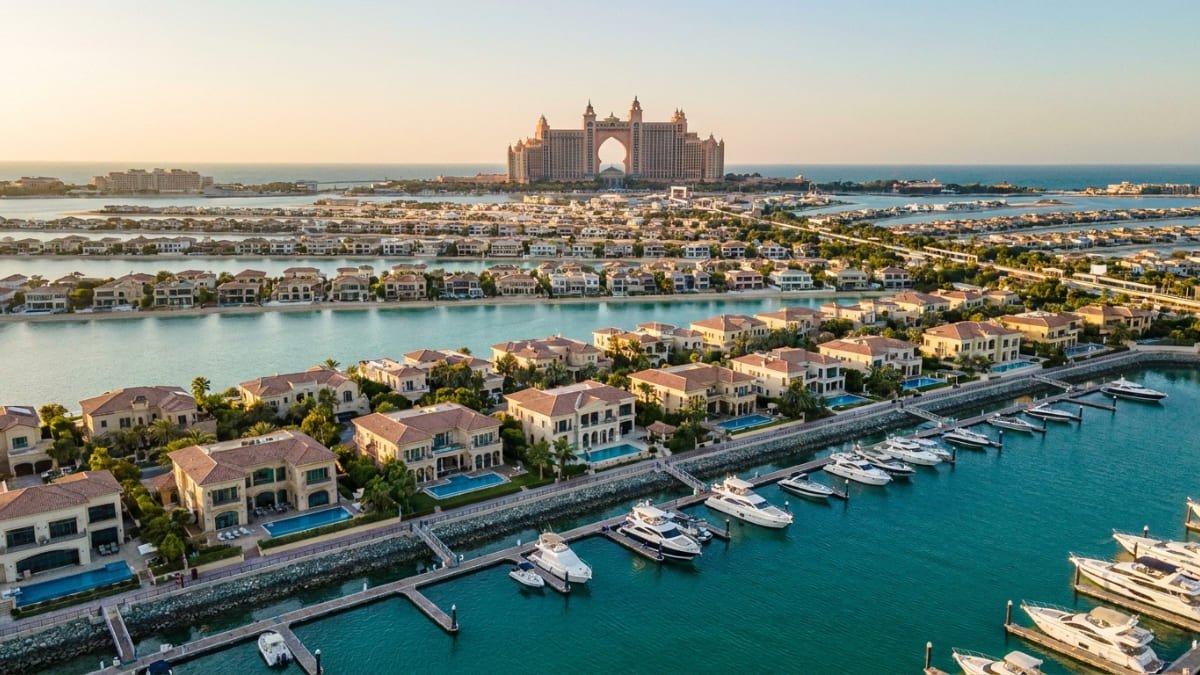
Quick Answer: Living in Palm Jumeirah means island life on a Nakheel-built, man-made archipelago: apartments on the trunk and crescent, villas on the fronds, beaches and hotels on your doorstep, and Nakheel Mall and The Pointe for daily needs. In 2026 it is a split market. DLD-based data shows apartments averaging about AED 3,087 per sqft in Q3 (down 5.4% year on year) while villas average about AED 7,900 per sqft (up about 10.6%). A one-bedroom apartment rents for roughly AED 146,000 a year. There is no metro station on the island, so most residents drive or use the monorail and tram. Major schools are on the mainland, mainly in Al Sufouh and Al Barsha. Last checked: 27 Oct 2026.
Palm Jumeirah is the most recognisable address in Dubai, and also one of the most misunderstood. It isn’t one market. A trunk apartment and a frond villa have very different prices, trends and lifestyles, and many online guides blend them into a single average.
This guide separates the two, shows the numbers with their sources and dates, and gives you an honest list of trade-offs, including the ones brochures skip: no metro on the island, schools on the mainland, and a premium that doesn’t always show up in the rental yield. It’s written for people deciding whether to rent or buy here, or comparing it with other communities. For the wider picture, see our guides to the best communities to live in Dubai and the best communities to invest in.
Key Takeaways
- Two markets, two trends. Apartment prices softened in Q3 2026, while villa prices kept rising.
- No metro on the island. The Palm Monorail connects the entrance to Atlantis, and a tram link leads to the Red Line.
- Schools are mostly on the mainland. The island has nurseries, but families drive to Al Sufouh or Al Barsha for school.
- Yields are modest. Apartments gross about 3.9–4.4% on current data, well below mid-market areas.
- It’s a lifestyle purchase. Beaches, hotels and views are the draw, not the yield.
- Check the numbers behind the headlines. Published figures vary, so we show the range and the reasons.
What Is Palm Jumeirah?
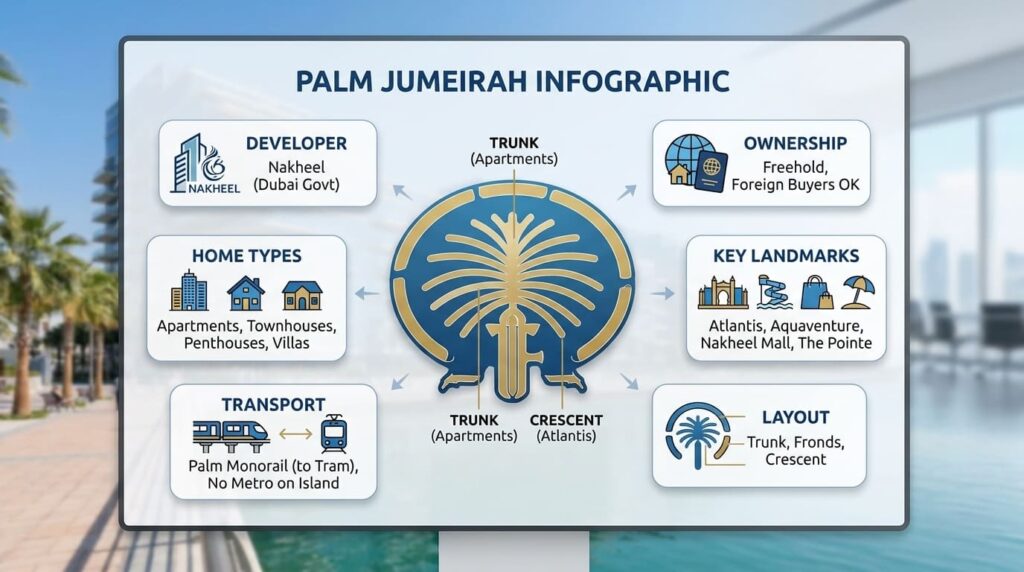
Palm Jumeirah is an artificial archipelago created by land reclamation and developed by Nakheel, a company owned by the Dubai government. It is shaped like a palm tree: a trunk with apartment buildings, about 16–17 fronds lined with villas, and a crescent around the outside that includes Atlantis, The Palm. It is freehold and open to foreign buyers.
| Detail | Palm Jumeirah |
| Developer | Nakheel |
| Layout | Trunk, fronds (about 16–17, depending on how they’re counted) and crescent |
| Home types | Apartments, townhouses, penthouses, signature villas and garden homes |
| Ownership | Freehold; open to foreign buyers |
| Key landmarks | Atlantis The Palm, Aquaventure, Nakheel Mall, The Pointe, beach clubs |
| Public transport | Palm Monorail (5.5 km), linked to the Dubai Tram; no metro station on the island |
Frond counts differ between guides. Property details change, so confirm on the title documents.
Is Palm Jumeirah a Good Place to Live?
For many people, yes, if you value the waterfront lifestyle and accept the premium. It offers sea views, beach access, hotels and dining, and a polished, international community. The trade-offs are cost, the lack of a metro, and the fact that schools are on the mainland.
Who It Suits
- Professionals and couples who want beachfront living close to the Marina and Al Sufouh
- Luxury buyers who want a frond villa with private beach access
- Households that value hotel-style amenities and dining
- Owners who can hold long term and aren’t chasing the highest yield
Who It Doesn’t Suit
- Families who want schools next door
- People who rely on public transport
- Investors seeking maximum rental yield
- Anyone who dislikes tourist crowds, especially near the hotels
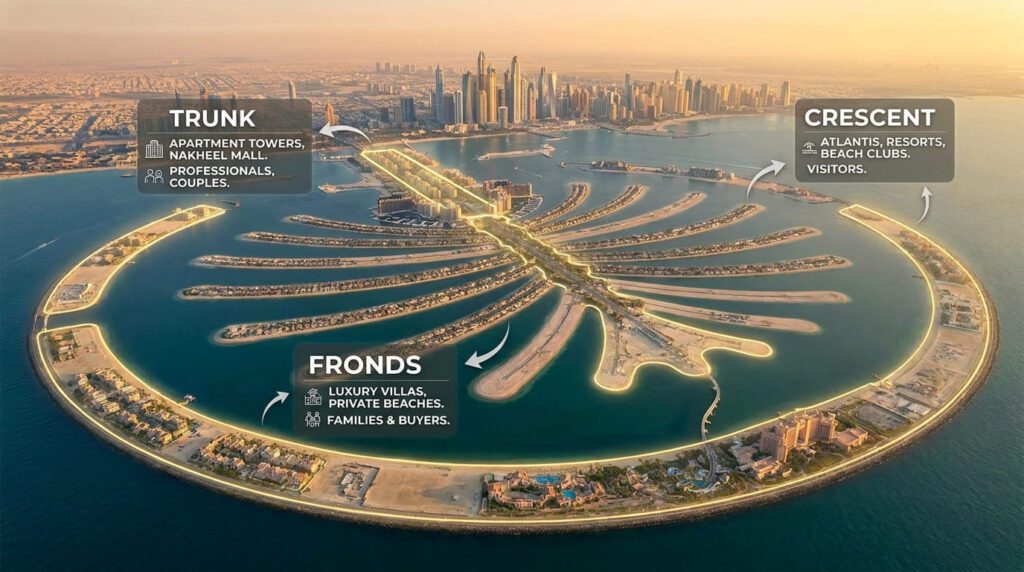
Trunk, Fronds and Crescent Explained
| Zone | What’s There | Typical Resident |
| Trunk | Apartment towers, low-rise buildings, hotel apartments, Nakheel Mall, shoreline apartments | Professionals, couples, investors, short-stay guests |
| Fronds | Villas, many with private beach access; some mansion-sized homes with more than seven bedrooms | Families and luxury buyers |
| Crescent | Atlantis The Palm, Aquaventure, hotels and beach clubs | Visitors, with some branded residences |
Palm Jumeirah Prices in 2026: A Split Market
DLD-based figures from Property Monitor, published by Metropolitan, show the divide:
| Property Type | Average Price per sqft | Change vs a Year Earlier |
| Apartments (H1 2026) | AED 3,252 | Up about 3% |
| Apartments (Q3 2026) | AED 3,087 | Down about 5.4% |
| Villas (Q3 2026) | About AED 7,938 | Up about 10.6% |
Source: Property Monitor and Metropolitan resale reports, based on DLD registrations. Averages mix building types and conditions.
Other measures point the same way. ValuStrat’s August 2026 index, as reported by Dubai Chronicle, showed Palm Jumeirah apartments down about 8.6% year on year, while Knight Frank’s prime index showed Dubai prime homes up about 10.9% to June. In other words, ultra-prime and villa stock has held up much better than apartment stock.
Why Price Figures Differ
You’ll see Palm apartments quoted anywhere from about AED 3,000 to AED 4,000 per sqft. For example, REIDIN put apartments at AED 3,202 per sqft and villas at AED 6,464 per sqft in Q2 2026, while dubizzle’s H1 2026 report, which is based on asking prices in a luxury-heavy sample, shows AED 4,036 per sqft for apartments and AED 6,137 for villas. The gap comes from three things: asking vs registered prices, which period is used, and which buildings are included. Always check the method before comparing a figure to a listing.
For a sense of listing prices, dubizzle’s H1 2026 averages were about AED 3.72 million for a one-bedroom, AED 7.03 million for a two-bedroom and AED 12.51 million for a three-bedroom apartment, and about AED 32.8 million, AED 51.9 million and AED 63.7 million for four-, five- and six-bedroom villas. These are asking averages, not registered sales.
Buying Costs
- DLD transfer fee: 4% of the price, plus a small administration fee.
- Agency commission: typically 2% plus VAT.
- Service charges: published guides quote anything from about AED 18 to AED 45 per sqft per year, depending on the building, so ask for the exact statement.
- Mortgage and valuation costs if you’re financing.
If you’re comparing premium apartments, see our luxury apartments buyer guide and our guide to Burj Khalifa Residences.
Rent in Palm Jumeirah
Engel & Völkers’ May 2026 data puts the average one-bedroom rent on the Palm at about AED 146,300 a year, higher than Downtown Dubai (about AED 120,300) and Dubai Marina (about AED 97,400).
Metropolitan’s data shows average apartment rents of about AED 131 per sqft per year in Q3 2026 (down about 4.4% year on year) and AED 142 in H1 2026 (up about 2.9%). Applying that to typical sizes gives a rough guide:
| Apartment Size | Implied Annual Rent (at AED 131–142/sqft) |
| About 600 sqft (studio) | AED 78,600 – 85,200 |
| About 1,000 sqft (1-bed) | AED 131,000 – 142,000 |
| About 1,500 sqft (2-bed) | AED 196,500 – 213,000 |
Illustrative arithmetic, not a published rent table. Rents vary widely by building, view and furnishing. Villa rents vary too widely for a single average, so ask for recent registered contracts.
To compare with the rest of the city, see our average rent in Dubai guide, and for renewals and Ejari, our Dubai rental market guide.
Rental Yields on Palm Jumeirah
Palm Jumeirah rewards patient capital more than it rewards cash flow. dubizzle’s H1 2026 report estimated an ROI of about 3.91% for apartments and 4.05% for villas, and dividing Metropolitan’s rent per sqft by its price per sqft gives about 4.2–4.4% gross for apartments. That is our own calculation. Some guides quote 4.5–6.5%, but those figures come from sources that don’t show their method. After service charges, which can be high, net yields are lower still.
If yield is your priority, compare it with our best areas to invest in Dubai. If you’re considering holiday letting instead, that is a different regime; read our short-term rental guide.
Beaches, Beach Clubs and Outdoor Life
Outdoor life is the main reason people pay the premium. Frond villas typically have private beach access, and many trunk buildings sit on the shoreline. Beach clubs along the island offer day passes, memberships and dining, and some accept non-residents. Prices vary widely, so check the current rates and rules.
Atlantis and Aquaventure anchor the crescent, and the boardwalk and waterfront promenades are popular for walking and running. Water sports, yacht charters and marinas are all easy to find.
Dining, Shopping and Daily Life
- Shopping: Nakheel Mall and The Pointe on the trunk and crescent cover daily needs, dining and entertainment.
- Dining: Atlantis and The Pointe host a wide range of restaurants, and many hotels have their own.
- Community feel: Because many apartments are used as holiday lets, parts of the trunk can feel transient. Villa fronds are quieter and more residential.
Schools and Nurseries
The island itself has nurseries, but few or no major schools. Most families drive to the mainland.
| School | Location | Notes |
| Dubai College | Al Sufouh | British, ages 11–18, a short drive via Al Sufouh Road |
| GEMS Wellington International School | Al Sufouh 1 | British curriculum |
| International School of Choueifat | Al Sufouh 2 | Nearby option |
| Kings’ School Al Barsha | Al Barsha | British curriculum, reachable via the mainland roads |
| GEMS Dubai American Academy | Al Barsha | American curriculum |
| JESS (Jumeirah English Speaking School) | Jumeirah | British; several campuses |
Lists differ between guides, and ratings, fees and seat availability change. Check KHDA and each school directly before you choose a home, and join waiting lists early.
Nurseries on or near the island include several in Golden Mile and on the trunk, plus branches such as Jumeirah International Nurseries. The school run is the main family trade-off, so test the commute at peak hours.
Healthcare
The Palm has medical clinics and centres, but full hospitals are on the mainland, mainly in Al Barsha and Jumeirah. Before you choose a home, check your nearest 24-hour emergency option and the route to it at different times of day.
Getting Around: Roads, Monorail, Tram and Metro
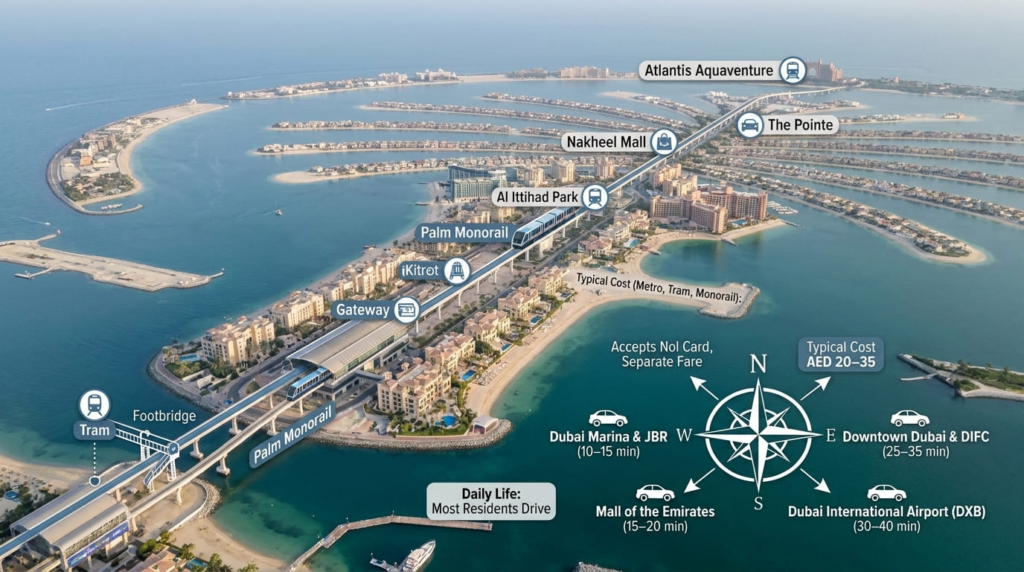
There is no metro station on Palm Jumeirah. The island’s only public transport line is the Palm Monorail, a 5.5 km elevated line from Palm Gateway at the entrance to Atlantis Aquaventure, with stops including Al Ittihad Park, Nakheel Mall and The Pointe.
| Route | How It Works |
| Monorail | Gateway to Atlantis Aquaventure. It accepts a nol card but charges a separate fare, with no free transfer from the tram or metro. |
| Tram to monorail | The Dubai Tram stops at Palm Jumeirah station, with a footbridge to Palm Gateway Station. |
| Metro to tram | Red Line to Sobha Realty (connects to the Dubai Marina tram stop) or DMCC (connects to the JLT tram stop), then the tram to Palm Jumeirah. |
| Typical cost | Portal guides estimate about AED 20–35 for the metro, tram and monorail combined. |
For daily life, most residents drive. Approximate drive times in normal traffic, which vary a lot at peak hours:
| Destination | Approx. Drive Time |
| Dubai Marina and JBR | About 10–15 minutes |
| Mall of the Emirates | About 15–20 minutes |
| Downtown Dubai and DIFC | About 25–35 minutes |
| Dubai International Airport (DXB) | About 30–40 minutes |
Approximate; test your own commute at the times you’ll actually travel.
Cost of Living on Palm Jumeirah
| Cost | Typical Range | Notes |
| Rent | About AED 131,000–142,000 (1-bed) to well over AED 200,000 (2-bed) | Per year, depending on building |
| Service charge | About AED 18–45 per sqft per year | Sources differ; ask for the statement |
| Beach club | Varies | Day passes and memberships |
| School fees | Mainland schools, depending on school and year group | Check KHDA |
| Car costs | Fuel, insurance, Salik, parking | Most households need a car |
Pros and Cons of Living on Palm Jumeirah
Pros
- Waterfront lifestyle with beaches, views and hotels
- Private beach access on many frond villas
- Close to Dubai Marina, JBR and Al Sufouh
- Wide choice of homes, from apartments to signature villas
- Retail and dining at Nakheel Mall, The Pointe and Atlantis
- Strong long-term demand from international buyers
Cons
- High purchase prices and rents
- No metro on the island
- Schools are on the mainland, so the school run takes time
- Modest rental yields and high service charges
- Tourist traffic and a transient feel in parts of the trunk
- Apartment prices softening in 2026
Palm Jumeirah vs Other Communities
| Community | How It Compares |
| Dubai Marina | Lower rents (one-bed about AED 97,400 per Engel & Völkers), more apartments, metro and tram access; no private beaches |
| Burj Khalifa Residences and Downtown | City-centre, metro access, no beach; one-bed rents about AED 120,300 |
| Emirates Hills | Golf-course mansions, very low density; typically no beach and a different lifestyle |
| Creek Edge and Creek Gate Tower 2 | A more affordable waterfront option in Dubai Creek Harbour |
| DAMAC Islands | Newer waterfront villa community, different price tier |
For villa alternatives, see our rankings of the best villa communities in Dubai and gated communities in Dubai.
Should You Buy or Rent on Palm Jumeirah?
Rent first if you’re new to Dubai, want to test the commute and lifestyle, or aren’t sure whether you prefer the trunk or the fronds. Buy if you plan to hold for years, value the lifestyle, and accept lower yields and high running costs.
Market Timing in 2026
The 2026 data points to a split. Apartment prices and rents softened in Q3, which gives buyers and renters room to negotiate, while villa prices kept rising and supply is thin, so there’s less room to bargain on frond homes. Compare any asking price with registered sales in the same building, and use our renting vs buying numbers to work out your break-even.
Tips Before You Move In
- Visit at rush hour and on a weekend to test traffic around the entrance and the hotels.
- Check the building. Service charges, amenities and the share of holiday lets vary a lot.
- Ask which side and floor you’re on, because views change prices.
- Test the school run to Al Sufouh or Al Barsha if you have children.
- Verify prices against registered DLD transactions before you negotiate.
- If you’re buying, read our risks of buying property in Dubai checklist and our freehold property guide.
- If you later sell, our NOC for property sale guide explains the process.
How We Compiled This Guide
This guide combines DLD-based resale and rental data from Property Monitor and Metropolitan, REIDIN and dubizzle market reports, rental averages from Engel & Völkers, ValuStrat and Knight Frank coverage, and transport and school information from community and transport guides, all checked in October 2026. Where sources disagree, we say so. This article is general information, not financial or legal advice.
Talk to First Call Real Estate
If you’d like help comparing the trunk and the fronds, checking recent registered sales, or shortlisting apartments and villas, contact First Call Real Estate or browse our current listings. To compare agencies first, see our Top 50 real estate companies in Dubai ranking.
Last updated: 27 Oct 2026. We refresh this guide quarterly as new data is published.
Frequently Asked Questions
Is Palm Jumeirah a good place to live?
For many people, yes. It offers beach and sea views, hotels, dining and a wide choice of homes. The trade-offs are high prices, no metro on the island, schools on the mainland, and modest rental yields.
Is Palm Jumeirah good for families?
It can be, especially in the frond villas with private beach access. The main challenge is schools: the island has nurseries but the main schools are in Al Sufouh and Al Barsha, so families should test the daily commute.
Is Palm Jumeirah freehold?
Yes. It is a freehold area open to foreign buyers. Always confirm the title type in the property documents.
How much is rent in Palm Jumeirah?
A one-bedroom averages about AED 146,000 a year (Engel & Völkers, May 2026). DLD-based data shows apartment rents of about AED 131 per sqft per year in Q3 2026, which implies about AED 131,000–142,000 for a 1,000 sqft one-bedroom.
How much does an apartment cost in Palm Jumeirah?
DLD-based data shows an average of about AED 3,087 per sqft in Q3 2026, down about 5.4% year on year. Asking-price averages from dubizzle’s H1 2026 report were about AED 3.72 million for a one-bedroom and AED 7.03 million for a two-bedroom.
How much does a villa cost on Palm Jumeirah?
Villas average about AED 7,900 per sqft in Q3 2026, up about 10.6% year on year, according to DLD-based data. dubizzle’s H1 2026 asking averages were about AED 32.8 million for a four-bedroom and AED 51.9 million for a five-bedroom.
Is there a metro on Palm Jumeirah?
No. The island is served by the Palm Monorail, which links to the Dubai Tram at Palm Gateway. The tram connects to the Red Line at Sobha Realty and DMCC stations.
How do I get to Palm Jumeirah by public transport?
Take the Red Line to Sobha Realty or DMCC, switch to the Dubai Tram to Palm Jumeirah station, then cross the footbridge to Palm Gateway and use the monorail. The monorail has a separate fare.
Are there schools on Palm Jumeirah?
The island has nurseries, but most major schools are on the mainland, including Dubai College and GEMS Wellington International School in Al Sufouh, and Kings’ School Al Barsha and GEMS Dubai American Academy in Al Barsha.
Is there a hospital on Palm Jumeirah?
The island has clinics, but full hospitals are on the mainland. Check the nearest 24-hour emergency option before you choose a home.
What are the pros and cons of living on Palm Jumeirah?
Pros include beach access, views, hotels and dining. Cons include high costs, no metro, schools on the mainland, tourist traffic, and modest yields.
What is the rental yield on Palm Jumeirah?
Roughly 3.9–4.4% gross for apartments and about 4% for villas on current data, before service charges and other costs.
What are the service charges on Palm Jumeirah?
Published guides quote about AED 18–45 per sqft per year, depending on the building. Ask for the current statement for the specific property.
Palm Jumeirah vs Dubai Marina: which is better?
The Palm offers beaches, villas and a more exclusive feel at higher prices. Dubai Marina has lower rents, more apartments and better access to metro and tram. The better choice depends on budget, lifestyle and commute.
Can I rent out my Palm Jumeirah home short term?
Holiday letting needs the right permits and compliance. See our short-term rental guide for how the rules work.


