Dubai Property Price Forecast 2027: Will Prices Fall?

Quick Answer: Dubai property prices are more likely to soften selectively than crash in 2027. S&P Global expects the regional conflict and a wave of 2027–28 deliveries to deepen the price correction in investor-driven apartments, while prime areas and low-density villas look more resilient. Our base case is flat to modestly lower prices citywide, with weaker mid-market apartments (down roughly 5–10%) and steadier prime and villa stock. Waiting only pays off if you expect your specific segment to fall by more than your rental yield within a year. Last checked: 16 Oct 2026.
If you are a buyer waiting for better prices, the honest answer is that nobody can give you a single number for 2027. The market has already turned: citywide prices are now below where they were a year ago on some indices and above on others, transactions have dropped sharply, and a record number of new homes is due over the next two years. What you can do is understand which segments are exposed, what would change the outlook, and what waiting actually costs you.
This guide pulls together the latest data and forecasts from S&P Global, Fitch, Knight Frank, ValuStrat and CBRE, explains why the indices disagree, lays out three scenarios for 2027, and ends with a decision framework for buyers. It is written for people deciding whether to buy now or wait. If you are earlier in the process, start with our renting vs buying numbers and our guide to the best areas to invest in Dubai.
Key Takeaways
- The correction is already under way, but it is moderate. ValuStrat’s index was down 3.1% year on year in August 2026 and about 10% below its February level. That is a normalisation, not a collapse.
- Apartments are weaker than villas and prime. Apartments fell 5.3% year on year in August, villas 1.7%, while Knight Frank’s prime index was up 10.9% to June.
- Supply is the 2027 story. S&P expects Dubai’s residential stock to grow by about 20% over two years, mostly apartments.
- Geopolitics is the swing factor. S&P’s base case assumes regional disruption continues into 2027; if risk eases, it expects prices to stabilise.
- Do not wait for lower mortgage rates. The UAE base rate rose to 3.9% in September 2026, and three-month EIBOR is above 4%.
- Location matters more than the headline. Some communities are down double digits while others are still rising.
Where Dubai Property Prices Stand Right Now (October 2026)
The starting point matters. Dubai spent four years on a record run: ValuStrat data shows average freehold villa values were 206% above post-pandemic levels and 86% above the 2014 peak, and Knight Frank’s index shows Dubai prime prices rose 155% in five years. That run has now reversed in parts of the market since the regional conflict began in early 2026.
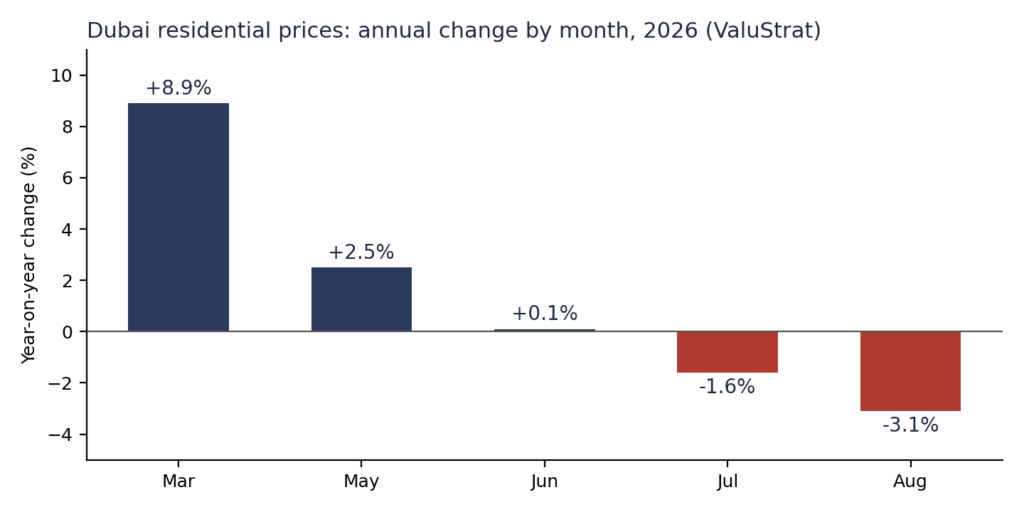
Source: ValuStrat monthly index, as reported by Sands of Wealth (March to July) and Dubai Chronicle (August). The index moved from strong growth to a decline in five months.
What the Main Price Indices Say
| Index / Source | Latest Reading | What It Tells You |
| ValuStrat VPI (Aug 2026) | −3.1% year on year; −0.2% month on month; apartments −5.3%, villas −1.7%; about 10.2% below the February level | Valuation-based and fast-moving. Villas had their first annual fall since 2021. |
| CBRE (Q2 2026) | +1.9% year on year (apartments +1.3%, villas +5.7%); about −4% on the quarter | Transaction-based. Still positive annually, but falling quarter on quarter. |
| DLD transactions, average price per sqft (Q2 2026) | Apartments about AED 1,960 (+1.9% year on year); villas and townhouses about AED 1,646 (+8.5%) | Averages are lifted when more high-value deals close. |
| Knight Frank prime index (to June 2026) | Dubai prime +10.9% year on year | Luxury has diverged from the mainstream market. |
| S&P Global (Oct 2026) | Moderate price correction in some segments; sharp fall in transaction volumes | Rating-agency view on credit and supply risk. |
Index definitions and release dates differ, so readings are not directly comparable. CBRE and DLD Q2 figures are taken from secondary reports of the underlying data; check the original releases before quoting them.
Why the Numbers Disagree
“Prices are up” and “prices are down” can both be true. Valuation indices such as ValuStrat re-value the whole stock every month and react quickly. Transaction averages, such as DLD-based price per square foot, move with the mix of deals: if more luxury homes sell, the average rises even when like-for-like prices are flat. Prime and mainstream markets are also moving in different directions, and registration lags can delay when a sale shows up in the data. When you read a headline, check which index it uses, which segment it covers and which month it measures.
Transactions Have Slowed Sharply
Volume has fallen further than prices. The Dubai Land Department recorded about 35,000 residential sales in Q2 2026, down roughly 19% on the previous quarter, and off-plan sales made up around three quarters of activity. For the first half of the year, total sales value was AED 286.4 billion. Falling volume with slowly falling prices is typical of a market where sellers are reluctant to cut and buyers are waiting, which is exactly where negotiating room opens up.
Dubai Property Price Forecast 2027: What the Major Forecasters Say
| Source | Date | View on Dubai Prices |
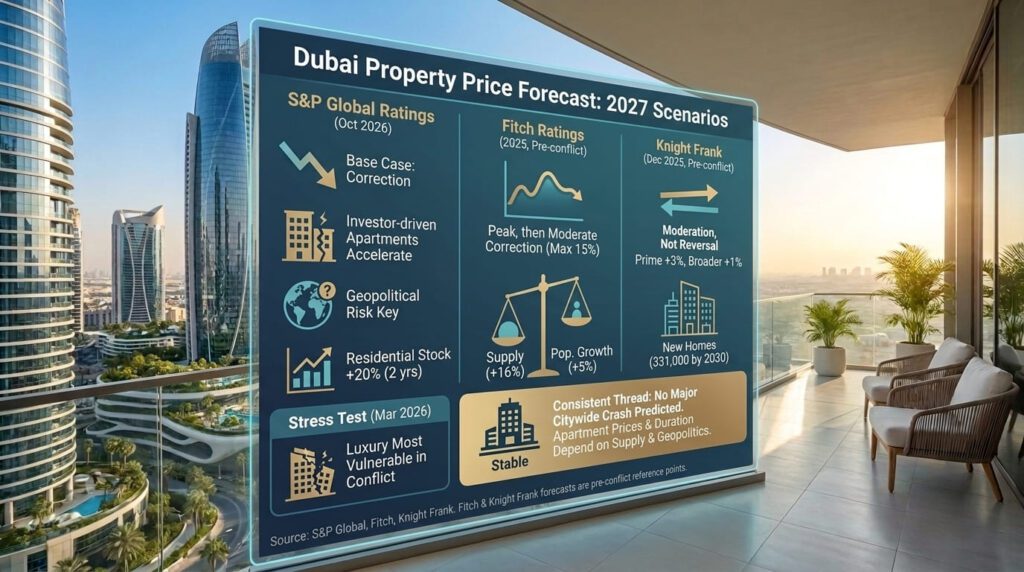
| S&P Global Ratings | Oct 2026 | Base case: regional disruption continues into 2027. Together with 2027–28 deliveries, this could accelerate the correction in investor-driven apartments. If geopolitical risk eases, prices could stabilise despite extra supply. Residential stock could grow about 20% over two years. |
| Fitch Ratings | 2025 (pre-conflict) | Prices peak, then correct by no more than about 15%. Supply growing about 16% over 2025–2027 against population growth of about 5%. |
| Knight Frank | Dec 2025 (pre-conflict) | Moderation, not reversal: prime prices about +3% in 2026 and the broader market about +1%. Around 331,000 homes could complete between 2026 and 2030. |
| S&P stress test | Mar 2026 | Apartment prices expected to fall more than villas because of the supply pipeline; luxury seen as most vulnerable in a prolonged conflict. |
Fitch and Knight Frank’s forecasts pre-date the conflict. Treat them as reference points for the supply story rather than current price targets.
The consistent thread is that no major forecaster is calling a citywide crash. The disagreement is about how far apartments fall and how long the correction lasts, which depends mostly on supply and geopolitics. For a broker-side summary of the three scenarios, see dataHabibi’s forecast.
Our 2027 Scenarios: Base, Bear and Bull Case
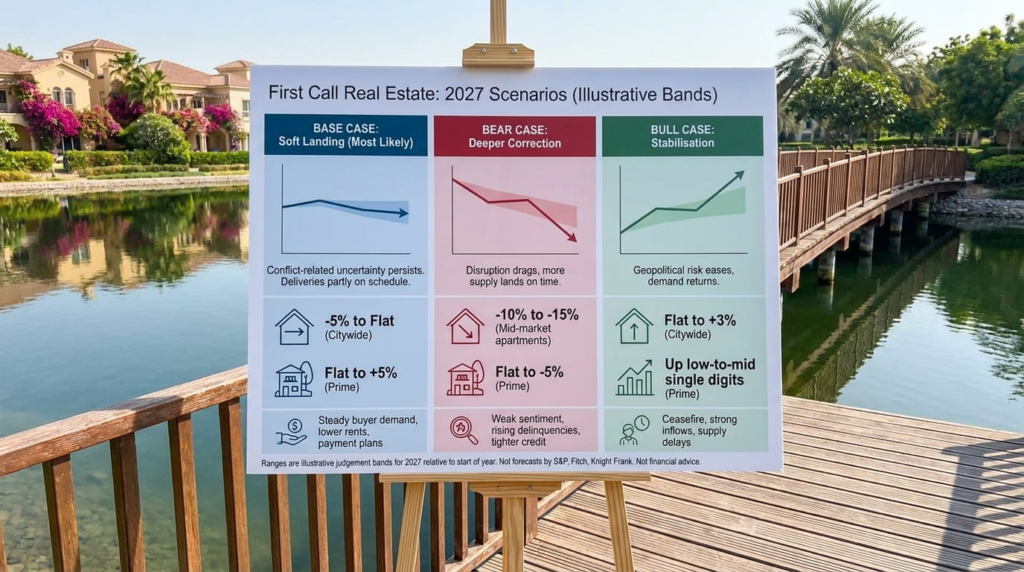
The table below is First Call Real Estate’s scenario framework, built from the data above. These ranges are our own judgement and are not forecasts issued by S&P, Fitch or Knight Frank.
| Scenario | What Happens | Price Range in 2027 | Triggers |
| Base case: soft landing (most likely) | Conflict-related uncertainty persists but does not escalate; deliveries arrive partly on schedule. | Citywide roughly flat to −5%. Investor apartments in heavily supplied areas −5% to −10%. Prime and low-density villas flat to +5%. | Steady but slow buyer demand; rents drift lower; developers keep offering payment plans. |
| Bear case: deeper correction | Disruption drags on and more of the 2027–28 supply lands on time. | Mid-market apartments −10% to −15% (the top of Fitch’s earlier range). Prime flat to −5%. | Weak sentiment, rising delinquencies on off-plan payments, tighter credit. |
| Bull case: stabilisation | Geopolitical risk eases and demand returns. | Citywide flat to +3%. Prime up low-to-mid single digits. Apartments stabilise. | Ceasefire or de-escalation, strong visa and population inflows, supply delays. |
Ranges are illustrative scenario bands for 2027 relative to prices at the start of the year. They are not guarantees and are not financial advice.
What Will Drive Dubai Property Prices in 2027?
- The supply wave. Knight Frank estimates around 331,000 to 350,000 homes could complete through 2030, and S&P puts stock growth near 20% over two years, with apartments making up most of it. Historically only part of the scheduled units arrive on time, so the real number is uncertain.
- The regional conflict. S&P’s base case is that disruption continues into 2027. This is the biggest swing factor: de-escalation supports a stabilisation, while escalation tilts toward the bear case.
- Interest rates. The Central Bank of the UAE raised its base rate from 3.65% to 3.9% on 17 September 2026, and three-month EIBOR was 4.22% in early October. If you are waiting for cheaper mortgages, there is currently no sign of them. A fixed rate protects you from further rises, and off-plan instalments are not affected by rate changes.
- Demand quality. S&P credits the UAE’s visa reforms with bringing in more long-term investors and end users, which cushions the market against the speculative selling seen in earlier cycles.
- Rents. CBRE recorded annual rent declines of about 2.6% in Q2 2026. Softer rents weaken the investor case, especially for apartments.
- Developer behaviour. Payment plans, incentives and launch pricing influence resale prices. Heavy discounting on new launches pulls resale prices down.
Which Segments and Areas Are Most at Risk in 2027?
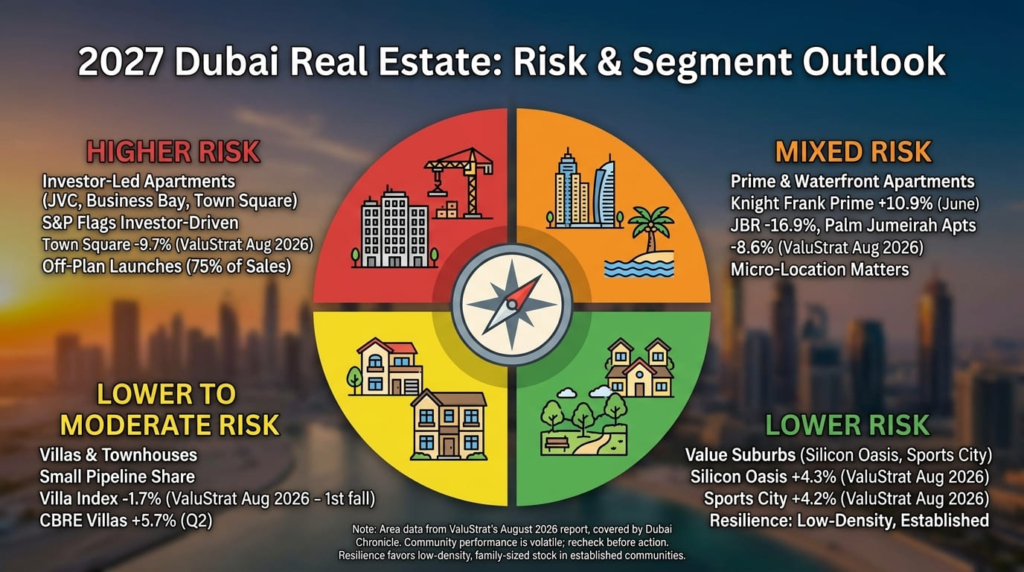
| Segment | 2027 Risk | Evidence |
| Investor-led apartments in heavily supplied areas (JVC, Business Bay, Town Square) | Higher | S&P flags investor-driven apartments. ValuStrat’s August data shows Town Square down 9.7% year on year, and apartments down 5.3% overall. |
| Prime and waterfront apartments | Mixed | Knight Frank prime index +10.9% to June, but ValuStrat shows Jumeirah Beach Residence down 16.9% and Palm Jumeirah apartments down 8.6% in August. Micro-location matters. |
| Villas and townhouses | Lower to moderate | Villas are a small share of the pipeline, but ValuStrat’s villa index fell 1.7% year on year in August, its first annual fall since 2021, while CBRE shows villas +5.7% in Q2. |
| Value suburbs (Silicon Oasis, Sports City) | Lower | ValuStrat’s August figures show Dubai Silicon Oasis +4.3% and Dubai Sports City +4.2% year on year. |
| Off-plan launches | Higher | Off-plan is about three quarters of sales. Prices depend on delivery risk, payment plans and resale premiums narrowing. |
Area data is from ValuStrat’s August 2026 report as covered by Dubai Chronicle. Community performance changes month to month, so recheck before acting.
Resilience tends to sit in low-density, family-sized stock in established communities. See our guides to the best villa communities in Dubai, gated communities and Green Community for how those markets are behaving. For apartments, our cheap apartments guide and Town Square guide show where entry prices and yields sit. For prime assets, read the luxury apartments buyer guide and our guide to Burj Khalifa Residences, or look at specific towers such as Creek Gate Tower 2 and Creek Edge.
Will Rents Fall Too? What It Means for Yields
CBRE’s Q2 2026 data shows rents down about 2.6% on the year, with a sharper drop on the quarter. When prices fall faster than rents, yields rise, which tends to attract income-focused buyers and put a floor under the market.
| Scenario (AED 1.5M apartment) | Price | Annual Rent | Gross Yield |
| Today | 1,500,000 | 90,000 | 6.0% |
| Price −10%, rent unchanged | 1,350,000 | 90,000 | 6.7% |
| Price −10%, rent −5% | 1,350,000 | 85,500 | 6.3% |
Illustrative only. Real yields also depend on service charges, vacancy and management costs.
To benchmark your target area, see our average rent in Dubai guide and Dubai rental market guide, and if you plan to rent your unit out short term, our short-term rental guide.
Is Dubai Heading for a Crash Like 2008 or 2014?
The data does not point that way. Fitch framed the risk as a normalisation after prices rose about 60% between 2022 and early 2025, not a repeat of the 2008 or 2014 drawdowns. ValuStrat found that 61% of freehold apartment communities and 73% of villa communities held their values in August, and Dubai’s adjustment so far is shallower than the corrections other global cities saw after 2021. S&P points to visa reforms and a larger share of long-term owners as reasons the market is better placed than in earlier cycles.
That does not make the bear case painless. Leveraged investors in oversupplied apartment areas could still see double-digit paper losses, and off-plan buyers face delivery and payment risk. Read our risks of buying property in Dubai checklist before committing.
Should You Wait Until 2027 to Buy?
Waiting has a price: you keep paying rent while you wait. Here is what waiting 12 months looks like for a AED 2,000,000 apartment that would rent for about 5% a year (AED 100,000):
| Price Change Over 12 Months | Price After | Saved vs Buying Today | Rent Paid While Waiting | Net Result of Waiting |
| −10% | 1,800,000 | +200,000 | −100,000 | +100,000 |
| −5% | 1,900,000 | +100,000 | −100,000 | 0 |
| 0% | 2,000,000 | 0 | −100,000 | −100,000 |
| +5% | 2,100,000 | −100,000 | −100,000 | −200,000 |
Simplified: ignores service charges, mortgage interest and the roughly 6% purchase costs (4% DLD fee plus agent commission) you would pay either way. The break-even is a fall equal to your rental yield.
So waiting only beats buying if you expect your specific segment to drop by more than the rent you will pay in the meantime. For a 5% yield, that means a fall of more than about 5% within a year.
Wait if…
- You are targeting investor apartments in a heavily supplied area such as JVC or Business Bay.
- You are buying off-plan with a long handover and can’t absorb a flat or lower market until completion.
- You have cash, can rent cheaply, and have no deadline.
- You want to see the next two or three ValuStrat and S&P updates before committing.
Buy now, or soon, if…
- You need a home within the next 12 months and rent costs are rising for you.
- You are targeting villas, townhouses or prime stock in a low-supply community.
- You have found a motivated seller and can negotiate a real discount against registered sale prices.
- You are waiting for lower interest rates. The recent direction of the base rate and EIBOR doesn’t support that bet.
How to Buy Smart if Prices Soften in 2027
- Negotiate using registered sales. Compare asking prices with recent DLD-registered transactions in the same building. In a slow market, sellers who need to move will accept real discounts.
- Favour ready or near-handover homes. If you buy off-plan, test the deal assuming flat prices until handover and read our guides to buying off-plan and the off-plan investor guide. Know your exit too: see how to sell off-plan property in Dubai.
- Check the supply pipeline by community. Two apartments at the same price can face very different supply risk. Our best areas for off-plan property and best communities in Dubai guides help you compare.
- Stress-test your rent. Run your numbers with rents 5–10% lower than today’s asking level.
- Fix your rate if you borrow. With the base rate rising, a fixed mortgage removes one risk. Lenders stress-test affordability at two to four percentage points above the loan rate.
- Plan to hold for five years or more. Purchase costs of about 6% make short-term flipping unprofitable in a flat market.
- Confirm the title type. Some communities are leasehold, not freehold. See our freehold property guide.
- Work with a licensed agency. Compare brokers in our Top 50 real estate companies in Dubai ranking.
If you do buy and later need to sell, our NOC for property sale guide explains the transfer process.
Indicators to Watch Before You Decide
- ValuStrat’s monthly index. The direction of the annual change is the clearest short-term signal.
- DLD monthly transactions and off-plan share. A recovery in volume usually leads a recovery in prices.
- S&P, Fitch and Knight Frank updates. Watch for changes in supply or correction estimates.
- The CBUAE base rate and EIBOR. The next US Federal Reserve decision is scheduled for 28 October.
- Actual handover numbers. Delays reduce the supply pressure on prices.
- Developer discounts and payment plans on new launches. Rising incentives are a sign of weak demand.
- Rents at renewal. Falling rents weaken the investor case.
How We Built This Outlook
This article draws on rating-agency commentary (S&P Global, Fitch), consultancy research (Knight Frank, CBRE), valuation and transaction data (ValuStrat, the Dubai Land Department) and press coverage from Khaleej Times, Gulf News and Dubai Chronicle, all as of 16 October 2026. Where a figure comes from a secondary report, we say so. Scenario ranges are our own. Forecasts are uncertain, and this article is general information, not financial or investment advice.
Talk to First Call Real Estate
If you’d like a view on a specific community, help benchmarking an asking price against registered sales, or a shortlist of resilient options, contact First Call Real Estate or browse our current listings.
Last updated: 16 Oct 2026. We refresh this outlook as new price data and forecasts are published.
Frequently Asked Questions
Will Dubai property prices fall in 2027?
Selectively, yes. S&P expects the correction in investor-driven apartments to continue into 2027 if the regional disruption persists, while prime stock and villas look more resilient. No major forecaster is calling a citywide crash.
What is the Dubai property price forecast for 2027?
There is no single figure. Our base case is flat to modestly lower prices citywide, with mid-market apartments down about 5–10% and prime and villa stock flat to slightly higher. A bear case would see mid-market apartments fall 10–15%, and a bull case would see stabilisation if geopolitical risk eases.
Will Dubai property crash in 2027?
A repeat of 2008 or 2014 looks unlikely. Fitch has framed the risk as a normalisation after roughly 60% growth between 2022 and early 2025, and a larger share of buyers are long-term owners and cash buyers than in earlier cycles.
Is 2027 a good time to buy property in Dubai?
It can be, if you choose carefully. A softer market gives buyers more negotiating power, but apartments in heavily supplied areas carry more risk than villas or prime stock. Buy for the long term, not for a quick gain.
Should I wait for prices to drop before buying in Dubai?
Only if you expect your segment to fall by more than your rental yield within a year. For a 5% yield, a drop of more than about 5% is needed for waiting to beat buying now.
Which Dubai areas could see prices fall in 2027?
Investor-heavy apartment areas with large pipelines, such as JVC, Business Bay and Town Square, carry the most risk. Check current data before acting, because community performance changes monthly.
Will Dubai rents fall in 2027?
CBRE recorded rents down about 2.6% year on year in Q2 2026. Further declines are possible in apartments if new supply arrives on schedule, while renewals remain anchored by the RERA rental index.
How much have Dubai property prices fallen in 2026?
ValuStrat’s index was about 10% below its February level and down 3.1% year on year in August. Other indices still show small annual gains, so the answer depends on the index and segment.
Is off-plan property safe to buy in 2027?
Off-plan carries more risk in a soft market: delivery delays, narrower resale premiums and payment obligations. Check the developer’s track record and stress-test the deal assuming flat prices to handover.
How much new supply is coming to Dubai?
Knight Frank estimates around 331,000 to 350,000 homes could complete through 2030, and S&P expects residential stock to grow about 20% over two years, mostly apartments. Actual deliveries are usually below scheduled numbers.
Will interest rates fall in 2027?
Nobody can say. The UAE base rate was raised to 3.9% in September 2026 and three-month EIBOR is above 4%. Buyers who wait only for lower rates may be waiting a long time.
What did S&P say about Dubai property in 2027?
Its base case is that Middle East disruptions continue into 2027, which together with 2027–28 deliveries could accelerate the price correction in investor-driven apartments. If geopolitical risk subsides, it expects prices to stabilise despite the extra supply.
When will Dubai property prices recover?
No one can give a reliable date. Recovery depends on geopolitical conditions, how quickly new supply is absorbed and the return of buyer demand. Watch transaction volumes, which usually recover before prices.