Dubai Tenant Rights 2026: The Complete Enforcement Guide
Quick answer: Dubai Tenant Rights in 2026 are governed by Law No. 26 of 2007, as amended by Law No. 33 of 2008, and enforced through RERA. Landlords cannot raise rent beyond the RERA index cap, cannot evict without 12 months’ notarized notice, and cannot enter a property without 24 hours’ notice. Disputes are filed through the Rental Dispute Center for AED 500–3,500, with resolution typically in 3–6 weeks.
Dubai’s tenancy law is one of the most tenant-protective frameworks in the region most tenants simply don’t know how to use it to their advantage. Understanding Dubai Tenant Rights isn’t a legal luxury; it’s the difference between accepting an illegal rent hike and standing your ground with the law fully behind you.
Here’s the core truth most tenants never hear from their landlord: rent cannot be raised arbitrarily, eviction cannot happen without 12 months’ written notice delivered through a notary, and no landlord can enter your home without your permission. Every one of these protections is backed by a fast, affordable dispute process designed to resolve conflicts in weeks, not years.
In 2026, this knowledge carries more weight than ever. Rental supply across Dubai is increasing, and some landlords are testing the limits of what tenants will accept without pushing back. The tenants who know the rules are the ones who keep their money, their homes, and their peace of mind.
This is where a guide, not just a broker, makes the difference. If you’re still searching for a place, our guide on how to rent an apartment in Dubai walks through the process from Ejari registration to signing day. But once you’ve signed, this guide picks up where that one leaves off.
Ahead: the 12 core rights every Dubai tenant holds, the RERA rent increase calculator explained tier by tier, eviction defenses that actually hold up, maintenance enforcement steps, deposit recovery, and exactly how to file a dispute.
Your 12 Core Rights as a Dubai Tenant
Every right below traces back to Law No. 26 of 2007, as amended by Law No. 33 of 2008, and is enforced through the Real Estate Regulatory Agency (RERA). Dubai Tenant Rights exist on paper but they only protect you once you know how to invoke them.
- Fair Rent: Increases are capped by the RERA rental index and cannot exceed it, regardless of what your landlord asks for.
- 90 Days’ Notice: Written notice is required before any rent increase or non-renewal. Verbal notice has no legal standing whatsoever.
- Right to Renew: Your contract renews automatically on the same terms unless the landlord has a valid legal ground to end it.
- Privacy: Landlords must give 24 hours’ notice before entering, except in genuine emergencies.
- Habitable Property: Structural issues, plumbing, electrical faults, and AC failures are the landlord’s responsibility, not yours.
- Deposit Return: Your deposit must be returned within roughly 30 days, minus only documented damage.
- 12 Months’ Eviction Notice: Required for personal use, sale, or demolition, and must be delivered via notary.
- Right of First Refusal (Article 29): You have first option to return to the property after demolition or renovation.
- Utility Protection: A landlord cannot threaten or cut your DEWA services to force you out.
- Dispute Resolution: Your right to file with the Rental Dispute Center cannot be waived in any contract clause.
- Protection Against Illegal Eviction: Self-help evictions are illegal. Changing your locks is a criminal matter, not a civil one.
- Subletting: Permitted only with explicit contractual permission from your landlord, relevant even for short term rental Dubai arrangements.

The RERA Rental Increase Calculator
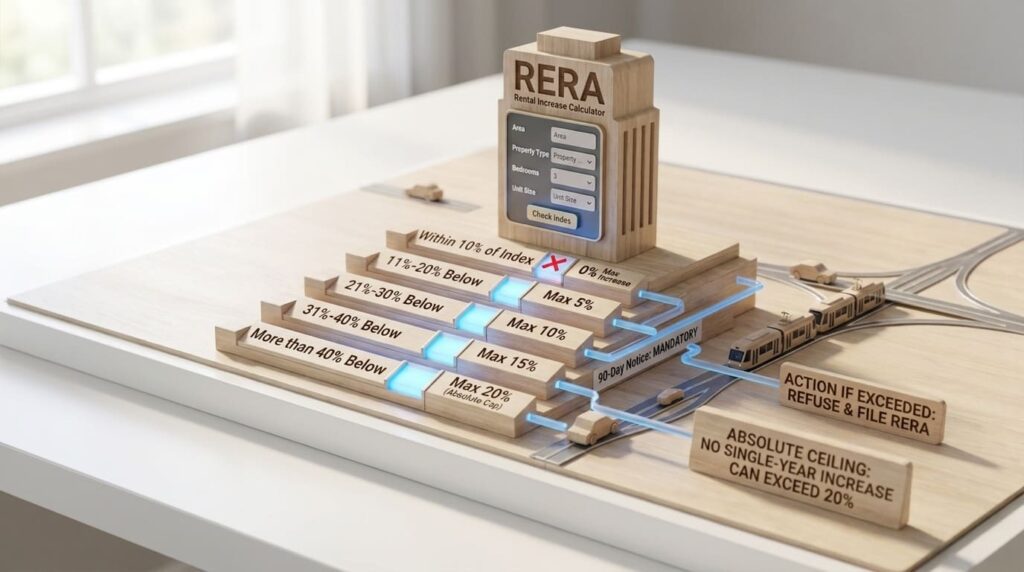
Before you accept any rent increase, check the RERA index at dubailand.gov.ae. Enter your area, property type, number of bedrooms, and unit size to see where your current rent sits against the market benchmark. For broader context on where your rent should fall, our average rent in Dubai 2026 guide breaks down pricing by community.
Once you know your index position, the maximum legal increase follows a strict five-tier structure:
| Current Rent vs. RERA Index | Maximum Allowed Increase | 90-Day Notice | Action If Exceeded |
| Within 10% of index | Zero no increase | Mandatory | Refuse in writing file RERA |
| 11%–20% below index | Maximum 5% | Mandatory | Calculate reject if more |
| 21%–30% below index | Maximum 10% | Mandatory | Calculate reject if more |
| 31%–40% below index | Maximum 15% | Mandatory | Calculate reject if more |
| More than 40% below index | Maximum 20% (absolute cap) | Mandatory | Reject anything above cap |
No matter how far below the index your current rent sits, no single-year increase can exceed 20%. That’s the absolute ceiling, full stop.
What to Do If Your Landlord Increases Rent Illegally
A RERA Rent Increase that exceeds your tier is not a negotiation point it’s a legal violation. Here’s how to respond:
- Check the RERA index for your exact property using the calculator above.
- Calculate the maximum allowed increase using the tier table.
- Send a written objection citing Law No. 26 of 2007 and your RERA figure, via registered mail and WhatsApp for a dual evidence trail.
- Allow 7 days for the landlord to respond or correct the error.
- File a formal RERA complaint if unresolved, attaching your contract, Ejari, RERA printout, and all correspondence.
Filing fees run AED 2,000–3,500 depending on rent value, with resolution typically taking 3–6 weeks.
Your Eviction Rights: When a Landlord Can and Cannot Evict
Rental Laws Dubai draw a hard line between legal grounds and illegal pressure tactics. Personal use, sale, demolition, and non-payment all qualify as legal grounds but only when notice is delivered correctly. Wanting a higher rent, preferring a different tenant, or sending notice via SMS, WhatsApp, or email does not.
The 12-month notice requirement must be delivered via notary. No exceptions. A landlord who texts you an eviction notice has sent you nothing of legal consequence.
| Eviction Reason | Legal | Notice Required | Tenant Defense |
| Personal use self or first-degree family | Yes | 12 months via notary | Request proof; claim compensation if re-let within 2 years |
| Sale of property | Yes | 12 months via notary | Right to remain full 12 months |
| Demolition (government-approved) | Yes | 12 months via notary | Request approval proof |
| Non-payment of rent | Yes after court process | Court order required | Not instant; court process only |
| Landlord wants higher rent | No | N/A | File RERA remain in property |
| Landlord wants a different tenant | No | N/A | File RERA immediately |
| Notice via WhatsApp/SMS/email | No | N/A | Notice invalid ignore |
| Less than 12 months’ notice | No | N/A | Stay and file RERA |
| Changing locks / cutting utilities | No criminal | N/A | Call police, file RERA |

Maintenance Rights: How to Force Your Landlord to Repair
The liability split is clear: landlords cover structural issues, major plumbing and electrical faults, and AC failures. Tenants cover minor items lightbulbs, small fixtures, and day-to-day wear. A Dubai judge has affirmed that maintenance liability sits with the landlord, not the tenant, reinforcing what the law already states.
- Submit a written repair request via WhatsApp or email.
- Allow 7–14 days for non-emergency repairs.
- Send a second formal written notice referencing the first.
- File a RERA complaint if there’s still no response.
- RERA can order the repair and set a firm compliance deadline.
Emergencies flooding, major leaks require a landlord response within 24 hours. Anything less is a violation you can document and escalate.
Security Deposit Rights: How to Get It Back
The core rule: your full deposit is returned within roughly 30 days, minus only documented damage beyond normal wear and tear.
- Document the property with timestamped photos and video at move-out, compared directly against your move-in records.
- Request the deposit in writing with a clear 30-day deadline.
- Dispute unfair deductions by challenging each line item in writing.
- File at the Rental Dispute Center (AED 500–3,500) or Dubai Small Claims Court for deposits under AED 20,000 no lawyer required.
Rental Dispute Center: How to File a Complaint for Dubai Tenant Rights
The Rental Dispute Center, operating under Dubai Courts, is the specialized, faster, and cheaper alternative to civil litigation. You can file online via dubailand.gov.ae, in person at Dubai Courts Bur Dubai, or through the Dubai REST app.
Required documents: your tenancy contract, Ejari certificate, Emirates ID or passport, and any supporting dispute evidence.
- Under AED 50,000 — AED 500
- AED 50,000–100,000 — AED 2,000
- Above AED 100,000 — AED 3,500
First hearings typically occur within 2–4 weeks, with full resolution in 3–6 weeks. For most standard disputes, RERA is the correct first stop courts only become necessary if a landlord refuses to comply with a RERA ruling.
What Your Landlord Cannot Legally Do
This is where most guides stop short they list rights but never name the violations directly. Here’s what crosses the line, and what to do about it:
- Entering without notice: Document it, file RERA.
- Cutting DEWA services: Call Dubai Police; this is a criminal matter.
- Changing locks: Call Dubai Police immediately.
- Removing your belongings: Call Dubai Police; file RERA.
- Harassment: Document everything, file RERA.
- Increasing rent without 90 days’ notice: Reject in writing, file RERA.
- Exceeding the RERA cap: Reject the increase, file RERA.
- Evicting without a court order: Stay in the property, file RERA.
- Withholding deposits without documentation: Dispute in writing, file RERA.
- Inspecting without an appointment: Document it, file RERA.
Know Your Rights, Then Use Them
Dubai Tenant Rights cover illegal rent increases, illegal eviction, maintenance neglect, and deposit disputes with real, enforceable teeth. But protection on paper only matters when it’s put to use.
Most landlord violations resolve through RERA without a lawyer ever entering the picture. The process is fast, affordable, and binding built for tenants, not against them.
First Call Real Estate guides tenants through every step of this process, from calculating a legal rent increase to filing a Rental Dispute Center complaint. If you’re facing a tenant rights issue right now, don’t wait for it to escalate.
Contact First Call Real Estate for a tenant support consultation or browse current rental listings to find your next home with a team that knows the law behind every lease.
Frequently Asked Questions
Can a landlord evict a tenant in Dubai?
Yes, but only on legal grounds personal use, sale, government-approved demolition, or non-payment following a court process. Each requires proper notice, and none of them permit immediate removal.
Can a tenant be evicted immediately in Dubai?
No. Even legal evictions require 12 months’ notarized notice for personal use, sale, or demolition. Non-payment cases require a court order first there is no path to immediate eviction.
What is the 12-month eviction notice in Dubai?
It’s the mandatory notice period a landlord must give before evicting a tenant for personal use, sale, or demolition. It must be delivered via notary WhatsApp, SMS, or email notices carry no legal weight.
What are the RERA rules for rent increases?
Increases are capped based on how far your current rent sits below the RERA index, ranging from 0% to a maximum absolute cap of 20%. Any increase requires 90 days’ written notice.
What happens if my landlord doesn’t return my security deposit?
Request it in writing with a 30-day deadline, then dispute any unfair deductions in writing. If unresolved, file at the Rental Dispute Center or Dubai Small Claims Court for deposits under AED 20,000.
Can my landlord enter my apartment without permission?
No. Landlords must provide 24 hours’ notice before entry, except in genuine emergencies. Unannounced entry is a violation you can document and report to RERA.
What is the new rental law in Dubai 2026?
There is no major new legislation for 2026. Law No. 26 of 2007, as amended by Law No. 33 of 2008, still governs tenancy, with the RERA rental index updated regularly to reflect market conditions.
How do I file a rental dispute in Dubai?
File online via dubailand.gov.ae, in person at Dubai Courts Bur Dubai, or through the Dubai REST app, with your tenancy contract, Ejari certificate, and ID ready. Fees range from AED 500 to 3,500, with resolution typically in 3–6 weeks.