Dubai Shared Housing Law 2026: Rules, Areas & Fines
Quick Answer: Renting a bedspace in Dubai is only legal if the building has a Dubai Municipality shared housing permit, sits in an approved area, and the person renting it to you is the property owner or a licensed establishment. Under Dubai Law No. 4 of 2026, which took effect on 8 September 2026, tenants can no longer sublet beds, rooms or partitions. Each occupant needs at least 5 sqm of bedroom space and each four occupants need a complete bathroom. Fines run from AED 500 to AED 500,000, doubling to AED 1 million for repeat violations. Existing operators have until 8 September 2027 to comply. Last checked: 20 Oct 2026.
On 7 October 2026, Dubai Municipality published the detailed rules that turn the new shared housing law into practical requirements: where shared housing is allowed, how much space each person needs, who can rent it out and what happens to buildings that don’t comply. If you rent a bed or room, own a unit that others share, or are thinking about investing in shared accommodation, these rules change what you can legally do.
News articles cover the headlines well. What most of them skip is the practical side: how to tell whether your specific bedspace is legal, what a landlord or investor has to do to get a permit, what the rules mean for rents and yields, and what happens to tenants if a building is shut down. This guide covers all of it, with sources and clear caveats where reports disagree. It sits alongside our Dubai rental market guide, which covers RERA, Ejari and tenant rights in general.
Key Takeaways
- Shared housing is now regulated, not banned. Roommates and legitimate co-living are allowed, but informal bedspaces and partitions are not.
- Tenants cannot sublet beds or rooms. Only the owner or a licensed establishment can rent out shared accommodation.
- Location matters. Shared housing is allowed in more than 44 approved areas, such as Al Barsha 1, Karama, Al Rigga and Al Nahda, and restricted to families on roads like Sheikh Zayed Road.
- Space and bathroom minimums apply. At least 5 sqm of bedroom space per person and one complete bathroom for every four people.
- Families and individuals cannot share a unit. Each unit and each designated building must serve one category.
- Existing operators have until 8 September 2027, but the grace period doesn’t excuse existing building violations.
- Rents may rise in approved areas, according to property experts, rather than fall.
What Is Dubai’s Shared Housing Law?
Dubai Law No. 4 of 2026 Regulating the Occupancy and Management of Shared Housing is the emirate’s first comprehensive framework for shared accommodation. It was issued on 27 February 2026, took effect on 8 September 2026, and applies to residential units across Dubai, including private development areas and free zones. It covers owners who allocate units for shared housing, the licensed establishments that manage them and the residents who live in them.
The law defines shared housing as a group of individuals or families living in the same property, each with an allocated space, while sharing facilities such as the kitchen, dining room and bathrooms. Dubai Municipality’s guide, published on 7 October 2026, sets the planning, building and occupancy requirements, and permit services run through the Build in Dubai platform.
Dedicated labour accommodation for workers is covered by separate legislation and is outside this law.
Timeline
| Date | What Happened |
| 27 February 2026 | Law No. 4 of 2026 issued, creating a shared accommodation register for tenancy contracts and resident data. |
| 8 September 2026 | Law takes effect. The one-year compliance period for existing operators starts. |
| 7 October 2026 | Dubai Municipality publishes its Planning and Building Requirements Guide and the list of 44+ approved areas. |
| 8 September 2027 | End of the grace period for existing shared housing buildings to regularise. |
One report gives a different effective date (late August 2026). Dubai Municipality’s own statement says 8 September 2026, which is the date used here.
Is Renting a Bedspace or Partition Legal in Dubai Now?
Only if it is part of a permitted shared housing arrangement. Dubai has not banned apartment sharing, but informal subletting and overcrowded bedspaces are now regulated through permits, occupancy standards and penalties.
| Generally Allowed | Not Allowed |
| A tenant living with family members | Renting out individual beds or rooms informally |
| A tenant with approved occupants registered through the official channels | Creating partitioned rooms without approval |
| A legitimate shared housing arrangement that complies fully with the regulations | Overcrowding beyond the permitted occupancy standards |
| Renting from the owner or a licensed establishment that holds a permit | Advertising illegal bedspace arrangements |
Example: if you lease a two-bedroom apartment and put four extra bunk beds in the living room to rent out, that is subletting. It needs a permit that an ordinary tenant can’t obtain, and even a landlord’s verbal agreement doesn’t make it lawful. Subletting a whole property is a separate matter and still needs the landlord’s written consent under the tenancy contract.
Where Is Shared Housing Allowed in Dubai?
Dubai Municipality has identified more than 44 areas where buildings and villas can be designated for shared housing, with more to be added once approved. The Khaleej Times list and the municipality’s map split them into areas where shared housing is allowed throughout and areas where it is allowed only in designated parts.
| Category | Areas Reported |
| Allowed throughout | Al Barsha 1, Karama, Al Rigga, Naif, Oud Metha, Al Nahda 1 and 2, Al Qusais, Al Muraqqabat, Al Muteena, Al Murar, Al Ras, Al Bateen, Riqqa Al Bateen (near Dubai Creek), Hor Al Anz, Al Waheeda, Al Rashidiya, Al Twar 5, Al Raffa, Al Badaa, Al Warqa 1, Al Dhagata |
| Allowed only in designated parts | Al Satwa, Al Baraha, Abu Hail, Al Hamriya, Al Jaffiliya, Al Hudaibiya, Al Mamzar, Al Qusais Industrial Areas 1 to 5 |
| Families only | Plots on Sheikh Zayed Road, Jumeirah Road, Al Wasl Road and Baniyas Road: shared housing for individuals is not permitted on these tourism and commercial roads |
Source lists differ. Some reports also place Mankhool, Jumeirah 1, Souq Kabeer, Muhaisnah 4, Sabkha, Eyal Nasser and Umm Hurair 1 and 2 on the list, and Jumeirah 1 is classified as full in one report and partial in another. Check Dubai Municipality’s official map for your exact plot.
Being in an approved area is not enough. The building or villa must still meet planning, construction and occupancy rules and hold a permit. And where the guidelines apply, the entire residential building or villa must be designated for shared housing: an owner can’t designate just one section.
If you’re comparing neighbourhoods for a legal, affordable room or apartment, our average rent in Dubai guide and cheap apartments guide show what each area costs, and our best communities to live in Dubai guide helps you weigh commute and lifestyle.
Space, Bathroom and Safety Rules
| Requirement | Minimum Standard |
| Bedroom space | At least 5 sqm per occupant |
| Bathrooms | One complete bathroom (washbasin, toilet, shower) for every four occupants |
| Separate toilets and showers (individual accommodation only) | One toilet per four occupants and one shower per six |
| Kitchen (inside apartments) | At least 1 sqm per occupant |
| Common areas (buildings for individuals) | Multipurpose dining and recreation area, plus laundry and drying facilities |
| Families | Each family needs a separate bedroom with its own private bathroom; more than one family may share a unit designated for family housing |
| Individuals | More than one person may share a bedroom, within occupancy limits and health standards |
| Fire safety | Dubai Civil Defence requirements for fire alarms and firefighting systems |
| Security | SIRA requirements for CCTV |
Worked Example: How Many People Can Legally Live in a Flat?
Take a three-bedroom apartment in a permitted building, designated for individuals, with bedrooms of 15, 12 and 12 sqm and two complete bathrooms:
- Bedroom capacity: 15 sqm allows 3 people, and each 12 sqm room allows 2 people, giving a maximum of 7.
- Bathroom capacity: two complete bathrooms support up to 8 people (one per four).
- Result: the lower figure applies, so about 7 people at most, and the municipality’s approved occupancy limit for the building can be lower still.
Illustrative calculation using the published minimums. The permit sets the actual approved occupancy for each unit.
Who Can Rent Out Shared Housing?
Only the property owner or a licensed establishment may rent out accommodation designated for shared housing. A landlord’s consent alone is not enough. According to Gulf News’ legal explainer, leasing can take three forms:
- Direct leasing: the owner rents to residents directly.
- Managed leasing: a licensed establishment manages and leases the property on the owner’s behalf.
- Company sublease: a licensed company leases the property from the owner and subleases to residents.
Owners can’t enter shared-housing agreements with people or companies that aren’t authorised. Government bodies, companies and educational institutions can house their own employees, workers or students in shared accommodation if they have the permit, and individual tenancy contracts aren’t required in those cases.
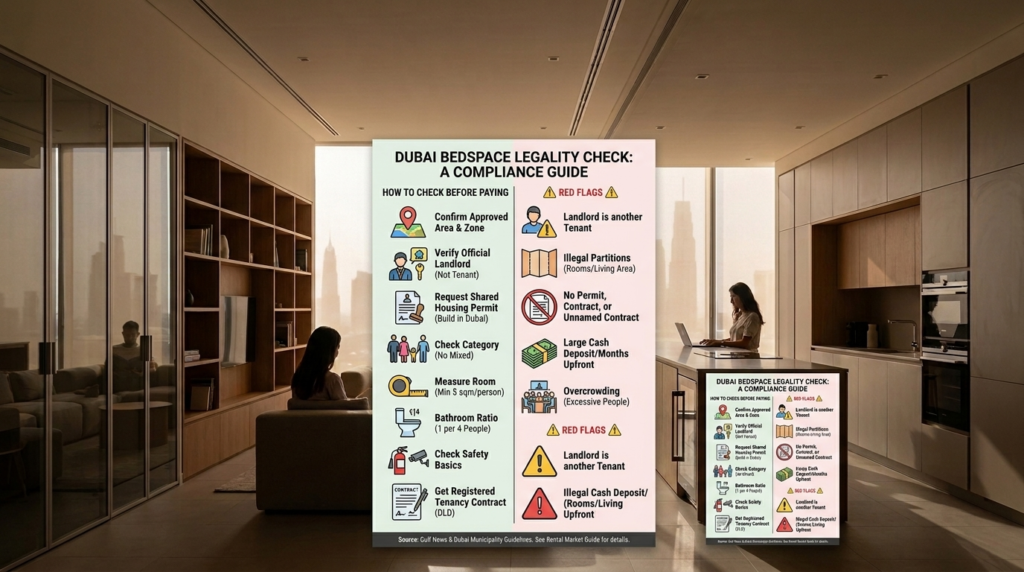
How to Check a Bedspace Is Legal Before You Pay
Dubai’s rules are now specific enough to check. Use this list before handing over a deposit, which Gulf News also stresses in its bedspace compliance check:
- Confirm the area. Is the building in an approved area, and in a full or partial zone?
- Ask who the landlord is. It must be the owner or a licensed establishment, not another tenant.
- Ask to see the shared housing permit. The permit comes from Dubai Municipality through Build in Dubai. No permit means no lawful shared housing.
- Check the category. The building should be for individuals or for families, never mixed.
- Measure the room. Divide the bedroom area by the number of people. It must be at least 5 sqm each.
- Count the bathrooms. At least one complete bathroom for every four residents.
- Look for safety basics. Fire alarm, firefighting equipment, CCTV and visible exits.
- Get a registered contract in your name. Shared housing tenancy contracts are meant to be recorded in an official register linked to DLD systems, so ask how yours will be registered.
Red Flags
- The “landlord” is another tenant renting out beds in a flat they lease.
- Partitions have been built inside rooms or in the living area.
- No permit, no contract, or a contract that doesn’t name you.
- A large cash deposit or several months’ rent demanded upfront.
- Far more people than the rooms and bathrooms can reasonably hold.
For broader renting safeguards, including deposits, Ejari and how disputes work, see our Dubai rental market guide.
Fines and Enforcement: What Happens to Non-Compliant Properties
| Measure | Detail |
| Fines | AED 500 to AED 500,000, depending on the violation |
| Repeat violation within one year | Fine can double, up to AED 1,000,000 |
| Activity suspension | Up to six months |
| Permit and licence | Permit can be revoked; the trade licence can be cancelled through the licensing authority |
| Utilities | Public utilities can be disconnected until the violation is fixed |
| Property transactions | Transactions can be suspended, and tenancy or management agreements blocked from registration |
| Equipment | Equipment used in the violation can be seized |
| Vacating | A non-compliant property can ultimately be vacated by an execution judge’s decision |
Administrative penalties don’t prevent civil or criminal liability where it applies. Not every breach attracts the maximum fine.
What About Residents If a Permit Is Cancelled?
Cancelling a permit or suspending an operator doesn’t necessarily mean immediate eviction. The law allows the authority to let occupants stay for a set period so they can find other accommodation. If you’re affected, keep your contract, payment receipts and messages, and seek advice early. Our rental market guide explains how disputes are handled through the Rental Disputes Centre.
For Landlords and Owners: How to Become Compliant
If you offer or plan to offer shared accommodation, the process follows the steps below, based on Khaleej Times’ step-by-step guide and Emirates 24|7’s permit guide:
- Check the location. The building or villa must be in an approved area. If it isn’t, it can’t be registered.
- Choose one category. Individual or family housing, never both in the same unit or designated building.
- Meet the space and facilities standards. Bedrooms, bathrooms, kitchens, common areas, fire safety and CCTV.
- Obtain a building permit. Applications go through an accredited engineering consultancy on the Build in Dubai platform, with login through UAE PASS.
- Submit documents. These typically include ownership proof such as the title deed, owner identification and, where relevant, authorisations.
- Receive the shared housing permit. It is issued after the completion certificate and is the document DLD needs before tenancy contracts can be issued to occupants.
- Renew on time. Permits are generally valid for one year, with a two-year option, and renewal applications should be filed at least 30 days before expiry.
The Grace Period Is Not a Free Pass
Existing operators have until 8 September 2027 to regularise. Dubai Municipality has said this does not excuse existing building violations, unauthorised changes of use or public-safety hazards. Illegal internal partitions, in particular, may have to be removed or corrected. If you own a unit that is currently shared informally, start the compliance review now rather than at the deadline.
Selling or buying a shared-housing property? Permit status and title can affect a transaction. See our NOC for property sale guide and risks of buying property in Dubai checklist.
For Investors: What the Law Means for Shared Housing as an Investment
Shared accommodation used to be a high-occupancy, informal corner of the rental market. The new law makes it a regulated one, and that changes how to underwrite it.
- You need the whole building or villa. Where the guidelines apply, a building must be designated in full for shared housing. An investor who owns one apartment in a multi-owner tower can’t turn that unit into shared accommodation on their own.
- Location is now a gate. If the property isn’t in an approved area, shared housing isn’t an option at all.
- Compliance has a cost. Permits, building alterations, safety systems, CCTV and a licensed operator all add to the cost, and unauthorised partitions may have to be removed.
- Pricing should become more transparent. Official guidance points to a dedicated DLD rental index for shared housing, standard tenancy templates and a shared accommodation register. This should make rents easier to benchmark.
- Verify the permit pathway before you buy. Treat a property marketed as a high-yield shared unit with caution unless the permit position is clear.
- Use conservative numbers. Don’t underwrite based on pre-law informal occupancy.
For general yield benchmarks, see our best areas to invest in Dubai and best communities in Dubai guides, and our average rent in Dubai guide. If you’re weighing holiday-let income instead, that is a different regime; read our short-term rental guide. This article is general information, not legal or investment advice.
Will Shared Housing Rents Go Up?
Property experts quoted by Dubai Standard and Khaleej Times don’t expect the law to lower rents. Their view is that compliance costs, stricter occupancy limits and the fact that the law doesn’t add housing supply could push rents up in communities approved for shared accommodation over the next 12 to 24 months. Others describe it as existing demand finally being counted, since partitioned flats and bedspaces that never appeared in Ejari will now be on the official record.
It is a forecast, not a certainty, and effects will vary by area. If you’re renting, budget for a possible increase and compare lawful alternatives.
Lawful Alternatives to a Bedspace
| Option | Typical Cost (Dubai Median) | Notes |
| Studio | AED 44,100 a year (about AED 3,675 a month) | Your own space on a normal registered tenancy. Value areas can be cheaper. |
| Two-bedroom shared by two adults | AED 103,000 a year (about AED 4,290 a month each) | Both on one registered contract, with the landlord’s agreement where required. |
| One-bedroom | AED 68,000 a year (about AED 5,670 a month) | Better for couples or a single tenant who wants privacy. |
| Licensed shared accommodation | Varies by operator and area | Ask for the permit and a registered contract. |
Medians are citywide DLD-registered figures used in our rent guide and vary widely by area. Whether two adults can share one tenancy depends on the contract and the landlord’s terms, so confirm before signing.
See our average rent in Dubai and cheap apartments in Dubai guides for where each of these options costs the least. Weighing whether to rent at all? Our renting vs buying numbers work through the break-even. If you’d like help finding a legal, affordable rental, contact First Call Real Estate.
Common Mistakes to Avoid
For tenants
- Paying a deposit before checking the permit and who the landlord is.
- Assuming that an approved area means an approved building.
- Accepting a contract that doesn’t name you as a resident.
- Subletting your own room to cover rent, which is now not allowed.
For landlords and owners
- Treating the one-year grace period as permission to continue existing violations.
- Mixing families and individuals in the same unit or building.
- Converting only one flat in a building that must be designated as a whole.
- Leaving partitions in place instead of rectifying them.
- Renting to residents through an unlicensed middle-man.
How We Built This Guide
This guide draws on Dubai Municipality’s announcement carried by AM, reporting from Gulf News, Khaleej Times, Emirates 24|7 and Dubai Standard, and legal commentary quoted by Gulf News, all as of 20 October 2026. Where sources disagree, we say so. This article is general information, not legal advice. Check Dubai Municipality, the Dubai Land Department and a qualified lawyer for your specific situation.
Talk to First Call Real Estate
Whether you’re looking for a compliant place to rent, weighing a rental investment or reviewing a property you own, contact First Call Real Estate or browse our current listings. To compare agencies first, see our Top 50 real estate companies in Dubai ranking.
Last updated: 20 Oct 2026. Dubai Municipality may add approved areas and publish further guidance, so we update this guide as new information is released.
Frequently Asked Questions
Is renting a bedspace legal in Dubai in 2026?
Only if the building holds a Dubai Municipality shared housing permit, is in an approved area and the bed is rented by the owner or a licensed establishment. Informal bedspaces and partitions rented out by tenants are not allowed.
What is Dubai Law No. 4 of 2026?
It is Dubai’s law regulating the occupancy and management of shared housing. It took effect on 8 September 2026 and sets rules on permits, who can rent out shared accommodation, occupancy standards, approved locations and penalties.
Can I sublet a room in my Dubai apartment?
Not as shared housing. Tenants and residents cannot sublet any room, bed or space, and subletting a whole property still requires the landlord’s written consent.
Can I have a roommate in Dubai?
Dubai has not banned apartment sharing. Living with family or approved registered occupants is generally allowed, as is a legitimate shared housing arrangement that complies with the rules. Check your tenancy contract and get your landlord’s written approval where needed.
Which areas allow shared housing in Dubai?
More than 44 areas, including Al Barsha 1, Karama, Al Rigga, Naif, Oud Metha, Al Nahda 1 and 2, Al Qusais and Al Warqa 1, with some areas such as Al Satwa and Abu Hail allowing it only in designated parts. Individual shared housing is not permitted on Sheikh Zayed Road, Jumeirah Road, Al Wasl Road and Baniyas Road.
How much space does each person need in shared housing?
At least 5 sqm of bedroom space per occupant, so a bedroom for four people needs at least 20 sqm.
How many bathrooms are required?
At least one complete bathroom for every four occupants. Where toilets and showers are separate, one toilet per four people and one shower per six, in accommodation for individuals only.
Can families and individuals share the same unit in Dubai?
No. Each unit and each designated building must serve one category. More than one family may share a unit designated for families if each has a separate bedroom with a private bathroom.
What are the fines under Dubai’s shared housing law?
Fines range from AED 500 to AED 500,000, and can double to AED 1 million for repeat violations within a year. Authorities can also suspend activity, revoke permits and disconnect utilities.
When do existing shared housing properties need to comply?
Owners and operators have one year from 8 September 2026, until 8 September 2027. The grace period doesn’t excuse existing building violations or unauthorised changes of use.
How do I check if a bedspace is approved?
Check the area, ask whether the landlord is the owner or a licensed establishment, ask to see the shared housing permit, measure the space per person, count the bathrooms and get a registered contract in your name.
What happens to tenants if a shared housing permit is cancelled?
Residents don’t necessarily have to leave immediately. The authority can allow them to stay for a set period while they find alternative accommodation.
How does an owner get a shared housing permit?
Check that the building is in an approved area, choose one category, meet the space and safety standards, obtain a building permit through an accredited engineering consultancy on the Build in Dubai platform, and receive the permit after the completion certificate. Permits last one year, with a two-year option.
Will rents go up because of the shared housing law?
Some property experts expect rents in approved communities to rise over the next 12 to 24 months because of compliance costs and stricter occupancy limits, rather than fall. It is a forecast, not a certainty.