

Luxury Property Investment Dubai: AED 5M+ Guide 2026
Luxury property investment in Dubai delivers the highest total returns of any major global market in 2026 zero capital gains tax, zero income tax, and structural supply scarcity across Palm Jumeirah, Emirates Hills, and Jumeirah Bay Island. This guide covers the AED 5M+ tier exclusively, with return data, developer comparisons, and a strategic framework for capital deployment above AED 10M.
Over 150 billionaires relocated to Dubai between 2024 and 2025. That single figure tells you what the data confirms: global UHNW capital is moving into luxury real estate Dubai at a pace without recent precedent. The question is no longer whether Dubai luxury performs. It is which property type matches your investment mandate and how to position your capital before the next appreciation cycle closes the entry window.
This guide covers the AED 5M+ tier specifically. Not standard Dubai property. Not the affordable apartment market. The category where scarcity compounds value permanently, where absolute income dwarfs percentage yield comparisons, and where Dubai’s zero-tax framework delivers its most powerful returns. First Call Real Estate builds complete luxury investment strategies for clients deploying AED 10M and above. This is not a listings guide. It is a strategic framework.
Why Luxury Outperforms Standard Investment in Dubai
The comparison starts with supply. Standard apartments in JVC and Dubai South see thousands of new units enter the market every quarter. Continuous supply compresses yield and moderates appreciation. Luxury operates by a different logic entirely.
Palm Jumeirah fronds are finite no new fronds are being created. Emirates Hills plots are finite no new plots are releasing. Branded residences from BVLGARI, Armani, and Atlantis produce extremely limited units per development. Scarcity here is not a marketing claim. It is a structural characteristic, and it compounds value permanently.
The buyer pool reinforces this advantage. Standard investment depends on UAE-employed expat tenants whose demand tracks the local employment market. Luxury demand comes from Russian, European, Indian, and GCC buyers who are entirely insulated from UAE employment cycles. UHNW buyers contract far less in downturns which is precisely why luxury holds in corrections while mid-market softens.
The absolute income argument is the one most investors underestimate. A JVC studio producing an 8% gross yield generates approximately AED 48,000 in annual rental income. A Palm Jumeirah villa at 5% gross yield generates approximately AED 700,000. Same investor time. Same management effort. Fourteen times the absolute income.
Appreciation data from 2020 to 2025 confirms the structural gap:
- JVC standard apartments: 40–60% appreciation
- Palm Jumeirah luxury villas: 60–90% appreciation
- Emirates Hills mansions: 80–120% appreciation
- Como Residences: 100%+ since launch
At the luxury tier, Dubai’s zero-tax advantage becomes its most powerful differentiator. A UK investor selling an AED 10M Dubai luxury property keeps every dirham of capital gain. The UK equivalent surrenders AED 2.8M to 28% capital gains tax. At AED 700,000 in annual rental income, Dubai’s zero income tax preserves AED 200,000+ annually that a comparable UK investment would lose. The larger the investment, the more powerful this advantage becomes. Explore Dubai real estate ROI data to see how that compounds across a five-year hold.
Luxury Property Investment Returns in Dubai 2026
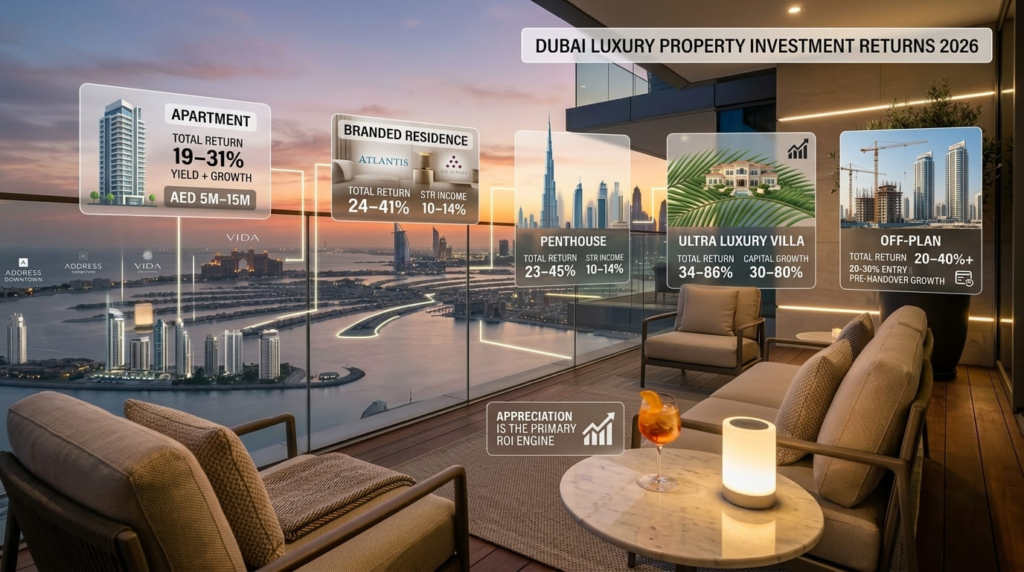
Returns vary significantly across luxury property types. The table below provides a clear comparison across the five categories relevant to this tier.
Table 1 — Luxury Property Investment Returns by Type 2026
| Property Type | Price Range | Gross Yield | STR Yield | Appreciation | Total Return | Best For |
| Luxury Apartment | AED 5M–15M | 4–6% | 8–12% | 15–25% | 19–31% | Yield plus growth |
| Branded Residence | AED 5M–50M | 4–6% | 10–14% | 20–35% | 24–41% | Brand premium |
| Luxury Penthouse | AED 10M–50M | 3–5% | 10–14% | 20–40% | 23–45% | STR income |
| Ultra Luxury Villa | AED 20M–100M | 4–6% | 15–25% | 30–80% | 34–86% | Capital growth |
| Off-Plan Luxury | AED 5M–40M | N/A | N/A | 20–40% | 20–40%+ | Appreciation |
Luxury apartments (AED 5M–15M) Address Residences Downtown, Grand Bleu Emaar Beachfront, VIDA Residences deliver total returns of 19–31%, driven primarily by appreciation. Net yield after service charges and management sits at 3–5%. Appreciation is the primary engine for Dubai real estate ROI at this tier.
Branded residences (AED 5M–50M) Address Hotels, Atlantis Residences, Six Senses, Dorchester achieve STR yields of 10–14% through hotel-managed programs, with 20–35% capital appreciation and total returns of 24–41%. The brand premium holds at resale, consistently 15–25% above non-branded comparables.
Luxury penthouses in Dubai (AED 10M–50M) represent the strongest STR investment case. Atlantis The Royal, the top floors of Burj Khalifa, and Address Sky View generate gross STR yields of 10–14%, with capital appreciation of 20–40% at the premium tier.
Ultra luxury villas in Dubai (AED 20M–100M) deliver the highest total returns of any category over a five-year hold. Palm Jumeirah and Emirates Hills properties produce appreciation of 30–80%, with STR rates reaching AED 500,000 per night at peak periods.
Off-plan luxury (AED 5M–40M) offers entry 20–30% below projected handover value. Capital appreciation of 15–40% before handover is achievable with Emaar and Nakheel, both carrying zero historical project cancellations. Payment structures typically 60/40 reduce upfront capital commitment significantly.
Best Property Types for Luxury Property Investment in Dubai
Strategy determines property type. The right asset for a yield-focused family office is not the right asset for a capital preservation buyer. Here is the framework.
If your goal is maximum yield: Choose luxury serviced apartments or branded residences Dubai in tourist-dense locations Downtown Burj Khalifa, Emaar Beachfront. STR yields of 10–14% are achievable through hotel-managed programs. Address Residences’ hotel management removes the landlord burden entirely. Avoid ultra luxury villas in Dubai for yield service charges at AED 30–80 per sq ft annually erode net returns significantly at large floor plates.
If your goal is maximum capital growth: Prime plots and villas on Palm Jumeirah, Emirates Hills, and Jumeirah Bay Island compound appreciation across five-year-plus holds. Off-plan luxury from Emaar or Nakheel bought at launch and held to handover delivers the steepest appreciation curve. Emirates Hills mansions have appreciated 80–120% in a single cycle.
If your goal is combined yield and growth: Branded residences in premium communities offer the strongest balance. Address Residences Downtown and Emaar Beachfront deliver STR yields of 10–14% plus appreciation of 20–30%, managed by a professional hotel operator.
If your goal is capital preservation: Palm Jumeirah Signature Villas and Jumeirah Bay Island BVLGARI represent the most defensible luxury assets in the market. Global brand recognition, permanent supply scarcity, and an ever-present buyer pool make them the closest Dubai equivalent to trophy asset preservation.
If your goal is tax structuring: Every luxury purchase above AED 2M qualifies automatically for the UAE Golden Visa for investors a 10-year residency that supports an FTA tax residency certificate. For UK and European investors, this combination can eliminate or materially reduce home-country capital gains tax. You earn rental income on a Dubai luxury asset and keep 100% of it.
The Branded Residence Investment Premium: Does Branding Add Real Value?
The entry premium is real. Branded residences command 20–35% above non-branded property in the same location. BVLGARI Jumeirah Bay carries a 30% purchase premium. Address Residences Downtown sits 25% above non-branded Downtown comparables. Six Senses Dubai Marina commands a 20% premium over standard Marina towers.
The more important question for investors is whether that premium holds at resale. DLD secondary market data confirms it does. BVLGARI resale transactions achieve 25–40% above non-branded Jumeirah Bay Island units. Address Hotels resale achieves 15–25% above non-branded Downtown property.
The mechanism is direct: global brand recognition means international buyers pay the brand premium regardless of where they are purchasing from. As the brand expands globally, Dubai units benefit from that marketing investment.
The STR premium amplifies the picture further. Branded units achieve 40–60% higher nightly rates on Airbnb and specialist platforms. Atlantis The Royal Residences command nightly rates 50% above equivalent non-branded Palm units. Hotel-managed programs deliver professionally optimized occupancy not owner-managed logistics.
Key branded developments by tier:
- BVLGARI: Jumeirah Bay Island AED 30M–120M
- Address Hotels: Downtown and Beachfront AED 2M–15M
- Atlantis Residences: Palm Jumeirah AED 10M–180M
- Six Senses: Dubai Marina AED 10M–40M
- Dorchester Collection: Business Bay AED 20M–60M
- Armani Residences: Burj Khalifa floors 9–16 AED 5M–20M
The Luxury Short-Term Rental (STR) Investment Case
Ultra-premium short-term rental yields represent a return category unavailable in any comparable global market. A Downtown Dubai Emaar penthouse achieves AED 5,000–20,000 per night. A Palm Jumeirah Signature Villa achieves AED 20,000–100,000 per night at peak. Emirates Hills mega-mansions reach AED 30,000–150,000 per night for exclusive events.
At realistic occupancy:
- Luxury penthouse at 60% occupancy: AED 3M–8M in annual STR revenue
- Palm villa at 50% occupancy: AED 5M–15M in annual STR revenue
After management fees of 15–20%, net STR income still surpasses long-term yield returns by a significant margin.
Demand drivers are calendar-based and predictable. New Year’s Eve commands the highest global nightly rates. The Dubai International Boat Show in February drives mega-villa demand. Art Dubai in March draws cultural UHNW visitors. Formula E and both Eid periods generate sustained GCC visitor surges.
All STR operations require a DTCM permit an annual renewal costing AED 500–1,500. First Call Real Estate manages the permit application process for clients.
Luxury Developer Comparison for Investors
Developer selection determines delivery certainty, payment structure, and secondary market liquidity.
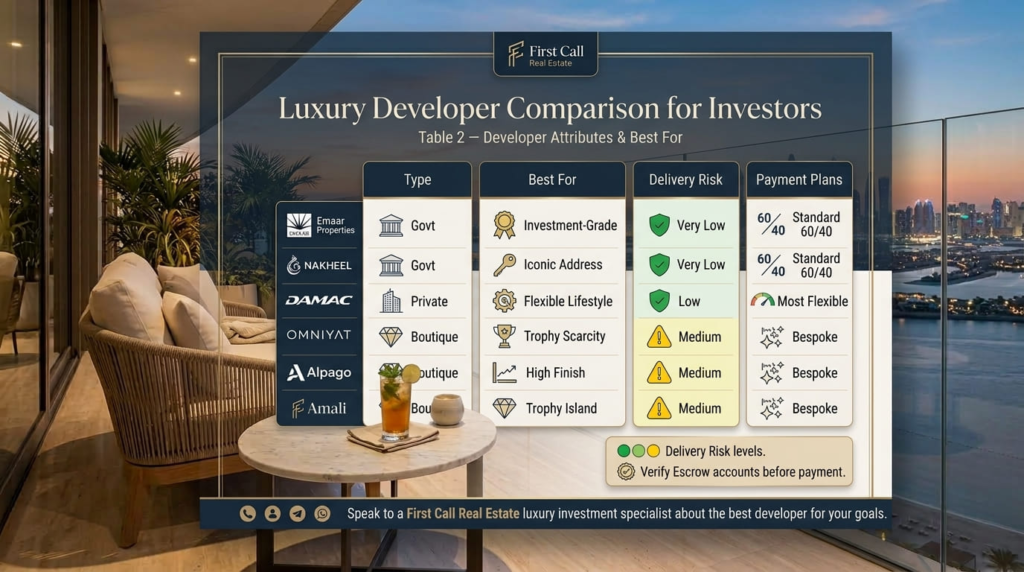
Table 2 — Luxury Developer Comparison for Investors
| Developer | Type | Best For | Delivery Risk | Payment Plans | Top Product |
| Emaar Properties | Government | Investment-grade certainty | Very low | Standard 60/40 | Address Residences |
| Nakheel | Government | Iconic address premium | Very low | Standard 60/40 | Palm Jumeirah Villas |
| Damac | Private | Flexible branded lifestyle | Low | Most flexible | Damac Hills Golf |
| Omniyat | Boutique | Trophy maximum scarcity | Medium | Bespoke | One Palm Orla |
| Alpago | Boutique | Highest finish quality | Medium | Bespoke | Palm Frond Villas |
| Amali | Boutique | Ultimate trophy island | Medium | Bespoke | Amali Island |
Emaar Properties and Nakheel are government-backed with zero historical project cancellations the benchmark for delivery certainty in off-plan luxury. Damac offers the most flexible payment structures and branded lifestyle product through Cavalli and Versace partnerships. Boutique developers Omniyat, Alpago, and Amali produce the scarcest and most appreciating assets in the market, but require RERA registration and escrow account verification before any payment commitment.
Honest Risks of Luxury Property Investment in Dubai
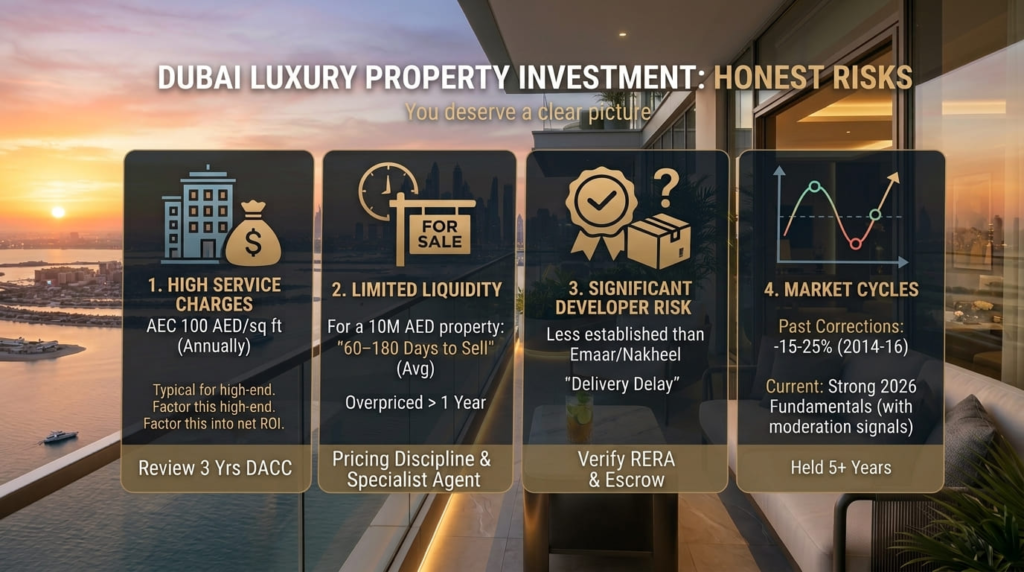
You deserve a clear picture of the risks at this tier not generic disclaimers.
Service charge burden. Luxury service charges run AED 30–80 per sq ft annually. A 10,000 sq ft villa carries AED 300,000–800,000 in annual service charges. This materially reduces net yield. Always review three years of OACC statements before committing to any luxury property.
Liquidity risk at high price points. Above AED 10M, the buyer pool is smaller than mid-market. A well-priced, quality luxury asset typically takes 60–180 days to sell even in a strong market. Overpriced luxury can sit for 12 months or more. Pricing discipline and specialist agent selection are the primary mitigation.
Boutique developer risk. Developers such as Amali, Alpago, and Omniyat carry less regulated financial oversight than Emaar and Nakheel. Always verify RERA registration and escrow account status before any payment. If delivery risk is a concern, government-backed developers remove it.
Market cycle risk. Dubai luxury corrected 15–25% during the 2014–2016 oil price downturn. Current 2026 fundamentals are strong, but moderation signals are present in some sub-markets. A five-year minimum hold horizon diminishes cycle risk appreciation compounds across cycles rather than within them.
Exit Strategy for Luxury Investors
Exit planning starts at acquisition.
Secondary market timing. October through April is the optimal selling window peak season for UHNW buyers in Dubai. Avoid July and August; GCC buyers are typically absent. A well-priced Palm Jumeirah villa sells in 60–90 days. An Emirates Hills mansion takes 90–180 days given a smaller, more bespoke buyer pool. Downtown luxury apartments are the most liquid luxury asset 30–60 days in normal conditions.
Off-plan pre-handover resale. Selling an off-plan unit before handover requires a review of the SPA to confirm transfer permissions. Most Emaar and Nakheel contracts allow it. The Oqood transfer through DLD typically completes in two to four weeks. Zero capital gains tax means you keep 100% of the profit.
Maximizing exit price. Professional furnishing adds 15–25% to final sale price. At AED 50M+, off-market sale is the fastest and most discreet route a specialist agent matches the property directly to known UHNW buyers without public listing.
Build Your Dubai Luxury Investment Strategy with First Call Real Estate
Luxury property investment in Dubai delivers what no comparable global market currently offers: appreciation at scale, rental income untaxed, and zero capital gains on exit all within a framework backed by structural supply scarcity and a UHNW buyer pool that spans every major wealth center on earth.
The critical variable is not whether to invest. It is which property type matches your investment goal, and how to deploy capital before the next appreciation cycle compounds beyond current entry points. A Palm Jumeirah villa, a branded Downtown penthouse, and a boutique Omniyat unit each perform differently across yield, appreciation, STR income, and exit liquidity. Strategy determines outcome.
First Call Real Estate builds complete luxury investment strategies for UHNW clients not listings, strategies. We work at the AED 10M+ tier with investors, family offices, and private wealth clients who require confidential, data-grounded advice before capital commitment.
View luxury investment listings | Request a private consultation
Frequently Asked Questions
Is luxury property investment in Dubai worth it?
Yes. Luxury consistently outperforms mid-market on absolute returns. Zero tax on both rental income and capital gains maximizes net gains at every price point. Structural supply scarcity on Palm Jumeirah, Emirates Hills, and Jumeirah Bay Island protects value in corrections while amplifying appreciation in growth cycles.
What is the ROI on luxury property in Dubai?
Total returns range from 19% to 86% depending on property type and strategy. Branded residences and ultra luxury villas lead the performance table. Appreciation is the primary driver at the luxury tier; STR income provides a powerful secondary return for the right asset types.
Which luxury property type gives the best return in Dubai?
Ultra luxury villas deliver the highest total return for appreciation-focused investors, with 34–86% across a five-year hold. Branded residences offer the strongest combined return STR yield plus capital growth plus brand premium at resale. The best property type is the one that matches your specific investment mandate.
Do branded residences outperform standard luxury in Dubai?
Yes, confirmed by DLD secondary market data. Branded residences achieve a 15–40% resale premium over non-branded comparables and 40–60% higher STR nightly rates. Branding adds genuine, measurable investment value not just lifestyle positioning.
What are the risks of luxury property investment in Dubai?
The primary risks are: high service charges eroding net yield at large floor plates; a smaller buyer pool extending selling timelines above AED 10M; boutique developer delivery risk outside government-backed schemes; and market cycle correction, historically 15–25% at peak-to-trough. All are manageable with the right strategy and a five-year-plus hold horizon.
How does Dubai luxury compare to London for investment?
Dubai delivers comparable appreciation trajectories and higher gross yields with zero capital gains tax on exit. A UK investor on a comparable London luxury asset surrenders 28% CGT at sale, equivalent to AED 2.8M on a AED 10M gain. For global capital allocation, Dubai luxury is the stronger net-return proposition at comparable price points.
What is the best luxury property for short-term rental in Dubai?
Downtown penthouses command AED 5,000–20,000 per night. Palm Jumeirah villas reach AED 20,000–100,000 per night at peak. Branded managed units through hotel programs achieve the highest occupancy rates combined with premium nightly pricing making them the strongest STR investment in absolute income terms.
How do I exit a luxury property investment in Dubai?
There is zero CGT on sale you keep every dirham of capital gain. Quality, well-priced luxury property sells in 60–180 days depending on type. The optimal listing window is October for a January–February close. At AED 50M+, off-market placement is the fastest and most discreet route.


